At the Spot Where Alex Pretti Was Killed
“Any righteous person would have done the same.”


We don’t know about you, but we’ve found it a little trickier than usual to summon a spirit of uncomplicated, leave-it-all-on-the-dance-floor, red-white-and-blue patriotism these days. But after a magical few days for America to close out the Winter Olympics—from Alysa Liu’s breathtaking gold-medal figure-skating performance to the gold-medal hockey wins for the American men and women (both in overtime!)—we were fist-pumping along with Mike Tirico’s Olympics signoff for NBC yesterday: “For all the young people out there, those dreams are formed now. Go chase them and go get them, because our country loves sports and it brings us together unlike anything else.”
Plenty of time ahead to get jaded again. But first, just once more, with feeling: USA! USA! USA!
Now we return to the bleaker parts of our reality. Happy Monday.

At Alex Pretti’s Memorial
by Sam Stein
One of the more unsettling elements of the Alex Pretti memorial site in Minneapolis is how unexpectedly it arrives on you. Driving down Nicollet Avenue, you see few indications it’s near save for subtle atmospherics: The streets seem more bare, and pedestrians offer the occasional nervous glance around for nearby agents.
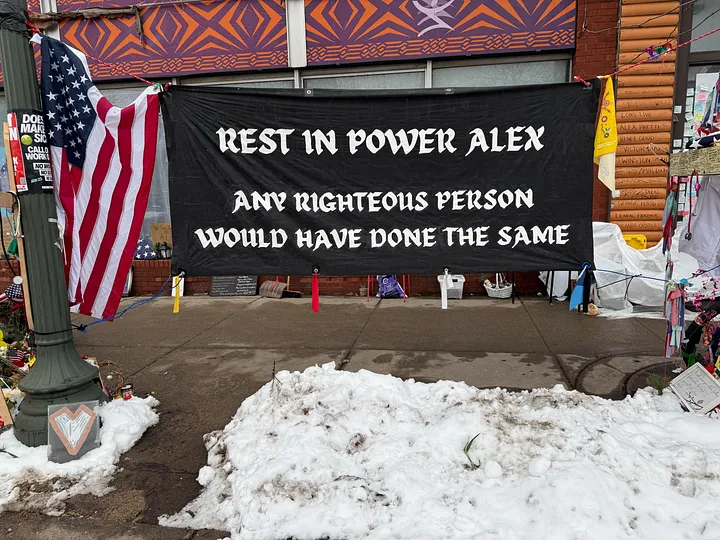
When you get to the site, you find just a slab of street, no longer than two parking spots, blocked off by traffic cones and tape. Flowers are strewn across the sidewalk, some falling onto the pavement. There are posters and signs and mementos. A nurse’s uniform with a stethoscope looped over it has been affixed to a wall, with “Freedom is not free – Alex Pretti” written in black marker on the front. A black banner stretches between two lampposts; its inscription, in a biblical-looking white block font, says “REST IN POWER ALEX / ANY RIGHTEOUS PERSON WOULD HAVE DONE THE SAME.” An American flag hangs sluggishly off the rope anchoring one corner of the banner, as if it was burdened by what happened that day in January. There are crosses and beads and a window in the background that is covered in post-it notes. So many post-it notes.


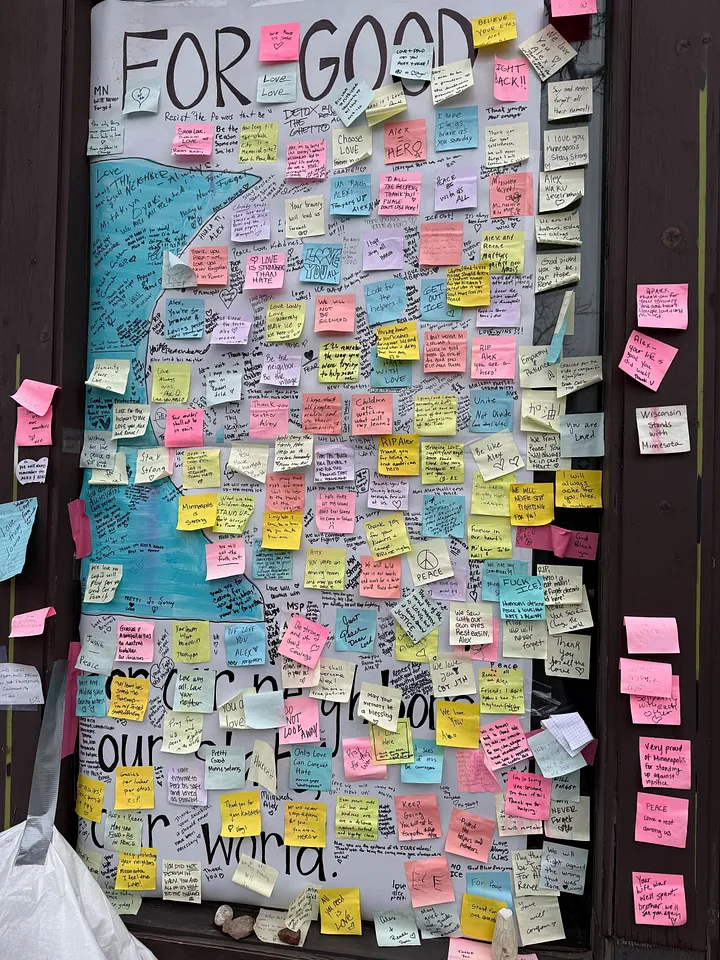
“I hope people at my school don’t feel scared to come to school :(“ reads one in pink.
“I pray (and I don’t normally do that) that we will have an ounce of the courage and compassion of Mr. Pretti,” reads a yellow square. “Alex, thank you for being brave enough for all of us ❤️” reads a purple one.
It’s been more than a month since Pretti was killed while protesting ICE. And while the Trump administration has since drawn down its deployment of agents to Minneapolis, the people who live here don’t feel as though things have changed. One Uber driver I spoke to—a Somali American with U.S. citizenship—said he’d been pulled over three times since the killing. Each time, an ICE agent claimed he looked like someone they’d flagged as being in the country illegally. They searched his car even after he produced papers; he now doesn’t drive without them. In one instance, he was held for 40 minutes before they let him go. In another, a customer sat in the backseat as the interrogation took place.
These experiences are now part of the well-understood pattern of life in a city under ICE occupation. The psychic effects, though, are harder to describe. One man I spoke with had begun volunteering to help form physical human barricades around crosswalks to protect children going to school. He said he felt spiritually called to the task. But it unnerved him, too. The children, he told me, often feared that he might be an ICE agent in disguise.
Pretti’s memorial draws people from within the city and outside of it. Two men were standing watch there the day I showed up. Micah Stewart, 22, saw video of the killing on his phone and felt immediately compelled to go to Minneapolis. So he hitchhiked from his home state of Washington. It took him about five days. He now stays overnight at the memorial site, except when it gets too cold and he boards with locals he has met. He told me that Pretti’s friends and relatives have come by to see it. But they do it with no fanfare, not wanting to be noticed.
Alongside Stewart was Bobby Fitzpatrick, 56, a Minneapolis resident of ten years. He stays around the site through the day and night, often until 2 or 3 in the morning. “It means something,” he said. “It touches anyone who has a heart.”
The site takes about ten minutes to reach by car from downtown Minneapolis, if that. Its setting is the kind you could envision in any other city: A sliver of life for people who enjoy the melding of cultures and a bit of urban vitality.
Within a one block radius of the memorial, there is a German restaurant, a Malaysian place, and a family-run Vietnamese sandwich shop. Across the street, next to the now-famous Glam Donut shop, is a hipster thrift store with racks of vintage shirts and pants and coats and banana pudding–colored walls covered with stacks of sunglasses and jewelry. There’s art on those walls, and disco balls hang from the ceiling, and signs touting political causes and community events have been plastered throughout. And on the day I visited, a guitarist and a singer performed a protest song that seemed more like an elegy.
We are all connected.
Can’t you see?
None of us are free, till all of us are free.
The performance lasted only a few minutes. But it served as a reminder that good things can come out of horrible tragedies. People can be galvanized into action, communities can be brought closer, neighbors can feel called to protect one another. Art can be made.
But even then, the tragedy remains. It’s inescapable.
Looking out from the thrift store at the memorial site across the street, I noticed the building just off to the side of it with a white banner over the door: the “New America Development Center.” Inside was an organization dedicated to helping immigrants culturally integrate into their new home here. What a cruel irony: a place predicated on immigrants being part of our social fabric at the same spot anti-immigrant forces ripped that social fabric apart.
We’re a pro-democracy community here at The Bulwark. It’s why we exist. Tell us in the comments what you’re doing to help democracy—whether it’s big or small, global or local.
Join us LIVE at 10 a.m. EST today for MAGA Mondays with Will Sommer and Sam Stein.
We’re going live on Substack and YouTube at 10 a.m. on Mondays. Today, Will Summer and Sam Stein will give us the first installment of MAGA Mondays, which will also live under our Bulwark Takes feed. If you can’t tune in live at 10 a.m. today, we’ll post the replay on the site and on YouTube afterwards.
And remember to join Bill and Andrew tomorrow at 10 a.m. for Morning Chaser!
The Tariffs Will Continue Until Morale Improves
by Andrew Egger
On Friday, at long last, the Supreme Court struck down one of the tentpoles of Donald Trump’s economic agenda: the “Liberation Day” tariffs he’d wielded under the International Emergency Economic Powers Act, which he’d taken as a license to set tariff rates at any time on any good from any country for any reason. The decision was an unalloyed triumph for the rule of law—but whether and how soon it will pay dividends for the economy remains to be seen.
In another universe, where Trump wasn’t Trump, the president could have quietly realized this apparent L was actually a blessing in disguise. The tariffs have been a pillow on the face of the economy; letting them lapse would, to say the least, be good for the economy’s health. Trump could even run a version of the talking-points playbook he ran after COVID, taking credit for the reviving economy while insisting it would have been even better if only SCOTUS had let him cook.
But alas: Trump is Trump, and deep in his belly he believes two things: Tariffs are goodgreatwonderfulbeautifulmagicalstrong, and nobody fucking tells me what to do. Working from the collapsed house of his IEEPA tariffs, Trump spent the weekend with one obvious top priority in mind: No matter what, we’re going to have more tariffs after this than we had before.
Hours after the Court’s decision, Trump announced a new global tariff rate of 10 percent, invoking a never-before-used trade authority under Section 122 of the Trade Act of 1974. On Saturday, having apparently considered the matter further, he announced the new rate would actually be 15 percent—the maximum allowed under the statute. (These tariffs, by law, can last no longer than 150 days without Congressional approval.)
And Trump’s vowed he’s not done. “The court has also approved all other Tariffs, of which there are many,” he proclaimed on Truth Social this morning, “and they can all be used in a much more powerful and obnoxious way, with legal certainty, than the Tariffs as initially used.”
Oh, you thought the old tariffs were obnoxious? You have no idea how obnoxious I can be.
Trump’s outburst is now threatening to collapse even the fragile trade deals he managed to strike last year. The European Union, for instance, reacted with outrage at the announcement of the new 15 percent tariff. Bernd Lange, who chairs the European Parliament’s trade committee, told Politico the announcement was “a clear breach of the deal we had agreed,” adding on X that they were seeing “pure tariff chaos from the U.S. administration.”
Pure chaos is right. In addition to the steep tariff rates themselves, what really crushed American businesses last year was the fact that the rates kept whipsawing around without warning. The second you’d adjusted your business plans to account for one new tariff, suddenly Trump would be rolling that one back and coldcocking you with a different one. Some of that had slowed in the second half of last year, but now we’re right back where we started: new tariffs cropping up as soon as Trump can think them up, a state of total uncertainty in our trade relationships with basically every other country, chaos, chaos, chaos. None of this helps the economy.
I don’t want to be too glum here. It’s nothing but good the court knocked down Trump’s IEEPA tariffs and the breathtakingly sweeping vision of presidential power on which they rested. Trump thrashes around like a caged animal any time he feels his unilateral authority is being constricted; that’s no reason to let him run free.
But the vanishing of these tariffs may not provide the hoped-for economic boon, either. Trump seems determined to see to that.
AROUND THE BULWARK
Health in the Time of MAGA… DR. ATUL GAWANDE joins MONA CHAREN on the latest Mona Charen Show to take on the hardening myths about COVID, the collapse of USAID, and the dangerous assault on American science.
Legacy of a Libertarian Leader… Longtime Cato Institute head Ed Crane died this month. Many in the movement he helped build have trouble seeing Trump clearly. JOSHUA TAIT on why libertarians need to pick a side, and why they have had trouble seeing the Trumpian threat.
Trump Is Considering More Iran Strikes. No One Knows Precisely Why…. As has become a pattern, the use of force isn’t part of a coherent plan, writes GISELLE DONNELLY.
On The Precipice of Illegal War… On Shield of the Republic, ELIOT COHEN and ERIC EDELMAN assess Marco Rubio’s effort to soften “Trumpism” in Munich and debate Trump’s strategic dilemmas in Iran. They then welcome FRANK DIKÖTTER to examine how Soviet backing, Stalinist ideology, and brutal violence enabled the Chinese Communist Party’s rise, the subject of Dikötter’s new book, Red Dawn Over China.
“It’s Time to Take a Power Washer to Washington, D.C.”... On How to Fix It, RAHM EMANUEL joins JOHN AVLON to argue that Washington needs a full reset—age limits across all three branches, bans on congressional stock trading, strict Supreme Court ethics rules, and an end to “investor days” in the Oval Office.
Quick Hits
WILL TRUMP BOMB IRAN? Last year, in the wake of Operation Midnight Hammer against Iran’s nuclear facilities, the White House insisted that Iran’s nuclear program had been “obliterated,” and that any “suggestions otherwise are Fake News.” So it was a little strange yesterday to hear Trump special envoy Steve Witkoff tell Fox News that “they’re probably a week away from having industrial-grade bomb-making material, and that’s really dangerous.”
Witkoff’s willingness to drop the “mission accomplished” rhetoric for warnings about ongoing threats from Iran are among the clearest signs yet that Trump is serious about the possibility of new strikes against the country, around which he’s been surging more American hardware and personnel now for weeks. USA Today reports:
Trump’s administration is currently locked in negotiations with Iran to curb its nuclear program, and the White House has repeatedly emphasized that Trump prefers the diplomatic route. But the mediated talks have not yet produced a deal. Israeli Prime Minister Benjamin Netanyahu has pushed to include Iran’s ballistic missile program and funding for its proxy forces in the region in the deal—conditions that experts say the Iranians are highly unlikely to accept.
Secretary of State Marco Rubio is scheduled to meet in Israel with Netanyahu on the evening [of] Feb. 28. Trump has typically consulted close ally Israel on his actions in the region and worked in close coordination with Israel when it bombed Iran’s nuclear sites last June. Netanyahu also visited Trump in Washington this month.
Over on the homepage, Giselle Donnelly gives the strategic, international, and domestic political context.
NO U.S. ATTORNEYS ALLOWED: Alina Habba and Lindsey Halligan may have crashed out of their posts as illegally appointed interim U.S. attorneys, but the Justice Department’s long war against the laws governing who can serve in these roles is ongoing. In the last two weeks, Deputy Attorney General Todd Blanche has fired two interim U.S. attorneys lawfully appointed by a local panel of district federal judges, baldly stating—in total denial of existing U.S. law on the subject—that “judges don’t pick U.S. attorneys, POTUS does.”
A quick refresher: The president indeed nominates people to serve as U.S. attorneys, who can begin the job as soon as the Senate confirms them. Until then, the president can pick someone to serve as an interim U.S. attorney—but only for a period of 120 days. After that, if the Senate still hasn’t moved forward, it falls to the district’s federal judges to select a new interim prosecutor until the president’s nominee is confirmed. Judges have repeatedly confirmed this in recent months, which is why Habba and Halligan are no longer at their posts.
But if they can’t win on the law, the DOJ has apparently decided they’ll win on brute force. If they can’t stop the judges from picking new interim U.S. attorneys, they’ll just fire the new selection as soon as it’s made—within a few hours, in one case.
You can think of some reasons why even Blanche and Attorney General Pam Bondi might not want to do this. The DOJ is starved enough of career lawyers these days as it is. And it’s hard to imagine a better recipe for utter chaos and low morale in a U.S. attorney’s office than to ensure nobody can run it—because the courts keep throwing out the White House’s illegal interim picks and the White House keeps throwing out the courts’ legal ones. But to the political leadership at Justice, all that’s a small price to pay rather than let the law get one over on Dear Leader. To prevent that, no cost is too great.
HATE IS STRONGER THAN LOVE: As they geared up to make an offer to buy Warner Bros. last year, father-and-son billionaire duo Larry and David Ellison thought they’d put themselves in prime position by attaching themselves tightly to Trump at every turn. So when Warner Bros. announced they’d decided to sell to Netflix instead, the Ellisons played their ace, announcing a hostile-takeover bid to acquire Warner Bros. while making an explicit argument that the government was unlikely to approve Netflix’s pitch.
And yet, to the Ellisons’ apparent surprise, Trump didn’t seem inclined to bring the hammer down on their behalf. In retrospect, perhaps they realized: It was less important for Trump to like them than for them to find a way to make Trump hate Netflix.
It was in this interesting environment that Laura Loomer—a Trump loyalist with a record of shaping administration policy and an alleged history of pay-for-play Twitter posts—hopped on X Saturday to spotlight comments former U.N. ambassador Susan Rice, who now serves on Netflix’s board, made on a podcast last week, saying that “it’s not going to end well” for companies that “take a knee to Trump,” and that “they’re going to be held accountable by those who come in opposition to Trump and win at the ballot box.”
“This is as anti-American as it gets, and Netflix is proving everyday they are an anti-American, WOKE company,” Loomer wrote, adding that the Netflix–Warner Bros. merger would also result in a worrying uptick in Barack and Michelle Obama-related streaming content. “President Trump must kill the Netflix-Warner Bros. merger now.”
Whoever set the bait, Trump took it hook line and sinker. “Netflix should fire racist, Trump Deranged Susan Rice, IMMEDIATELY, or pay the consequences,” he posted on Truth Social.
Cheap Shots

"And while the Trump administration has since drawn down its deployment of agents to Minneapolis, the people who live here don’t feel as though things have changed."
Why is this not front-and-center on every newscast? Homan says they've withdrawn, but apparently only the news coverage has stopped.
What is the DHS troop count in Minneapolis?
Have abductions and assaults by DHS troops ceased?
We can't let Minneapolis drop off our radar just because the administration says there's nothing happening.
The Bulwark coverage from Minneapolis has had my eyes leaking. Listening to the school superintendent talk about how the staff, school board, and parents were working to keep children safe was inspiring. You can't leave something and not be changed.