An Evening at Polymarket’s Totally Broken Pop-up Bar
The prediction-gambling company massively screwed up its attempt to schmooze D.C.

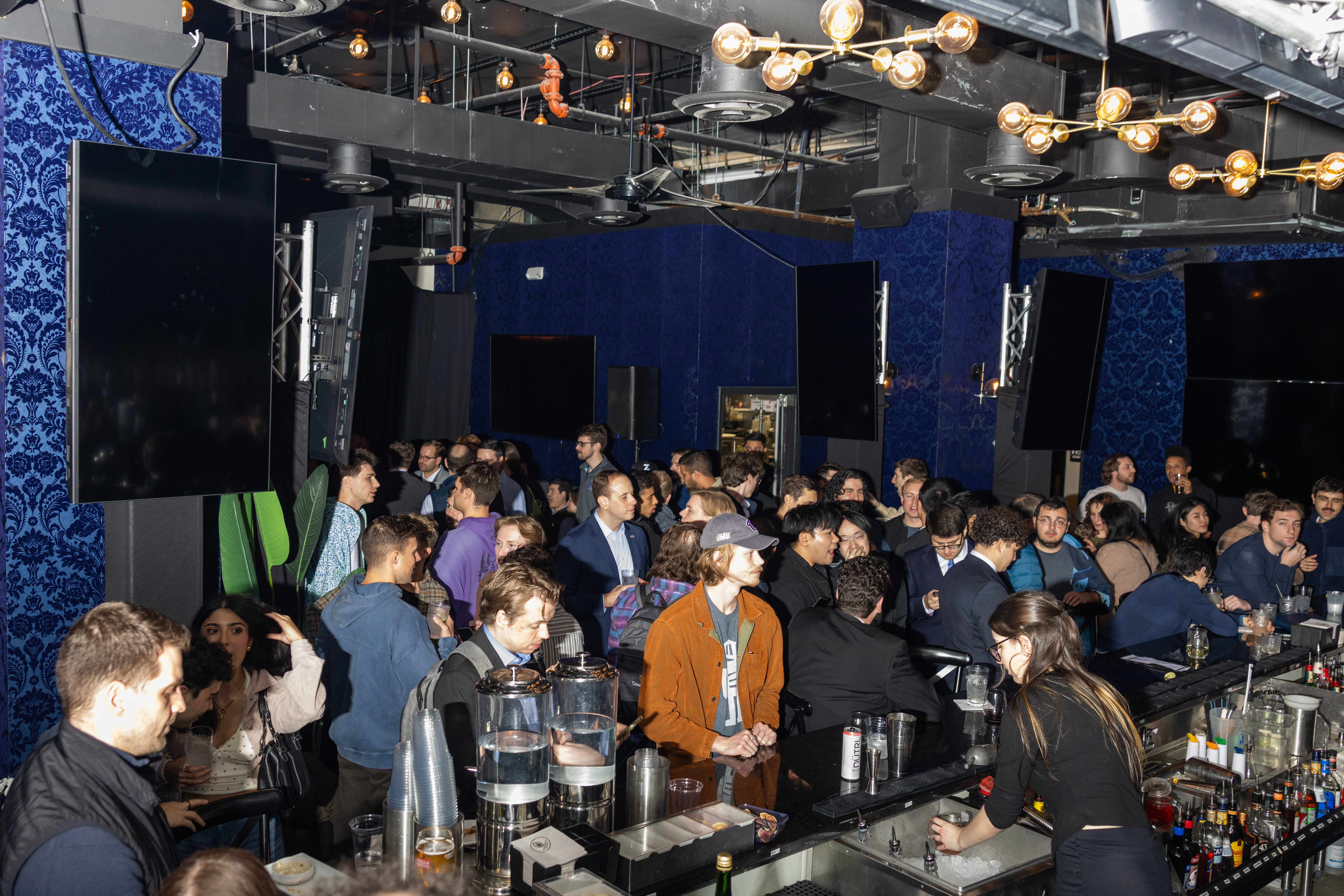
Monitoring the monitoring of the situation
For some time now, the prediction-market companies, which allow users to gamble on everything from sports to the weather to the military activities of the U.S. government to the timing of the Second Coming of Jesus Christ, have been energetically campaigning to win over the public to their vision of the good life, which centers on gambling on everything from sports to the weather to the military activities of the U.S. government to the timing of the Second Coming of Jesus Christ. Much of the PR effort has taken familiar shapes: The emerging industry’s major players have spent more and more on lobbying, media partnerships, and sports-league deals. But the accelerating public relations blitz has started to include riskier and more unusual ventures, including, most recently, a D.C.-area attraction meant to woo the Washington press corps.
It was a complete disaster.
Polymarket, one of top prediction-market companies, hosted a pop-up bar over the weekend a few blocks from The Bulwark’s office. The company billed the “Situation Room” as a place to grab a drink and “monitor the situation”—a meme expression intended as a gentle dig at guys who follow the news as a hobby but talk about it as though it’s much more than that, even if they don’t play a role in the policy process.
The bar was set to open at 5:30 p.m. for members of the media, and I gathered from the composition of the crowd that the term “media” was meant loosely: Both reporters and influencers were queued up, as were a few Capitol Hill staffers. I had mistakenly signed up for the general entrance list, meaning I wasn’t meant to be allowed in until 8 p.m. When I showed up at 5:30, the bouncer couldn’t find my name on the media list, but he waved me in anyway. That blithe gesture was a sign of things to come.
Neal Kumar, the chief legal officer of Polymarket, asked reporters to gather round for a brief gaggle.
“We view this as our real coming-out party in D.C. We spent much of our livelihood at Polymarket fighting to stay alive, being super scrappy. We’ve proven that the concept of prediction markets exists,1 and we’ve proven that the concept is here to stay,” Kumar said. “And we want to be a part of the conversations in D.C.—and where best to have a conversation than in a bar?”
Not long after Kumar went back inside, the pop-up team started having to deal with problems. As reporters gathered on the covered patio to get out of the rain that was just starting, a light fixture illuminating the Polymarket sign flickered on and off. A staffer set a ladder and climbed up to fix it. Moments later, one of the bouncers knocked over a fake plant, spilling its gravel soil near the entrance and breaking the planter in half. As so often happens in life, things started to unpredictably cascade.
The venue’s WiFi did not work, the rain got worse, and the roughly four dozen reporters and influencers forced to wait on the bar’s patio started to get antsy. As an NBC News reporter did a live hit from outside (instead of inside as he’d planned), waitresses approached the crowd to take drink orders. These were delivered and consumed outside. For now, we remained barred from the Room part of the Situation Room, and we were forced to monitor the situation in the old-fashioned way, using our phones.
As the patio became crowded, the line of vehicles waiting to drop off VIP attendees continued to grow. After a few black Chevy Tahoes began clogging up the street, the driver of a Jeep covered in rubber ducks became irate, laying on the horn for a bit before deciding to squeal their tires to get around the car-service parade. As the duck-covered Jeep whined by, I noticed that in the window of an Audi SUV with diplomatic plates a child was pressing his whole face against the inside glass. It was all very D.C., if you know what I mean.
As we kept waiting, I listened as a young man who claimed he works in the Senate but would not give his name told me that he regularly bets on Kalshi, Polymarket’s competitor. “Only on politics,” he said. “But I mostly just lose money.”2
After forty-plus minutes of keeping the media out, the Polymarket staffer managing the event gave up. The press would finally get to monitor the situation in the building’s interior. Inside the pop-up, however, what we found was yet another standard D.C. happy hour: A live band played chamber jazz while Washington journos and politicos networked.
The internet issues had not been resolved, but a Polymarket staffer assured us they would be at some point over the weekend. The bar featured nearly a dozen blank TV screens, which loomed like monoliths amid the room’s encroaching darkness. At least two features were working, though: a large glowing globe, and a long tabletop touch screen displaying market odds. Users could scroll this interface but not place any bets. Situation, monitored.
There were also fake newspapers strewn about whose front pages featured political cartoons. One depicted an adviser telling the president, “Sir, the latest intelligence.” Another showed a woman at work browsing Polymarket for odds on the winner of the 2028 presidential election. A third cartoon depicted an individual gambling on her phone at a baseball game and saying, “America’s greatest pastime.”
The crowd provided a visual exercise in D.C. taxonomy. People around here often fall into wardrobe tropes that allow for quick political identification. Democratic men wear navy suits, white shirts, and no tie, to look like Obama. Republicans wear cobalt blue suits and red satin ties, to look like Trump. The reporters look tired.
Uncategorizable, you could say, is cryptocurrency influencer Nick O’Neill, who bobbed around while his friends (or employees; it can be hard to tell) took photos of him and sipped drinks. O’Neill’s presence during the press hour was curious. He’s not a reporter or even a normal influencer (they often have product-related beats) but a hype man for, well, himself. His shtick includes posting about his lack of children and the yachts, money, young women, and Labubus he has acquired instead.


When O’Neill eventually posted a recap of the evening, I was surprised to see that the WiFi and TV screens appeared to be operational. His video, which was a paid promotion, made the Situation Room seem like a great time, which it was not. He also posed while being adorned with a glittery Polymarket chain he received for winning a “top trader award.”
Public relations is a vital component of any legitimacy and sanitization effort. Since last spring, Polymarket has been spending $90,000 per quarter to establish relationships with key players in government through David Urban, a former Trump campaign adviser. Polymarket’s advisory board features the president’s son, Donald Trump Jr. And the White House’s employees and allies are gaming and manipulating prediction markets to make substantial profit, according to Democrats.3
The Monday after the pop-up bar’s lackluster weekend, Polymarket updated their rules to supposedly prevent insider trading. In addition, Kalshi said that they would ban athletes from betting on their teams or leagues and political candidates from staking money on their own campaigns. The companies’ rule changes are a clear attempt to use self-imposed restrictions to take the wind out of the sails of potential future legislation that would further restrict prediction-market users and gambling topics.
Congress isn’t known for swift action, nor are members of Congress particularly experienced in regulating new and emerging technologies. But it’s obvious that the prediction-market companies are worried this might be the one area where lawmakers finally feel compelled to act. Polymarket’s dud of a party was a real sign of panic.
Men at work
Regular Press Pass readers probably know more on average about the trials and tribulations of Australian-American and “alpha male” conservative influencer Nick Adams than any other group of political news readers do. Over the past year, this newsletter has documented Adams’s nomination to serve as U.S. ambassador to Malaysia, his efforts to tone down his online persona, his inability to keep it toned down for long, and ultimately, the Trump administration’s withdrawal of the opportunity they offered him to become a full-fledged diplomat.
Losing out on the nomination may have hit Adams hard, but Trump softened the blow by offering him a new gig. Unfortunately for us all, it’s one that doesn’t require a Senate confirmation.
Adams announced Tuesday morning that Trump has selected him to be Special Presidential Envoy for American Tourism, Exceptionalism, and Values.
“I am beyond honored to serve my country, the American people and the greatest President and Secretary of State we have ever had,” Adams said in a statement.
I look forward to serving as America’s brand Ambassador, bringing the message of America’s excellence to the entire world. With America 250, the FIFA World Cup, and the Olympics coming up, the world needs to be reminded of all we have to offer. I will be a tireless spokesman for American greatness, at home and abroad.
Presidents can create or terminate special envoys with the stroke of a pen, making this a much better fit for Adams than any role that would entail a grueling Senate confirmation process. Following the many delays that affected his last appointment, too, it must be nice to be offered a job on a fast timeline: Adams already has a bio up on the State Department website touting the new gig.
What Adams is going to be doing in this role isn’t entirely clear. But you can rely on Press Pass to find out what that is, eventually.
The war of northern depression
Conservative regions of liberal states like to flirt with intrastate secession. It’s often how they vent frustration about their unpopularity and general political impotence.
In New York City, Staten Islanders who desire to secede from the Empire State have given their cause a new head of steam after many dormant years. Naaman Zhou writes in the New Yorker:
Lately, the fever to secede has descended again. Shortly before Christmas, Sam Pirozzolo, a Republican state assemblyman who represents parts of western and central Staten Island, wrote a declaration of independence for the island—modelled after the national one—and read it out loud at the former site of a tavern where, in 1776, British soldiers first heard the original. Andrew Lanza, a Republican state senator, has also drafted legislation that would make secession possible.
Notionally, this push was prompted by the election of Zohran Mamdani, whom Pirozzolo has said epitomizes the way that New York City doesn’t reflect Staten Island’s values. But the discontent runs deeper. Staten Islanders have tried to secede from the rest of the city at least a half-dozen times. In 1900, two years after the modern City of New York was consolidated, two hundred Staten Islanders gathered at a public hearing to say they were “ready to cede.” (Staten Island, one man told the New York bureau of the Chicago Tribune, “is the Ireland of Greater New York. We want home rule.”)
The island is richer, more suburban, more conservative, more car-dependent, less dense, and cut off from the rest of the city by the deep water of New York Harbor. There is a sense on the island that the rest of the city doesn’t listen to them, and that they pay for city initiatives they don’t want.
Proving that your product can exist at least as a cognizable concept is an important first step.
He said this jokingly, but I will figure out who he is eventually.
It’s also a reasonable inference for non-Democrats to make, based on a growing body of reporting on suspiciously timed trades through prediction markets and more traditional financial vehicles.
Re: your experience at The Situation Room, a grateful nation thanks you.
You weren't served, so we didn't have to be not served either.
Who could have predicted?