Department of Just-Indict-Someone
Even Trump can barely defend the charges against James Comey with a straight face.


We know we keep saying it, but this business about the Strait of Hormuz is getting really, really alarming. Oil prices hit their highest point since the war began overnight, with Brent crude prices surging above $120 a barrel before settling back around $114 at time of publication. And in comments to Axios yesterday, Trump seemed to see no end in sight: “The blockade is somewhat more effective than the bombing,” he said. “They are choking like a stuffed pig.” Setting that metaphor aside, it’s hard to ignore that the rest of the world is choking, too. Happy Thursday.
Todd Blanche Has a Thom Tillis Problem
by Andrew Egger
Start with the obvious: The felony indictment of former FBI Director James Comey for supposed threats to murder the president—based on nothing but a photo of seashells spelling the phrase “86 47,” which he posted to Instagram last year—is a naked act of political prosecution and a grotesque abuse of the powers of the Justice Department, and everyone involved knows it.
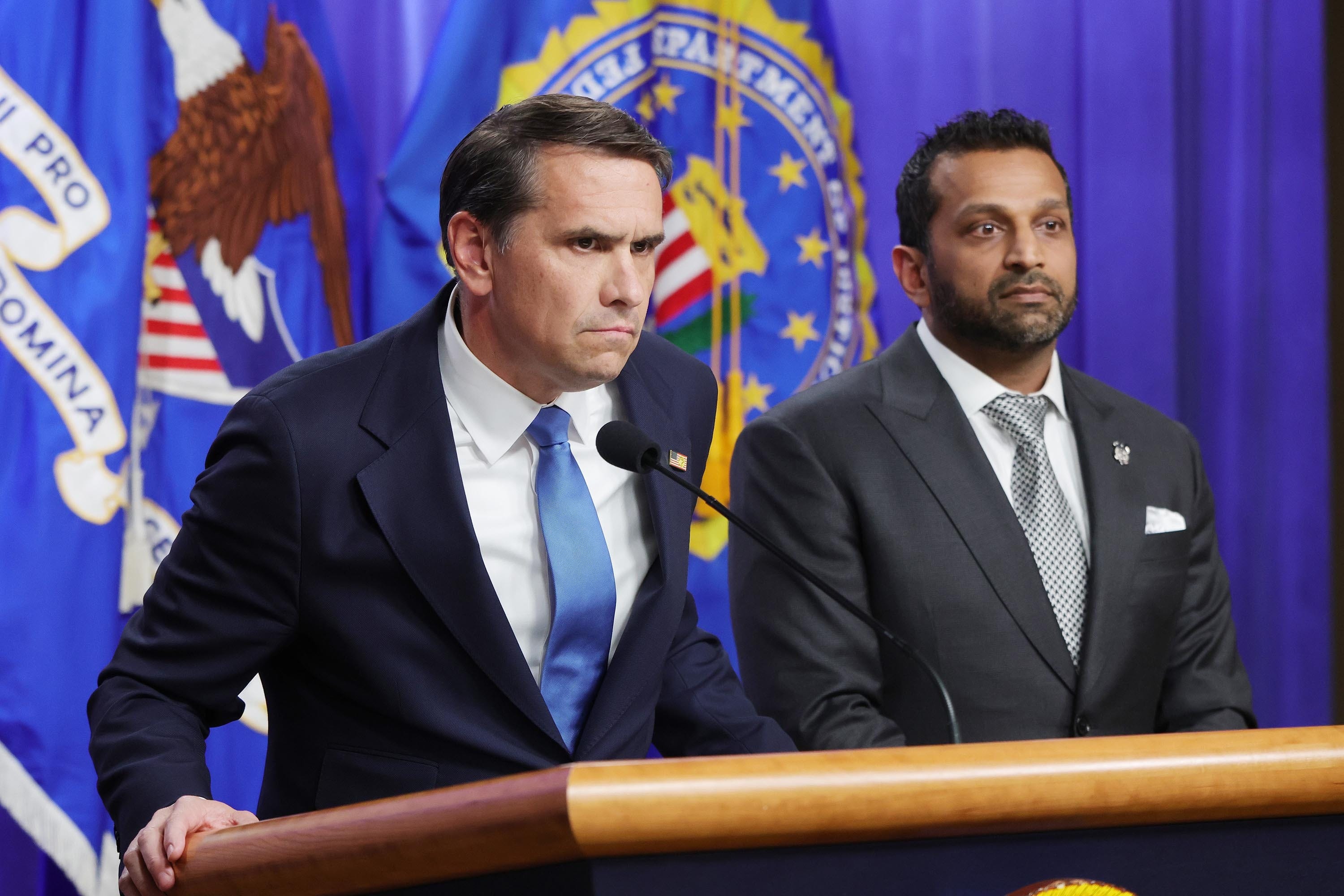
Acting Attorney General Todd Blanche, the driving force behind the indictment, knows it. Under ordinary circumstances, a seasoned prosecutor like Blanche1 would suffer untold torments rather than be subjected to the humiliation ritual his indictment of Comey has kicked off. The acting AG spent yesterday poker-facing his way through TV interviews: When asked in a CBS News interview if he had “proof that the FBI director knowingly and willfully threatened the life of the president,” Blanche responded that his proof “is in the fact that the grand jury returned an indictment.” Should a MAGA influencer’s mirror-image 2022 post to “86 46” also have been charged as a murder threat? “I have no idea whether there was an investigation into the other times that that post has been made and whether that investigation yielded different results,” Blanche spluttered. “This investigation that we undertook resulted in a two-count indictment.” The proof that he should have been indicted is that they indicted him.
FBI Director Kash Patel also knows the indictment is a farce. To answer the question “why now” with an answer beside the obvious—that Donald Trump is cranky and getting an enemy’s scalp would cheer him up—Patel was forced to pretend that reading an Instagram post, pretending it constituted a death threat, and charging it accordingly required a major FBI investigation: “This has been a case that’s been investigated over the past nine, ten, eleven months. These cases take time.”
Even Trump, who cares so little about free speech that he thinks lawmakers who remind his troops not to obey unlawful orders should be punished by death, struggled to keep a straight face on this one. Did he really think his life was in danger based on Comey’s post? “Probably. I don’t know,” Trump said. “You know, based on what I’m seeing out there, yeah. People like Comey have created tremendous danger, I think, for politicians and others.”
This, of course, is the whole point of the humiliation ritual. Blanche and Patel are the supplicants who badly want something from the president: Blanche to be tapped as Trump’s permanent AG, Patel to keep his job despite widespread reports Trump is tiring of him. It’s their job to grovel and squirm. Trump, on the other hand, needn’t bother so much. After all, who’s he got to impress?
A year ago, that might have been all there was to say on the matter: Trump and associates make mockery of federal government, rule of law; stay tuned for more outrageous depredations tomorrow.
But things are different now. The Trump administration no longer looks irresistible and unassailable in such matters. Politically, the president is the weakest he’s ever been; legally, his political-retribution investigations have been going down in flames one after the other. And it’s not impossible that Blanche could end up losing his shot at the permanent attorney general spot in the very act of trying to bootlick his way into it.
If Trump nominates Blanche, he’ll need to get the approval of the Senate Judiciary Committee to move forward, which means he’ll need the unanimous approval of committee Republicans. And it just so happens that one Republican who sits on the Judiciary Committee is North Carolina Sen. Thom Tillis—who is fresh off his victory in leveraging his vote to get the White House to drop yet another phony political prosecution into Fed chair Jerome Powell. (More on this from Catherine Rampell below.)
Might Tillis not run the same play again, should Trump attempt to tap Blanche for the top Justice spot? Yesterday, Tillis sounded deeply skeptical about the Comey indictment. “I searched to the end of the internet last night,” he told reporters. “I can’t find one example where the number 86 had anything to do with any violent threat.”
It’s unbelievably shameful that any such ultimatum over Blanche likely comes down to the judgment of Tillis alone, given that the Senate Judiciary Committee is stuffed with supposedly staunch free-speech defenders. Sen. Josh Hawley (R-Mo.)—a literal first-amendment lawyer before he launched his political career—sneered on Fox News yesterday that “you can’t tell me, when [Comey] arranged those shells on the beach that day and posted that picture, he just innocently didn’t know what he was doing. He knew exactly what he was doing.” Sen. Ted Cruz (R-Texas), a onetime Tea Party give-me-liberty firebreather, hasn’t weighed in on the indictment. But given his active support for the last baseless felony charges against Comey, it’s hard to imagine he’ll take a different path this time around.
But hey: The bleakness of it all being down to Tillis should just remind us how good it is that we’ve got a Tillis around at all. In the prosecution of Powell, he’s been a shining reminder that the Trump administration isn’t as all-powerful as it would like to pretend—and that all it takes to back them down sometimes is a little backbone. So how about it, Thom? One more song, for old times’ sake?
Jay Powell’s on Board
by Catherine Rampell
Contrary to popular opinion, true statesmen still exist. At least they do over at the Federal Reserve.
Jerome Powell’s term as Fed chair ends in two weeks. But on Wednesday, during his final press conference as chair, he announced he wouldn’t yet be riding off into the sunset. Instead, he’ll stick around, continuing to serve as a regular member of the Fed board “for a period of time to be determined” even after he’s no longer the boss.
This is an unusual decision. Treasury Secretary Scott Bessent decried the “violation of all Federal Reserve norms.” Trump claimed Powell just “can’t get a job anywhere else.” (Powell is 73 and had previously planned to retire.)
However angry MAGAland may be, though, they can’t claim to be surprised. Powell had said last month that he planned to stay until the Justice Department’s obviously politically motivated criminal probe into him was “well and truly over, with transparency and finality.”
Since then, he has gotten at best mixed messages about whether that would ever happen. In mid-April, U.S. Attorney for D.C. Jeanine Pirro dispatched her goons to “inspect” a Fed renovation project (in violation of a court order) as part of the investigation into Powell. Then, as it became clear that Sen. Thom Tillis (R-N.C.) would continue to block Trump’s pending Fed chair nominee until the Powell investigation was over, Pirro finally announced last week that her office would “close” the probe—or, at least, that it was handing it over to the Fed inspector general.
But the Powell probe is only “closed” in the same sense that the Strait of Hormuz is officially “open.” Which is to say: Trust neither pronouncement, at least when coming from this administration.
After all, in the same statement announcing her suspension of the probe, Pirro added that she would “not hesitate to restart a criminal investigation should the facts warrant doing so.” Trump then announced: “It’s not dropped.” And it sounds like Pirro will still appeal the judge’s ruling quashing her prior subpoenas, at least based on comments Tillis made on Sunday.
Despite Trump’s insistence that the investigation into Powell is on, Tillis still caved, voting to advance Trump’s next chair pick, Kevin Warsh, out of committee—the last serious hurdle before his confirmation.
But Powell is less credulous than Tillis. Which is perhaps understandable, given Trump’s penchant for prosecuting other perceived enemies on similarly flimsy grounds, such as seashell photos.
In the press conference yesterday, Powell said he planned to keep a “low profile,” not be a “shadow Fed chair.” “There’s only ever one chair of the Federal Reserve Board,” Powell said. “When Kevin Warsh is confirmed and sworn in, he will be that chair.”

Powell said he’s staying precisely because of the persistent attacks on the Fed’s independence—specifically, the “legal actions,” rather than the “verbal criticism by elected officials” (also once considered anathema).
“I worry that these attacks are battering the institution and putting at risk the thing that really matters to the public,” he said, “which is the ability to conduct monetary policy without taking into consideration political factors.”
This is exactly the right message.
Powell is staying to prove that Fed officials cannot be bullied. Lest you think this is about somehow saving his own skin, note that his decision to stay may well make him a bigger Trump target in the months and years ahead. That’s because Powell cannot stay indefinitely; his term as a member of the Fed Board of Governors ends on January 31, 2028. So even if he stays as long as possible, he’d nonetheless be exiting while Trump is still in office—and still controls the DOJ.
Plus, Trump has said he may try to push Powell out well before then, just as the president is already trying to fire another Fed governor, Lisa Cook.
The Cook case is pending before the Supreme Court, and Warsh has refused to say whether as Fed chair he would continue Powell’s defense of her tenure. Warsh also refused to say whether the DOJ investigation into Powell was politically motivated.
How exactly a “low-profile” former Fed chair might get along with a newly-minted Fed chair remains to be seen. For his part, Powell showed grace at the press conference, saying he would take Warsh at his word when the latter pledged his devotion to Fed independence. Powell also said he planned to support his successor however possible.
Frankly, Warsh will need all the support he can get. He’ll arrive in his new leadership post with a near-impossible task: delivering the interest rate cuts Trump expects, just as Trump’s war in Iran has jacked up price growth and thereby made rate cuts much less justifiable. To wit: Right now markets are not expecting any further rate cuts for at least the next year.
Hopefully Warsh’s spine is as steely as Powell’s.
AROUND THE BULWARK
The Real King Schools the Would-Be King… Charles III delivered a veiled message that Trump probably missed, observes MONA CHAREN.
The Supreme Court Hacks Away at the Voting Rights Act Yet Again… Get ready for new fights over racist gerrymandering, writes KIM WEHLE.
Did Trump Make an Ominous Shift on Iran? On the flagship pod, JOHN HEILEMANN joins TIM MILLER to discuss how Trump has backed off his promise of a short war, and why he’s making pretty wimpy threats against the regime.
Quick Hits
CHECKING IN ON THE MARGINAL VOTER: The ongoing crash in Donald Trump’s popularity is creating more and more opportunities for Democrats to consolidate power in the House of Representatives this November—or so one might imagine. But Lakshya Jain, data guru at the Argument, makes a possibly counterintuitive observation this week: Although Trump’s approval rating has fallen by a net seven percentage points since February, Democrats’ position on the generic congressional ballot has been stable over the same period. They led Republicans by 6 points among registered voters two months ago, and they lead Republicans by 6 points now.
On a certain level, this is to be expected. The lower Trump’s approval sinks, the more conservative we should expect the next marginal voter he loses to be. The more conservative that voter is, the less we should expect them to immediately swap from supporting Trump to being willing to pull the lever for Democratic candidates. And this is especially true if that voter cares a lot about issues like crime and public order where—despite everything—Republicans still enjoy a polling advantage.
Such voters might, however, be likelier simply to stay home the lower Trump goes. “The Democratic lead among voters who said they’re actually likely to vote in 2026 sits at 10 percentage points, which would imply the biggest blue wave since at least the 1980s,” Jain writes. But Democrats shouldn’t get complacent: “Strong midterms can be deceptive. Many of the voters who sit out 2026 will show up in 2028 (low-propensity voters tend to show up more in presidential years), and if Democrats are still fundamentally mismatched on important issues like crime, that risks a much greater chance of being reexposed.”
THE WRITING WAS ON THE WALL: Right before we hit send on this newsletter, Maine Governor Janet Mills announced that she was suspending her campaign. In a statement, she cited the inability to raise campaign funds as the reason for her decision. But that’s sort of a proxy for the fact that her candidacy was lagging in enthusiasm behind Graham Platner, the oyster-farmer progressive populist who has been the surprise candidate of the cycle. Mills’s departure from the race sets up a Platner vs. Susan Collins contest in the fall. And though it helps Mills avoid a potentially embarrassing primary defeat, it doesn’t spare embarrassment for Senate Minority Leader Chuck Schumer, who put in a lot of time and effort to convince Mills to run in the first place.
TOO GOOD TO QUIT: The Trump administration is in a bind. Earlier this year, it burned its bridges with the AI company Anthropic, canceling its government contracts, deriding its leadership as a bunch of radical-left loons, and trying to smear it as a danger to national security by labeling it a “supply-chain risk”—a label typically reserved for untrustworthy software companies with ties to hostile governments.
But the administration has been losing the breakup. Anthropic’s latest model, Mythos, is turning out to be the sort of tool governments will ignore at their peril, given its apparent talents cutting through suboptimal cybersecurity defenses like soft cheese, and a quiet clamor is growing inside the government to get busy using Mythos to strengthen those defenses.
Trump and Co. want to allow this—but they also don’t want to have to eat crow over their ludicrous earlier attacks on Anthropic. Thus, Axios reports, the White House is trying to find a way to, as one source put it, “save face and bring em back in.”
To no one’s surprise, it appears that Defense Secretary Pete Hegseth and his under secretary for research and engineering, former Uber executive Emil Michael, remain the most truculent against an Anthropic thaw. “While key players at the Pentagon are dug in on this issue,” Axios reports, “other stakeholders believe the fight has been counterproductive and are ready to find an offramp.” Read the whole thing.
Cheap Shots


Early in his career, he spent eight years prosecuting violent crimes in the Southern District of New York.
Anyone who doubts the hypocrisy of the recent James Comey indictment need only go on the internet and see the Maga merchandise that was for sale on its website during the Biden presidency.
There are tshirts for sale featuring this logo: "86 46". I don't remember any Trump supporter who bought or wore one of these tshirts being arrested or indicted, do you?
Just more blatant hypocrisy from Trump and his minions.
I know this point gets tired and tedious to those who actually follow the news, and you all are well aware of it already, but it is worth a moment of our time to reflect upon the point that exactly none of what is coming out of the power circles in Washington is about Us the People. It has become solely and exclusively a vanity project for the individuals involved and the advancement of their own agendas and self interests. There is no longer even a hint of their choices being about us and the fact that we are the ones who pay their salaries, pensions, and benefits. They speak and act as if they are there by birthright, and those who oppose them must be punished for believing that they are relevant and have the right to express an opinion other than what they want to hear. The next time any of them say "we serve at the behest of the American taxpayers, all of them" will be the first time in a long time, if ever. The mindset is that we are very lucky to have them there to determine our fate and should spend much more time appreciating it rather than asking questions and seeking information. Hint: history shows that these scenarios usually end very badly.
Thus endeth the reminder that we are dealing with, and too often controlled by, some of the worst people on Earth. Have a nice day. If they will allow it.