Every Day, Another Grotesque Secret
Trump’s letter to Epstein is undeniable. The White House spin is literally unbelievable. The MAGA base has been training all decade for this.


White House Press Secretary Karoline Leavitt heads to the press briefing room at 1 p.m. today. She should have a lot to talk about. Happy Tuesday.
The Letter Drops
by Andrew Egger
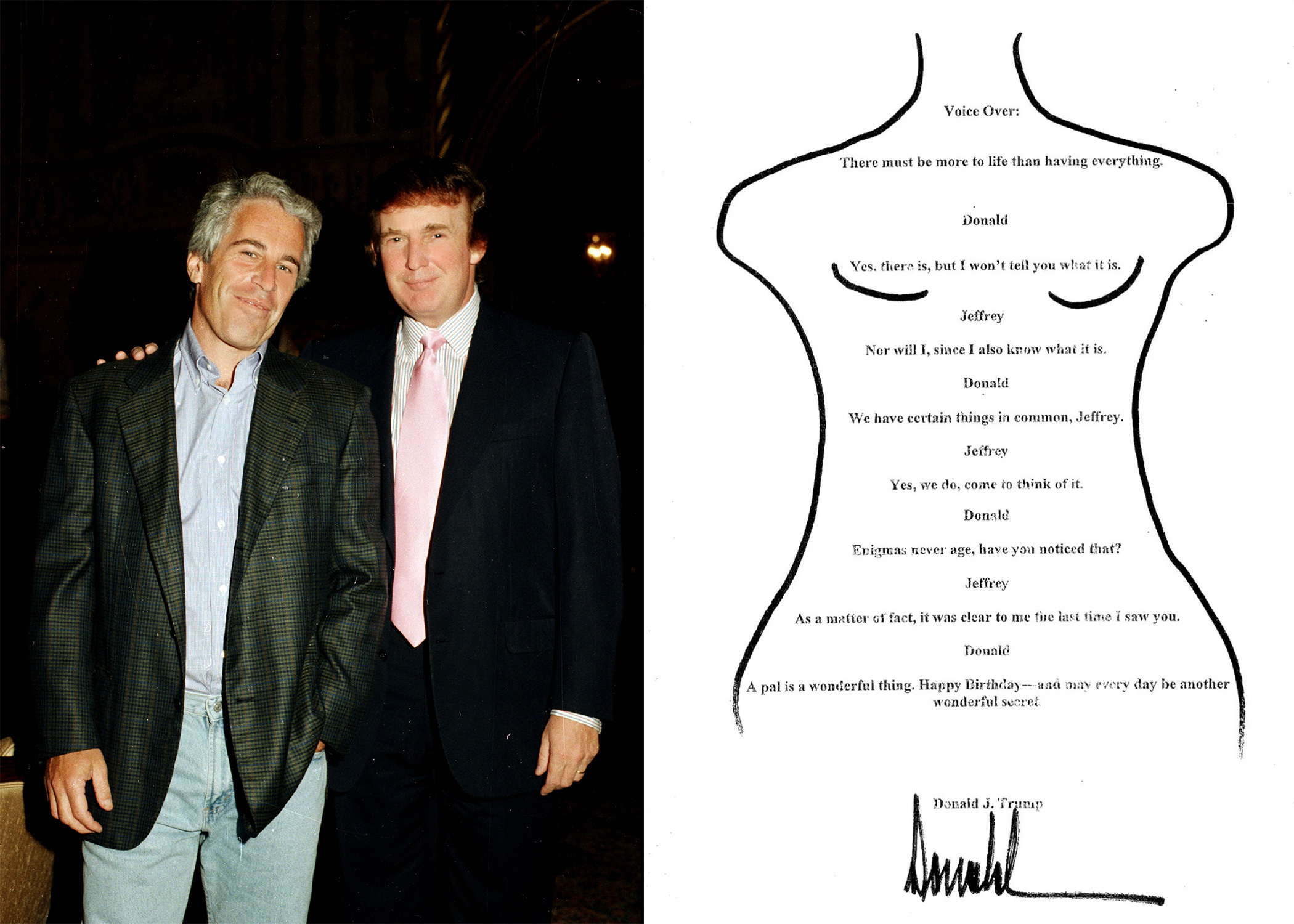
It’s a strange thing, psychologically speaking. When the Wall Street Journal reported this summer on Donald Trump’s leering “we have certain things in common” birthday letter to Jeffrey Epstein, it was painfully obvious that the White House response—it’s a forgery! A hoax! We’re suing everyone involved!—was a series of desperate lies and distractions. There was never any legitimate reason to doubt the letter’s authenticity.
Still, there’s knowing something is true intellectually, and then there’s knowing something is true beyond the shadow of a doubt. Yesterday, congressional Democrats released the full birthday book, compiled by Ghislaine Maxwell decades ago and handed over by Epstein’s estate. And there the letter sat, just as the Journal had described it, nestled grotesquely amid the “we’re so proud of you”s from his parents, the “you’ve made good, Jeff” letters from former Jewish-school teachers, and the ribald reminiscences of teenage exploits from lifelong friends.
“Happy Birthday, and may every day be another wonderful secret,” it read, signed by Trump’s own hand.
Incredibly, it turns out that the card wasn’t even the book’s only alarming suggestion of Trump’s knowledge of or participation in Epstein’s sordid affairs. A letter from longtime Mar-a-Lago member Joel Pashcow showed a picture of Epstein standing behind a giant novelty check, supposedly from Trump. “Jeffrey showing early talents with money + women!”, the letter reads. “Sells ‘fully depreciated’ [name redacted] to Donald Trump for $22,500.” A joke, obviously—but a joke referencing what, exactly? The “fully depreciated” woman, the Journal reports, was then in her 20s.
This is exactly the sort of juice Epstein truthers have been convinced for years was still locked away in Justice Department filing cabinets. It is the whole reason for all these years of RELEASE THE FILES rabble-rousing. The biggest unanswered question about Epstein to date is how distinct he kept the two halves of his life: his elbow-rubbing with elites and his despicable sexual appetites.
Trump’s letter makes it unbelievably obvious that he at the very least knew about Epstein’s perversions, to say nothing of him claiming in the letter to share them. Pashcow’s letter suggests that everyone basically knew about it, and that Trump was himself part of the joke they told themselves about it.1
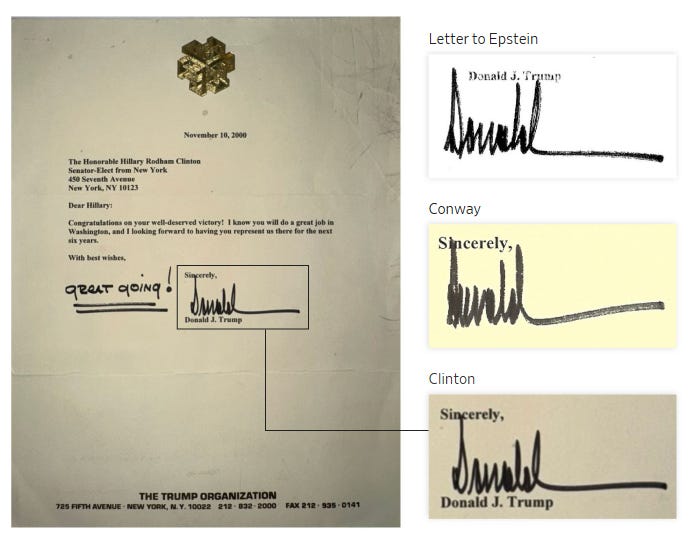
The White House’s explanations for all this, even by their standards, have been pathetic—shockingly, hilariously lame. “As I have said all along,” Press Secretary Karoline Leavitt wrote on X, “it’s very clear President Trump did not draw this picture, and he did not sign it.” Deputy Chief of Staff Taylor Budowich posted pictures of Trump’s signature today—which indeed looks a little different than it did in the early 2000s—as a supposed proof: “It’s not his signature. DEFAMATION!”
This despite the fact that Trump has been in public life for decades and has been signing every piece of paper within his reach for that entire span. The Journal compared the Epstein-letter signature with several other letters from Trump signed around that time. I mean, you be the judge:
What the White House is doing here isn’t persuasion or argumentation. It’s pure noise—an attempt to drown out a seemingly unspinnable story and get its people to change the channel to something else. As usual, JD Vance has the more puerile and purest form of the message: “The Democrats don’t care about Epstein. They don’t even care about his victims. That’s why they were silent about it for years. The only thing they care about is concocting another fake scandal like Russiagate to smear President Trump with lies. No one is falling for this BS.”
In a way, Donald Trump and his allies have spent their entire political lives preparing for this moment. The whole miserable decade of “alternative facts,” of witch hunts, of flooding the zone with shit—it all amounted to a long, powerful education for his base. It’s a training in a certain kind of zen meditation, in which stories damaging to Trump pass from the eyes and ears directly out of the body without ever intersecting the brain. By now, the base has gotten in their 10,000 hours. They’ve become masters of the craft. They can perform all sorts of remarkable feats—the media-cope equivalent of lying on beds of nails while cinderblocks are smashed on their chests. These cinderblocks, they whisper serenely, are just a liberal plot. If I pay attention, the Democrats win.
This Epstein story might as well be their final test. They’ve clamored for years for more information about Epstein’s sexual-deviant associates—and here Trump is, wallowing in that muck of perversity, clear as day. Trump plainly thinks he’s got them well trained enough that he doesn’t even need to find a good cover story. They’re ready to excuse him all on their own.
What Dems Can Do
by William Kristol
Just a couple of additional observations, for now, on the Epstein matter:
For me, an early sign that the Epstein files could be a major problem for Donald Trump—and that Donald Trump knew this could be a major problem—was his response to a question at a Cabinet meeting on July 8. The question was not directed to Trump but to Attorney General Pam Bondi, who had just released the memo concluding “no further disclosure would be appropriate or warranted” in the investigation.
An angry President Trump interrupted to challenge the reporter:
Are you still talking about Jeffrey Epstein? This guy’s been talked about for years. You’re asking—we have Texas [referring to the flooding in Texas], we have this, we have all of the things—are people still talking about this guy? This creep? That is unbelievable. I mean, I can’t believe you’re asking a question on Epstein at a time like this.
The president could easily have let Bondi take the question and blandly reiterate her conclusion from the memo. But he couldn’t resist lecturing the reporter—and the rest of us—that we shouldn’t talk about Epstein. It was a classic doth protest too much moment. And of course it’s not the innocent who protest too much.
It was clear then that Trump was scared of further Epstein inquiries. He was scared of what might come out. It turns out, he was right to be.
And when the Wall Street Journal, later that month, first reported on the birthday card he wrote to Epstein, Trump’s response was also a kind of admission of guilt. He denied that he wrote the card, denied that he had ever seen the card, and announced he was suing Rupert Murdoch and the Journal. That’s still his position, even after the Journal last night published the actual letter. It’s ludicrous. But it fits a pattern of guilt. If you are terrified of more discussion of the implications of what you’ve written, of inquiries as to what other documents might exist, you stonewall and hope the questions exhaust themselves rather than try to explain and thus invite follow-on inquiries.
Trump’s stonewall hasn’t worked, as we can see from today’s headlines. But what produced those headlines? The release of the original Epstein birthday book by the House Oversight committee. In late July, some Democrats on that committee ignored the conventional wisdom that there was nothing they could do beyond complain. They forced a vote on a surprise motion to subpoena the Trump Justice Department for all records related to the Epstein investigation. The motion passed, 8–2, with three of the panel’s Republicans joining with the Democrats.
It was an important victory, and an instructive one. It turns out aggressive backbenchers can make a difference. And it suggests that, in general, Democrats should spend less time telling themselves and everyone else that their minority status prevents them from accomplishing anything in Congress, and more time trying to accomplish some things, even against the odds.
So, a lesson for the media, for Democrats, and for all of us: Keep on insisting, keep on pushing, keep on fighting for the truth about Epstein—and Trump.
AROUND THE BULWARK
Elon Musk Torpedoed a Beloved Pediatric Cancer Bill. It’s Yet to Recover. Sometimes, a good piece of legislation fails to become a law for one simple, stupid reason: congressional inertia. SAM STEIN has this heartbreaking report.
Come Join Us in NYC or DC! We’ll be doing two live shows in October on the east coast. Get tickets before they sell out like our Toronto show did! See you there?
SCOTUS Allows Racial Profiling! Is Cam Running? On FYPod, TIM MILLER and CAMERON KASKY discuss the Supreme Court’s racial-profiling ruling, ethnic-cleansing narratives, and tensions within the left. They also examine Gen Z views on success, noting differences between men and women, and Cam mentions a possible run for New York’s 12th Congressional district.
Yet Another Right-Wing Payola Media Scandal! This time, the allegations involve paying influencers to post positively about India, a country increasingly in MAGA’s crosshairs. In False Flag, WILL SOMMER shares this details.
More Marriage = More Happiness… On the latest Mona Charen Show, BRAD WILCOX joins MONA CHAREN to discuss the latest stats on marriage, what singlehood means for kids, men, and women, and marriage’s new alt-right foes.
Quick Hits
IT’S THE CORRUPTION, STUPID: Ten years after Donald Trump burst onto the political scene, Democrats still have trouble unifying around a message to combat him. But as the 2026 midterms come into focus, two seasoned party operatives are urging the party to dust off an old script.
In a memo sent to party leadership and other members, Nancy Pelosi alums Jesse Lee and Ashley Etienne make the case for Democrats to more aggressively lean into the “culture of corruption” charge against Trump. The memo notes the historical potency of the line, which was used to great effect in the 2006 cycle. But the crux of the memo is this: the “culture of corruption” message is one of the few effective catch-alls for Trump-related controversies.

“The shocking Epstein cover-up, along with the GOP’s disastrous budget bill and the President’s hostile takeover of the District of Columbia, present a perfect new opportunity for a proven strategy,” reads the memo, which was obtained by The Bulwark. “The ‘culture of corruption’ message works because it taps into something broad and deeply felt: the public’s belief that the system is rigged and no one is held accountable.”
Messaging memos are the carbohydrates of politics; abundant, useful, but not worth overloading on. The Lee-Etienne one is distinct, however, because of the proactive advice it offers. For starters, it encourages Democrats to fit their currently preferred anti-Trump messaging—centered on cost-of-living—into a culture-of-corruption frame, specifically on the GOP’s tax-cut heavy budget bill. They offer similar advice for framing Trump’s authoritarianism and his handling of the Epstein affair. “Trump’s lawlessness,” they write, is “about redefining the rules entirely to serve his personal and political interests.”
More notable, perhaps, is that Lee and Etienne call on the party to put together a prospective legislative proposal to rein in Trump’s corruption, and they envision such a proposal would serve as a campaign platform. As for examples of what could be in it, they offer three: End stock trading in “both Congress and the White House”; end partisan redistricting; and apply “binding ethics rules to the White House.”
“It’s imperative that the Party run on working to fix the broken system,” they conclude, “and positioning itself on the right side of addressing corruption.”
– Sam Stein
BUILD FACTORIES HERE—BUT NOT LIKE THAT: It’s been a pillar of Trump’s trade-war messaging: If you don’t want to pay tariffs, build your factories here in America. And it’s been a non-negotiable ask in his trade negotiations with other countries: Pledge to invest in America, or we’re really going to sock you.
But companies and countries trying to comply with this advice can face their own complications. For instance, ICE might suddenly show up to arrest everybody you’ve got building the factory. The Washington Post reports:
The large-scale immigration raid on a Hyundai-LG battery factory in Georgia has sent shock waves across South Korea, a U.S. security ally that has this year pledged to invest hundreds of billions of dollars in the United States and is now balking at what many here view as the Trump administration’s bad-faith actions.
Opposition lawmakers, former government officials and newspapers across the ideological spectrum are expressing outrage at the raid in which more than 300 South Korean nationals were arrested, calling the U.S. administration “unusual,” “impulsive” and “contradictory.”
From the point of view of the South Koreans, the entire story is Kafkaesque. They’re trying to build one of their factories in America, like Trump supposedly wants. To build it, they need a number of skilled supervisors on the floor who have experience at their preexisting factories—which means they need South Koreans. But the U.S. work-visa process is already complicated enough that it’s difficult getting the people they need over here. Some Koreans are able to get the H-1B work visas they need, while others are here on “gray zone” authorizations like a B-1 business visa. But instead of working with them to make this system easier to navigate, the White House turns around and rounds their engineers up.
The icing on the cake is why the raid reportedly happened in the first place. Tori Branum, a Georgia Republican currently running for Congress, claims to have called in a tip to ICE against the plant. Just what the people of Georgia need: a politician who’s willing to do the hard thing and sabotage the construction of a new factory in the state in order to score immigration brownie points with the base.
Cheap Shots

And, of course, that’s to say nothing of Trump’s many other comments around this time suggesting much the same thing, like his 2005 narration to Howard Stern about his habits at his Miss Teen USA pageants: “I’ll go backstage before a show, and everyone’s getting dressed and ready and everything else. And you know, no men are anywhere. And I’m allowed to go in because I’m the owner of the pageant. And therefore I’m inspecting it. You know they’re standing there with no clothes. And you see these incredible-looking women. And so I sort of get away with things like that.”
Okay, so, I try not to like, openly reveal my identity online. But I have a job where I need to do signature verification training per state law every year. It's a 2-hour course. It's overkill. But part of the reason for the mandate in statute is that from the outside, signature verification can seem very much an art and not a science. How do you trust what seems like a subjective judgement? One way is to ensure that everyone who does the job gets the same training, and make sure the training is more robust than it needs to be. I'm not really complaining, just saying.
I want to say two things about the "That's not his signature!" responses from Trumpists.
(1) These are not and should not be discussed as good faith attempts to deny that it is Trump's signature. Instead, we should recognize the denials as a bad faith attempt to evade the topic.
(2) There is, based on my training and experience, almost no doubt Trump's signature. The only reason to doubt at all is that Trump himself claims it's not his, if you're inclined to believe his word.
As for (1): please, please, please do not get baited into debating whether or not this is Trump's signature. It isn't a good faith attempt at debate or conversation. It's 100% a bad faith attempts to derail the appropriate scrutiny of the Epstein materials. Let us not forget for even one second that JD Vance's first line of defense was: "If it is real, publish the letter." Let us not fail to notice that now that we have the letter, Vance has simply shifted the goal posts to, "Okay, but this is not real." There isn't a path to Vance admitting it's Trump's letter, because Vance is being dishonest. That's what I mean about bad faith.
As for (2): there's a bunch of stuff we look at when you do signature verification to make either a positive ID or to investigate potential fraud/impersonation. There's a million things people do with their handwriting that are very subtle and once you know how to identify it, it's easy to tell when it's the same person.
2.1: First of all, don't be distracted by small variance. No one signs exactly the same way twice in a row. There's always a small amount of deviation, and trained signature analysts know this. Think for a moment about how you might sign, say, your mortgage application paperwork (probably carefully, right?) versus when you sign the receipt for a credit card payment (not so much, right?).
2.2: Second of all, think about the context and date of the signature. The signature is backdated to 2003, 22 years ago. Think about where the signature is located. It's not a public document, and the creator of the letter stands to gain nothing in 2003 from creating it. What is the attempt to defraud here? Moreover, how much would someone who wanted to impersonate Trump know about how he signs his name? Did you know Trump signed everything in Sharpie in 2003? I sure as shit did not.
2.3: Finally, what are the things a trained signature analyst looks at?
2.3.1, the fact that Trump always using a fucking sharpie. If I was deciding the authenticity of a Trump signature, I'd probably be pretty skeptical of anything written with a normal pen like a normal person.
2.3.2, you look at the major features. This is stuff like the prominant letters or flourishes which are typically present. People have pointed out the D in Donald and the long Tail at the end. You also look at the things that are typically stylized or reduced -- most of us, especially as we become more "mature" in our signature, will develop very idiosyncratic shorthand. Most people's signatures have some mix of print and cursive, or they simplify some letters into non-existence, or if they don't, it stands out that they have a clear and distinct cursive letter for each letter, since that is comparatively rare. So, if you look at other signature samples, note which letters are clear and which dissappear into the EKG graph. If the signature didn't have the prominant D, the D forms a sharp point, the lower case 'd' at the end of "Donald," that "o" shape on the bottom of the 'd' is always disconnected, ETC.
2.3.3, you look at letter spacing and angle. People are very consistent, normally, which whether their letters slant right or left. They also tend to be pretty consistent with how close or far apart they make the letters in their signature. Again, look at the D in signature examples, and the angle of the upstroke towards the pointy top of the D, the width and angle of the curved down stroke, the relative size of the flourish that finishes inside the loop of the D and connects to the o, ETC.
2.3.4, you look at pen lifts. You can tell, with practice, where people have stopped a continuous line and start a new one. For example, Donald has to my eye two strokes. He does his D, strating fromt he bottom, to the top, ends in the internal flourish. He then starts a new stroke with the seperate 'o', which begins close to the D but you can see is not connected to the end of the stroke for the D.
2.3.5, you look at pen pressure. Basically, people characteristically will lift in similar places. Donald of course is slamming the sharpie into the paper. I think he maintains pretty clear pressure throughout. In some of his signature clips, you can see that the felt tip of the sharpie makes a darker point at the end of that flourish on the tail, which means he's pressing down throughout the tail, and he basically never lifts as he writes, which would cause a fainter mark and no "dot" from a final pressure point.
2.3.6, you look at **a lot*** of signature clips. You don't compare one or two. Ideally, you want dozens of samples. That is how you gleam insight into something like the difference between when the same person is rushed or not, versus what might be a possible forgery. So like here, he just signs "Donald." You'll notice he uses a more formal full name "Donald Trump" on stuff like the executive orders he signs. But that isn't an indication that it isn't him, when you compare the letter to similar circumstances, and when you isolate just the "Donald" part from even his more formal full name signature.
IMHO: It's him. To the untrained eye, to the trained eye, slam dunk. JD Vance's denial is farcical, but that isn't surprising because it's obvious bad faith.
“By now, the base has gotten in their 10,000 hours….They can perform all sorts of remarkable feats—the media-cope equivalent of lying on beds of nails while cinderblocks are smashed on their chests….If I pay attention, the Democrats win.”
Goddamn, Andrew. That is perfect. As if we needed more proof that this is a cult. These people are lost and the worst part is, they will exist long after Donny is gone and buried. We are so cooked.