Is That... a Republican Spine?!
Believe it or not, the House and Senate GOP actually said no to Trump.

Donald Trump keeps insisting the end of war with Iran is just around the corner, but other countries don’t seem to be counting on it. The New York Times reports that Oman has been negotiating with Iran over a possible joint tolling system in the Strait of Hormuz—the latest sign of dwindling hopes for a return to the pre-war status quo of free global travel through the ostensibly international waterway. Happy Friday.
Join JVL and Catherine Rampell for Receipts Live at 12:30 p.m. EDT today on Substack and YouTube.
Trump Doesn’t Have the Cards
by Andrew Egger
How far beyond the pale, how ludicrously far outside the bounds of law and morality, is Donald Trump’s $1.8 billion “anti-weaponization” slush fund? Far enough, apparently, to shock even the dead, embalmed consciences of GOP lawmakers back to life.
House and Senate Republicans do not, as yet,1 share my view that the creation of the Slush Fund from Hell is a cut-and-dried impeachable offense. But the energy to oppose it is stronger in both houses than I expected it to be.
In the House, Rep. Brian Fitzpatrick (R-Pa.) joined Rep. Tom Suozzi (D-N.Y.) to introduce a short, simple bill: “No federal funds,” it reads, “may be used for the payment of any claim submitted to the Anti-Weaponization Fund, established by the Department of Justice on May 18, 2026.”
And in the Senate, Republican anger over the fund burned hot enough to derail, for now, the must-pass reconciliation bill intended at long last to restore funding for ICE and the Border Patrol.
The White House, sensing congressional hostility, spent yesterday deploying both carrots and sticks to try to keep Republicans in line. According to Semafor, the White House warned Republican senators that they would risk Trump’s veto if they passed a reconciliation bill that didn’t fund his East Wing ballroom project or that restricted the weaponization fund. Meanwhile, acting Attorney General Todd Blanche was deployed to yesterday’s Senate Republican lunch to help them look on the bright side: Don’t sleep on the fact, Blanche urged them, that “senators whose records were secretly subpoenaed” by Special Counsel Jack Smith can get in on the settlement fund too!
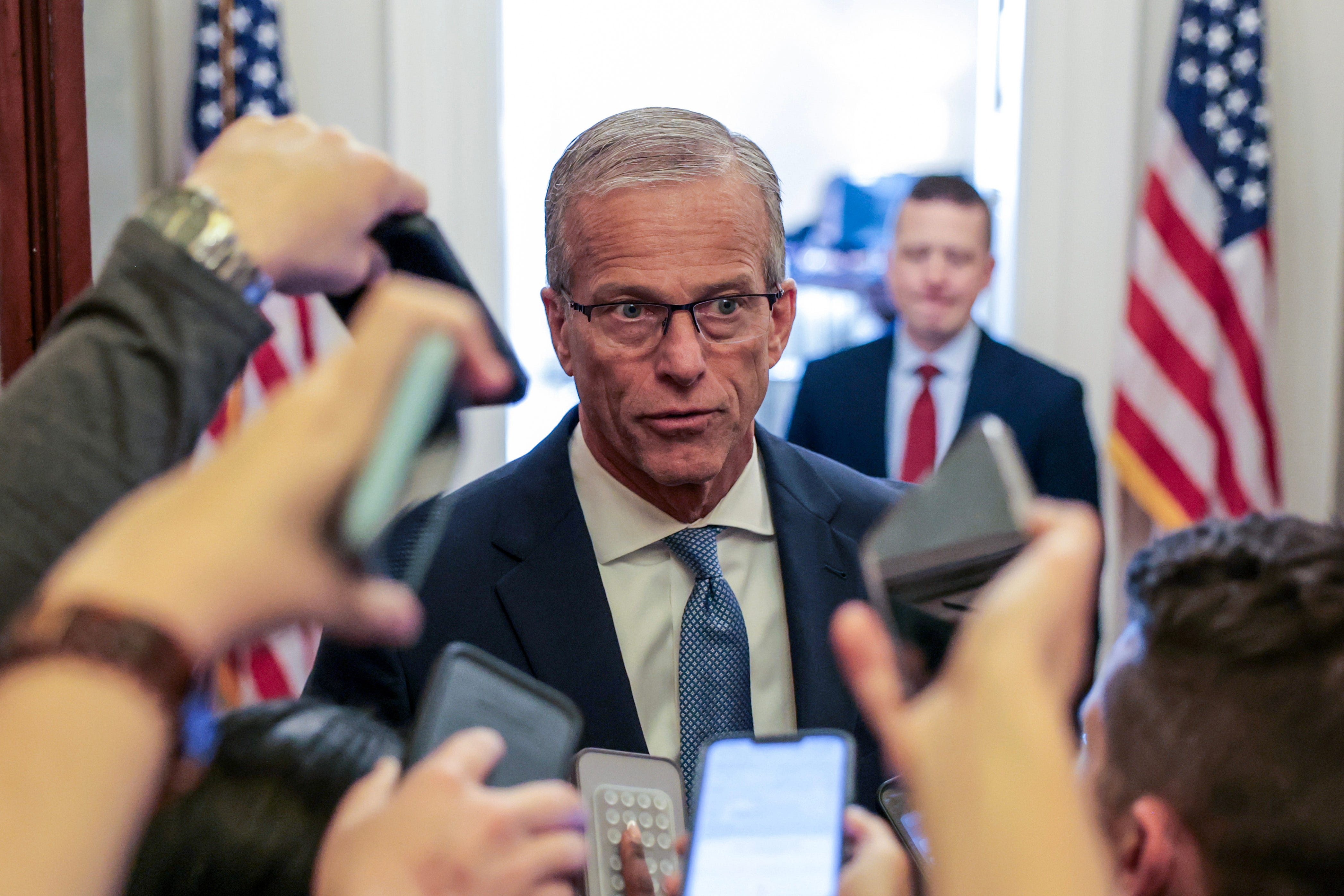
It didn’t work. The response to Blanche, Punchbowl News reported, was “incredibly hostile,” with roughly half the Republican conference standing up to speak in opposition to the fund and expressing a desire not to pass the reconciliation bill without including language reining it in in some way. “The nation’s top law enforcement official is asking for a slush fund to pay people who assault cops?” Sen. Mitch McConnell (R-Ky.) said in a statement afterward. “Utterly stupid, morally wrong—take your pick.”
There are lots of reasons—beyond the obvious one that the slush fund is evil, stupid political malpractice in a terrible political climate in an election year—why Republicans might be rediscovering their spines here.
First, Trump’s immediate-term political leverage over them is weakening. The 2026 primary cycle is now mostly past, giving lawmakers more room to breathe. A Trump-backed MAGA primary challenger in 2028 (or, for some senators, even later) is a problem for their future selves. At any rate, they’ve got to survive an extremely Trump-hostile electorate in 2026 first.
Second, many GOP senators are currently at the height of their anger over the endorsements Trump did make this cycle. Sens. Bill Cassidy and John Cornyn are liked and respected in the Republican conference. Many of their colleagues view Trump’s shivving of Cassidy as a ludicrous relitigation of old grievances and his endorsement of Ken Paxton over Cornyn in Texas as just as bad: Paxton is far likelier to lose Republicans the seat and, should he beat the odds and win, they’ll have to start hanging out with Ken Paxton.
Third, there remains just enough plausible deniability over the slush fund that Republicans can still make their objections to it in a form they remain more comfortable with: As an objection to acting Attorney General Blanche, not to Trump. It was no accident that McConnell’s statement singled out “the nation’s top law enforcement official.” Despite Trump’s own history of applying that label to himself, it’s clear McConnell meant Blanche.
And while we’re on that subject, one wonders: What if, in this particular case, they’re right? Trump plainly approves of the anti-weaponization fund. He’s spoken favorably of it and trotted out various administration officials—Blanche, Vice President JD Vance, Deputy Chief of Staff Stephen Miller—to give it support. But it’s equally plain he doesn’t feel as strongly about it as he does about, say, his ballroom. After all, it’s a slush fund for his supporters, not for him himself. He has not been burning up Truth Social putting public pressure on senators to comply; in fact, he has yet to post about the anti-weaponization fund online at all.
Whatever the reason, it’s good that Trump is finding his slush fund harder than expected to ram down the gullets of his ordinarily pliable congressional allies.
It’s also worth pointing out the quiet role Senate Democrats played to set the stage for this fight. The only reason Republican senators are in a strong position to stare the White House down on this issue in the first place is because they have a pressure point of their own—the ICE reconciliation bill—to hold hostage over possible changes. And the only reason that bill exists is because Senate Democrats were so relentless in pressing their anti-ICE advantage during spending fights earlier this year, when they successfully backed Republicans into a corner and got them to fund everything in the government except the immigration-enforcement components of the Department of Homeland Security.
In other words, the current level of Republican dysfunction is only possible thanks to this year’s strategic successes by Senate Democrats, who trusted that the winds of public opinion were at their back and pushed for—and got—serious concessions in earlier games of legislative chicken. Trump is only getting weaker. It’s a template they should look to replicate.
AROUND THE BULWARK
The Smugness of Anti-Empathy Politics… CATHY YOUNG breaks down Gad Saad’s ‘own the libs, scorn the weak’ ethos.
Prepare for a Post-America World Order… It will take a long time to recover America’s credibility after Trump’s foreign policy chaos, writes MATT GURNEY.
Tim, Sarah, and Sam LIVE From the Bulwark Tour Bus… If you couldn’t make the California shows but you want to feel like you were there for the whole tour, check out this video.
Quick Hits
THE TRADER IN THE WHITE HOUSE: One might be tempted, against the backdrop of so many other corruption scandals, to view Donald Trump’s stock-trading behavior as small ball. But as Joe Perticone wrote in Press Pass yesterday, the reality is that in this form of corruption, too, Trump seems determined to break the scale:
Filling in as press secretary on Wednesday, Vice President JD Vance told reporters “the president doesn’t sit at the Oval Office on his computer on his Robinhood account buying and selling stocks. That’s absurd.” True enough—someone (or a team of people) is obviously making the trades for him. But they’re still his transactions being conducted in his name using his money. The whole thing reeks of the same unethical behavior that earned Congress its reputation for corruption over the years. . . .
But Trump’s case is different. And it’s not just because of the brazenness of his approach but the sheer volume of his trading.
The total value of Trump’s transactions in the first three months of this year—again, $750 million—is higher than the value of all trades by all 535 members of the House and Senate combined in an average year.
According to data compiled by Quiver Quantitative and provided to The Bulwark, the average of the total dollar amounts traded by all members of the House and Senate between 2021 and 2025 comes out to around $650,000,000. Since the start of this year, federal lawmakers have traded just north of $213,000,000, which puts them on pace for a slightly slower year than normal, with a projected year-end total of around $550,000,000, assuming their rate of buying and selling remains steady.
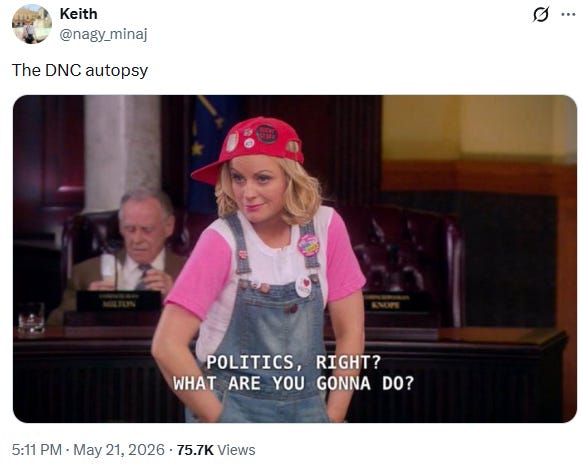
DEMS STEP ON AUTOPSY RAKE: For months now, Democratic National Committee Chair Ken Martin has been fending off questions—and conspiracy theories—about what happened to the party’s long-promised post-2024 autopsy. In an article for The Bulwark last week, former Kamala Harris deputy campaign manager Rob Flaherty alleged that the “stupider than fiction” truth was that “no autopsy was released because there is no actual autopsy,” and that the autopsy team had been “in over their heads and struggled to put the thing together.”
Turns out: Yeah, pretty much! On Thursday, CNN obtained and published a copy of the report, leading Martin to follow suit by releasing it himself—while acknowledging it “wasn’t ready for primetime” and “does not meet my standards.” He wasn’t kidding: The document contains few insights, a dizzying quantity of typos and factual errors, and enormous chunks where promised sections were apparently never written at all. Making the whole thing more surreal, the whole document is studded with the DNC’s own corrections and annotations criticizing the quality of the work.
Martin took responsibility—if not blame—for the poor product on a call with DNC members yesterday, saying that being a leader meant owning up to mistakes, both “those of your creation and frankly those not of your creation.” He also said that the document’s primary author, Democratic strategist Paul Rivera, is no longer working at the DNC. Still, the whole thing has to make Democrats uneasy: It’s bad enough to lose to Trump, but to be so dysfunctional that you can’t even manage to figure out and write down why it happened? Read the whole thing, if you’re a glutton for punishment.
TALK ABOUT TAKING STOCK: Some companies are just too big to play by the rules. Nasdaq, in a bid to win the IPOs of SpaceX, OpenAI, and Athropic, changed its restrictions on how quickly new stocks can be incorporated into indices. The Financial Times explains what the new “fast track” rules mean:
SpaceX will make relatively few shares available to public investors at its IPO next month, a small “free float” which under old rules would exclude the rocket company from indices tracked by trillions of dollars of passive investments. However, Nasdaq has loosened its rules as it battled to win the SpaceX listing over its rival NYSE, allowing the stock to join the Nasdaq 100 after just 15 days. SpaceX and other new entrants will also be given an index weighting equivalent to three times the value of the shares floated. S&P Dow Jones Indices is also consulting on changes that could fast-track the stock’s entry into the S&P 500. . . .
JPMorgan estimates that if 50 per cent of the company’s shares are eventually floated with a valuation reaching $2tn, passive investors would have to sell $95bn of Wall Street’s eight biggest existing tech stocks.
In other words, anyone whose retirement account includes an index fund—millions of people—will suddenly, in effect, own much less of all the companies they previously had, and much more of SpaceX and the AI companies.
—Benjamin Parker
ARCH CYNICISM: The Trump Administration is moving forward as fast as possible with its plans to build a 250 ft. arch in the middle of the traffic circle that lies between Arlington National Cemetery and the Lincoln Memorial. So quickly, in fact, that administration officials have decided (shocker) they don’t need Congress’s approval—or, more precisely, that they already have it. The Washington Post has more:
Administration officials have cited a 1924 report by a federal commission charged with designing the Arlington Memorial Bridge. That report called for building a pair of 166-foot-tall columns, surmounted by statues, on Columbia Island that would frame the nearby Lincoln Memorial.
Congress formally ratified the commission’s report in 1925, and the Memorial Bridge was soon built. However, the columns were not constructed, and Trump officials today argue that in building the arch they would be carrying out past lawmakers’ wishes.
Only a politician or a Trump administration lawyer could think that “a pair of 166-foot-tall columns” is the same as a 250-foot-tall arch. Go figure.
As it happens, there is already an arch at Arlington. At one of the original entrances to the cemetery, the red stone McClellan Gate—a much more human-scale thirty feet high—bears a fitting few lines from Theodore O’Hara’s poem, “Bivouac for the Dead”:
“On fame’s eternal camping ground their silent tents are spread / And glory guards with solemn round, the bivouac of the dead.”
—Benjamin Parker
Cheap Shots
Let a guy dream!
The American stock market surges every time the President announces that the war with Iran is about to end. Why wouldn't he keep saying this?
"Don’t sleep on the fact, Blanche urged them, that “senators whose records were secretly subpoenaed” by Special Counsel Jack Smith can get in on the settlement fund too!"
Detail that makes this even more odorous: They can get the money in secret.