
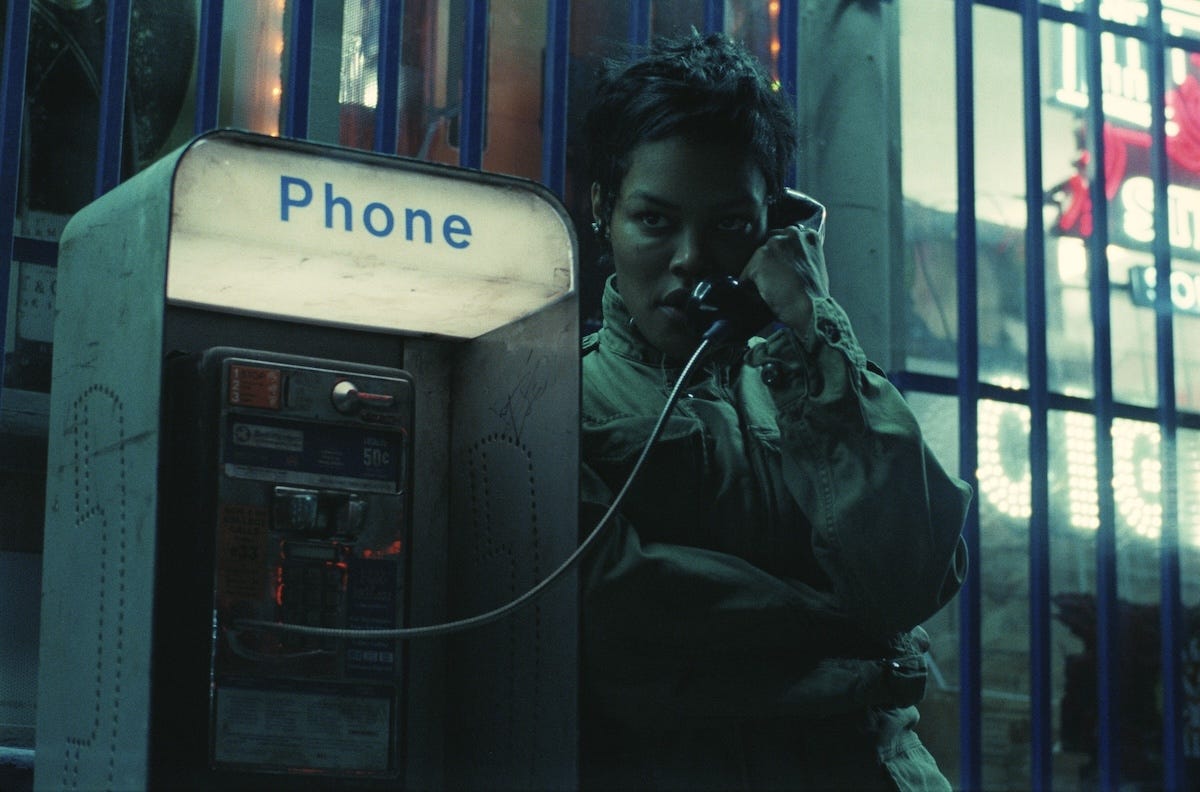
I’m a little softer on One Battle After Another than most of my critical brethren. It is, at times, the best, most propulsive movie of the year—but those times are the first forty minutes and it stumbles along after that. Here’s the opening of my review:
One Battle After Another is simultaneously thrilling on a moment-to-moment basis and kind of a slog: fast-paced yet repetitive, a movie with pretense to daring subversion that nevertheless hews neatly to nearly every political instinct of writer-director Paul Thomas Anderson’s intended audience, ensuring there’s never an uncomfortable moment.
The best sequence in the film is the opening forty minutes or so, in which the French 75—a Weathermen-style group led by the revolutionary Perfidia Beverly Hills (Teyana Taylor) and explosives expert Ghetto Pat (Leonardo DiCaprio)—free a group of illegal immigrants from a detention center. During the operation, Perfidia sexually humiliates Col. Steven Lockjaw (Sean Penn), who becomes infatuated with her; as the random bombings and other actions pile up, he has his eyes on her, allowing her to continue to work in exchange for sexual favors.
Anderson moves us with deftness and dexterity through this early action, guiding us from bombing to bombing with skill and highlighting the solipsistically sexual nature of Perfidia’s actions. She’s a self-styled revolutionary, but she’s really doing this because she gets off on it. She gets off on the danger, she gets off on Pat’s bombmaking, she gets off on dominating Lockjaw. It’s revolution as kink, more peccadillo than persuasive politics. (Turns out the key text to comprehending One Battle After Another isn’t Thomas Pynchon’s Vineland, on which it is loosely based, but Bryan Burrough’s Days of Rage: America’s Radical Underground, the FBI, and the Forgotten Age of Revolutionary Violence.) She is, ultimately, a self-centered narcissist, unwilling to be a proper mother to her daughter, professing jealousy that Pat pays more attention to her baby than her. That she couches her narcissism in the language of social consciousness only deepens her shame; it’s the one real political complication Anderson throws into the film, this recognition that people like Perfidia are more committed to themselves than any cause.
You can read the rest here.
I would just like to emphasize the usefulness of Burrough’s Days of Rage; one thing that comes across in that book is how much of the Weatherman/Weather Underground appeal had to do with Bernardine Dohrn’s sexiness. “Clad in a tight miniskirt and knee-high Italian boots, Dohrn burst onto the scene. . . . Everyone who met her—every man, at least—seemed mesmerized. ‘Every guy I knew at Columbia, every single one, wanted to fuck her,’ remembers one SDSer, and Dohrn knew it. She liked to wear a button with the slogan cunnilingus is cool, fellatio is fun,” writes Burrough. Dohrn’s a fucking psychopath—Burrough quotes her infamous reaction to the murder of Sharon Tate: “First they killed those pigs, then they ate dinner in the same room with them. They even shoved a fork into the victim’s stomach! Wild!” which led those listening to lift “their hands in four-finger salutes, signifying the fork shoved into the pregnant Sharon Tate’s belly”—but she’s hot, and so can get away with a lot.
Much the same could be said about One Battle After Another’s Perfidia Beverly Hills; Teyana Taylor deserves a supporting actress nomination at the Oscars solely for setting the entire movie in motion by arousing all the men in the movie to action. She moves with lithe, potent sexual energy, and Paul Thomas Anderson shoots her gyrations as lasciviously as any cameraman in his breakthrough feature, Boogie Nights. The combination of sex and violence has rarely been as pronounced as it is here, and the film loses something when she disappears from the action.
One thing Paul Thomas Anderson captures through Taylor’s performance is the ambivalence Dohrn’s set of pseudo-revolutionaries had toward actual violence: Once Perfidia actually has to pull a trigger on a guy, there is something like fearful revulsion in her face. Not pity, precisely, but terror at crossing this particular Rubicon. Neither Perfidia’s French 75 nor the original Weathermen had the stomach for what revolution would actually entail, which allows them to maintain an air of romantic sentimentality in the public imagination.1
On the Bulwark Movie Club we talked Clear and Present Danger, in no small part because it presents a vision of a presidential administration attempting to excuse any misbehavior with the claim that the actions are being done in the national interest. Sound familiar? Hope you enjoy it, it’s one of my favorite action movies of the 1990s.
Slightly unusual episode of The Bulwark Goes to Hollywood this week, as I talked to Nate Soares about his new book, If Anyone Builds It, Everyone Dies: Why Superhuman AI Would Kill Us All. I wanted to dig into the ways that Hollywood might be able to steer away from the Terminator-style representation of AI and toward something more like what could actually happen if an artificial general intelligence or superintelligence develops.
How Movies Can Better Prep Us for the AI Threat

On this week’s episode, I’m joined by Nate Soares to talk about his new book, cowritten with Eliezer Yudkowsky, If Anyone Builds It, Everyone Dies: Why Superhuman AI Would Kill Us All. It’s a fascinating book—some will say fearmongering and sensationalist; I, frankly, think they’re overly optimistic about our ability to const…
Over at Across the Movie Aisle this week we discussed Disney backing down on the benching of Jimmy Kimmel—an unambiguously good thing in the face of the administration’s pressure to punish the comedian—and how it might outline a game plan for resisting similar moves in the future. We also talked about Robert Redford’s legacy a bit following his death last week at the age of 89.
The FCC v. Jimmy Kimmel

On this week’s episode, delayed slightly due to technical difficulties, Sonny, Peter, and Alyssa broke down the struggle between Jimmy Kimmel, Disney, Nexstar/Sinclair, and Brendan Carr at the FCC. Is this just business as usual at the FCC, or has the regulatory administration overstepped its bounds here. Then we sai…
Speaking of Robert Redford …
Assigned Viewing: All the President’s Men (Criterion Channel)
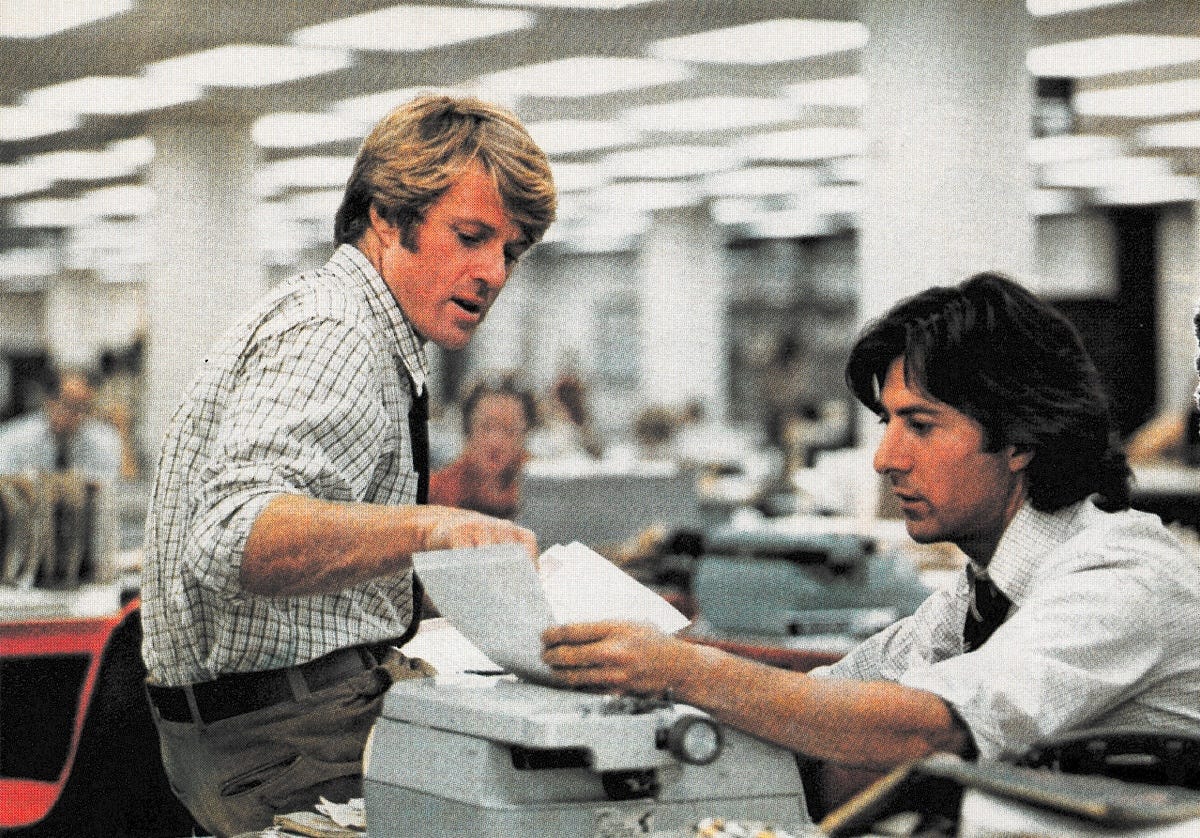
On this week’s movie club, we’re discussing All the President’s Men, Alan J. Pakula’s look at the reporting that brought down Richard Nixon after the Watergate break-in. Jonathan Cohn’s sitting in for Sarah Longwell, though, sadly, he won’t be able to tape with his framed All the President’s Men poster in the background.
There is an argument to be made that this sentimentality curdles into overtly saccharine treacle in One Battle After Another’s final five minutes, but that’s an essay for another day.
Recently re-watched All the President's Men. Thought it would be depressing in the sense that we seem to be experiencing at least one Watergate event perpetrated by DJT and Co. every day these days...but it's not, it's a great, great movie (on an aesthetic and moral level) that reminds me what can happen when a few people hunt tenaciously for the truth, then make sure it gets out there. (But the depression returns when I wonder - do Americans still have the capacity to care about the truth?)
Maybe you already did this one.
The Madness of King George. 1994