




Viktor Orbán’s defeat wasn’t the only dent in MAGA International this week. Yesterday, Giorgia Meloni, Italy’s right-wing prime minister, denounced Trump’s barrage of attacks on Pope Leo XIV: “I find President Trump’s remarks about the Holy Father unacceptable,” Meloni said. “The Pope is the head of the Catholic Church, and it is right and proper that he call for peace and condemn all forms of war.” Happy Tuesday.
Hungary Shows the Way
by William Kristol
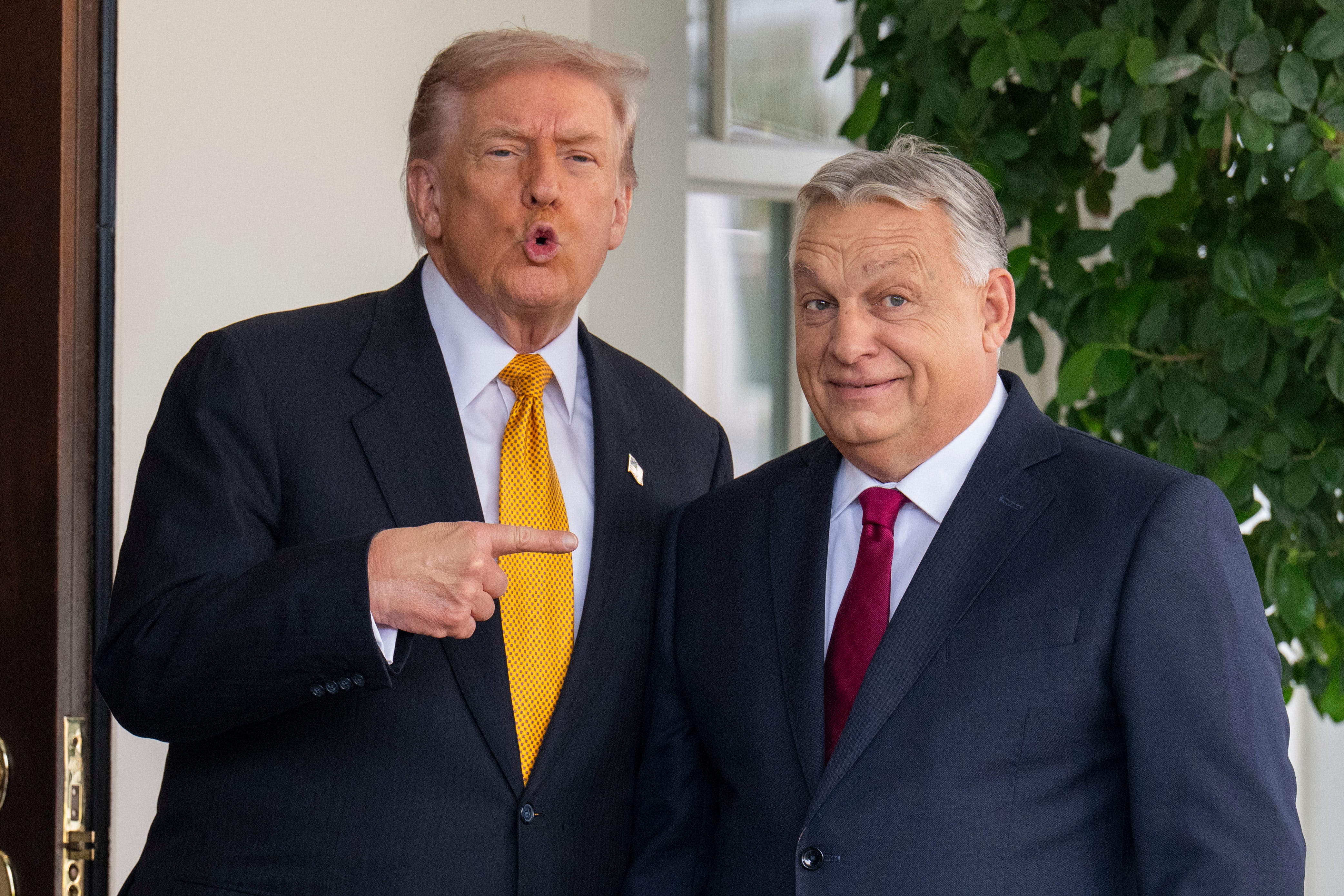
Hungary’s Viktor Orbán was, according to MAGA propagandist Steve Bannon, “Trump before Trump.” Or as the Heritage Foundation’s Kevin Roberts put it, Orbán’s Hungary was “not just a model . . . but the model.”
So it’s reasonable to wonder whether Orbán’s defeat on Sunday might not be a herald of failure for Trump, a harbinger of the defeat of Trumpism.
Orbán was in a stronger position in Hungary than Trump is here. Orbán had been in power for sixteen years, reelected with supermajorities in 2014, 2018, and 2022. He succeeded in establishing his dominance of the political system in his sixteen years in office, rewriting the constitution, changing electoral rules, and establishing a remarkable degree of control over the courts, the media, and the private sector. All this was in the service of institutionalizing the “illiberal democracy” he proclaimed as his goal in 2014.
Yet Orbán lost in a landslide. He was defeated by Péter Magyar, who’d been a member of Orbán’s Fidesz party until joining the Tisza Party two years ago. Magyar was able not only to bring together and unite disparate parts of the resistance to Orbán, but to turn that opposition into a kind of social movement that transcended normal partisanship and that offered the country a different vision of a Hungarian future.
David Baer, whose dispatch from Budapest was featured in yesterday’s newsletter, emphasized to me as were texting last night that Magyar was not merely a skilled political tactician; his campaign offered a vision that promised to “make people proud of their country again.” David noted that Magyar’s campaign often cited the great Hungarian national poet, Sándor Petőfi, a hero of the Hungarian Revolution of 1848, who was “a great LIBERAL and PATRIOTIC poet.”
Here are the lines from Petőfi that the Magyar campaign liked to quote, in David’s translation:
Beautiful again shall be Hungary’s name
Worthy of its ancient fame
What centuries past have smeared with blight
We shall wash off and set aright.
We swear by God we shall be free
No longer sons of slavery.
And David remarks,
The extent to which Magyar’s campaign, and he himself, seem infused with the very classical liberal ideals of Hungary’s 1848 revolution is lost in the reporting that characterize him as conservative. We don’t fully know who he is yet, but you could make a good case that he’s a liberal in the way conservatism in America used to be liberal.
This of course raises the question and the possibility: Could liberal patriotism overcome authoritarian nationalism here as well? As Orbán showed the way for the authoritarian turn in American conservatism, could Magyar herald a revival of a vigorous and victorious patriotic liberalism?
This wouldn’t be the first time the small country of Hungary held aloft the torch of liberty.
The Hungarian revolutionaries in 1848, led by Lajos Kossuth, inspired liberals not just in Europe but in the United States (including Abraham Lincoln).
The example of the Hungarian freedom fighters in 1956, with their valiant uprising against the Soviet Union—“the first tear in the Iron Curtain”—was important to many both within and outside the Soviet bloc who resisted communism over the next decades.
And in 1989, Hungary led the way in breaking up the Warsaw Pact, opening its border to the West in September and dissolving its communist government in October, before the Berlin Wall came down.
Hungary is a small country. We’re a big one. And we’re used to indulging in the conceit that it’s our role to show others the way. So we often have. But it’s also been the case that others have shown us the way. One thinks especially of Churchill and the people of Great Britain who stood alone in 1940, as we remained mostly aloof from the fight against Nazism. One also thinks of Zelensky and the people of Ukraine who have so courageously fought alone against Putin’s Russia—though with support from the free world—over the past four years and longer.
Obviously what happens next in Hungary—to say nothing of what happens here—is up in the air. But for now we can at least express gratitude to the people of Hungary who have inflicted such a notable defeat not just on Viktor Orbán but on Vladimir Putin and Donald Trump. Let us see to it that it is not the last.

The Geopolitics of ‘Your Rules’
by Andrew Egger
Your rules, your rules, your rules! For much of today’s online right, these two words are a slogan, a rallying cry, a way of life. They’re a core part of the permission structure of a politics built around nothing but owning the libs. The good guys, it is suggested, have actual moral standards and codes that their godless dishonorable enemies lack, but they need not actually hold to these codes in their dealings with those enemies. In such instances, “we’re only playing by your rules.”
In theory, this is a condensed argument about double standards. In practice, it’s an all-purpose excuse for pretty much anything. That was obvious this week, when we saw the apotheosis of “your rules” thought from both the president and the vice president.
On Sunday morning, Donald Trump was asked on Fox News to defend his threat last week that “a whole civilization will die tonight” if Iran did not capitulate to his demands—an obvious, explicit threat of genocide. “I’m fine with it,” Trump said, insisting that the threat had “brought [Iran] to the table.” Then he added: “They’re allowed to say ‘Death to America.’” Your rules.
Then, last night, JD Vance had this to say—again on Fox—about America’s blockade of the Strait of Hormuz, which comes atop Iran’s blockade of the strait: “What they have done is engage in this act of economic terrorism against the entire world—they’ve basically threatened any ship that’s moving through the Strait of Hormuz. Well, as the president of the United States showed, two can play at that game.” Your rules.
There are, of course, major differences between Iran’s blockade and America’s: Our military has promised to interdict ships transiting the strait under Iran’s permission, not to attack them with drones, menace them with mines, or ram them with speedboats. But Vance’s core argument, like Trump’s above, is predicated on a simple rhetorical point: How can anyone object to us treating Iran the way they treat us?
This argument is simply incompatible with the way America, until about fifteen seconds ago, conceptualized its position in the world. America was supposed to be a beacon of the good things that were possible for human civilizations to attain: freedom, prosperity, the rule of law. To borrow the hoary old phrase from John Winthrop via Ronald Reagan: the “shining city upon a hill.” This was both a noble aspiration and a great international brand that helped America become the linchpin of a global order that benefited it immensely.
But Trump, his lackeys, and his movement have nothing but contempt for both the old aspiration and the old order. All that ever did, they believe, is get us ripped off by people who were willing to be more devious and unscrupulous than us. But thanks to them, America is now wise to their tricks. We’re not going to let them get away with it anymore. Now, we’re playing by their rules.
We weren’t always perfect in following them, but our rules helped raise America to heights no other country had ever achieved. Now, the president and vice president suggest, no one can or should complain if we lower our standards to the level of the world’s most lawless regimes. We’re only playing by your rules.
AROUND THE BULWARK
What a ‘Blockade’ in the Strait of Hormuz Really Means… It’s not as easy as it sounds, explains MARK HERTLING.
RFK Jr.’s Lifelong Lapse of Judgment… A new book shines light, if any were needed, on the man’s manifest unfitness, writes BILL LUEDERS.
Trump’s Weird DoorDash Stunt Backfires… On Bulwark+ Takes, ANDREW EGGER and CATHERINE RAMPELL break down Donald Trump’s bizarre McDonald’s DoorDash photo op at the White House, meant to highlight his “no tax on tips” policy.
A 250-Foot Monument to Trump’s Ego… On the Mona Charen Show, Washington Post architecture critic PHILIP KENNICOTT joins MONA CHAREN to discuss Trump’s physical desecration of Washington, D.C.
Calling all West Coast Bulwark+ members: Today starting at 9:00 a.m. PT, tickets will go on sale for our Bulwark Live shows in San Diego on May 20 and Los Angeles on May 21. Click here to get the members-only presale code and links to the ticketing sites.
Tickets go on sale for everyone else starting on Friday, April 17.
Quick Hits
THE MAN HIMSELF: Sometimes there just isn’t room in even as meaty and substantial a newsletter as Morning Shots to give adequate time to every ludicrous thing our president sets himself to in a given day. So we’ll just briefly mention here his “No Tax on Tips” stunt at the White House yesterday, in which a self-proclaimed “DoorDash Grandma” named Sharon Simmons delivered McDonald’s to the Oval Office to talk about how Trump’s Big Beautiful Bill has saved her money on her deliveries. Trump subjected her to an unexpectedly uncomfortable barrage of questions:
“I think you voted for me?”
“Uh . . . maybe.”
“Do you think that men should play in women’s sports?”
“I really don’t have an opinion about that. I’m here about no tax on tips.”
Simmons also stood by awkwardly as Trump offered a howler of an explanation for his Sunday Truth Social post of AI-generated artwork depicting him as Jesus, which had incensed many religious conservatives online: “I thought it was me as a doctor. And had to do with Red Cross, as a Red Cross worker there, which we support.”
DOGGED PURSUIT OF JUSTICE: We’ve said it before, and this won’t be the last time: It is a grotesquery of our era that old outrages are so rapidly followed by new ones that the old ones are difficult to bear in mind. The horrors of ICE’s occupation of Minneapolis are barely past us—Renee Good was killed just 98 days ago, Alex Pretti just 80—and yet those horrors can already feel like a distant memory.
Some attempts at accountability persist, however. Yesterday, county officials in St. Paul, Minnesota announced the latest development in their investigation of ICE’s contemptible January treatment of ChongLy Thao, a U.S. citizen whom ICE agents inexplicably dragged half-naked from his home into the Minnesota winter.1
Ramsey County prosecutors have been investigating the incident as a possible kidnapping, but ICE—and we’re sure this will shock you—has proven remarkably uncooperative. At a press conference yesterday, county officials said the federal government has rebuffed all requests for basic records on the incident, and that they were preparing to sue if ICE’s stonewalling continues.2
“There are limits on ICE authority just like there are limits on ours,” Ramsey County Sheriff Bob Fletcher said at the press conference. “When someone breaches those limits of authority, there are consequences. . . . There is no such thing as absolute immunity for federal agents.”
TWO CREEPS OUT: Well, that was fast. One week ago, Rep. Eric Swalwell (D-Calif.) was the odds-on favorite to become California’s next governor. Now, in the wake of a sudden blizzard of sexual assault and misconduct allegations, Swalwell’s career seems to have winked out of existence. On Friday, Swalwell insisted that “these allegations are flat false, and I will fight them.” On Sunday, he dropped out of the governor’s race. And on Monday, he announced his immediate resignation from Congress.3
This resignation had an unexpected effect: Shortly thereafter, Rep. Tony Gonzales (R-Texas) announced he would be “retiring,” too. Gonzales, you may recall, is the congressman who last year allegedly pressured a staffer into an affair—then broke off contact when her husband found out. The staffer then killed herself by setting herself on fire. Gonzales, whose months of implausible denials of wrongdoing included accusing the woman’s widower of participating in a conspiracy to bring him down, finally announced last month that he would abandon his re-election campaign. But he had remained obstinately in his current office—until now.
The timing is notable. Both men were facing possible expulsion votes upon the return of the House this week—with a Democratic lawmaker announcing immediately after Swalwell’s resignation announcement that she would personally file the motion to expel Gonzales should he fail to resign. In our era of total-war partisanship, it seems that disgraced Republican lawmakers can stagger on for a while by calling all accusations against them witch hunts—at least until there’s a disgraced Democrat to trade their resignation for, like a swap of prisoners of war.
Cheap Shots


The Department of Homeland Security claimed its agents had mistaken Thao for one of two criminal migrants they expected would be at the address—but as Andrew reported at the time, neither looked a bit like him, and one of the two was already in state prison.
Last month, the county filed a document known as a Touhy Demand, a procedural request for federal-government records that opens the door to legal action if the government refuses to produce them. The deadline for ICE’s compliance is April 30.
In his resignation statement, Swalwell apologized for “mistakes in judgment I’ve made in my past” while pledging to fight “the serious, false allegation made against me.” One former staffer has accused Swalwell of rape and other women have accused him of less extreme forms of misconduct; the simplest reading here of his denial of “the serious, false allegation”—singular—seems to be that he is admitting the latter while continuing to deny the former.
Who among us hasn't drunk a fifth of bourbon and suddenly, inexplicably, arrived in a Waffle House two states away?
Perhaps it's finally time to stop the weird Anglo-American habit of using the word "liberal" as a synonym for "leftwing".
Historically, it has always referred to "freedom" and therefore "democracy". That's why Orban chose to call his neofascist regime "illiberal".