The Good Fences Trump’s Destroying
Plus: Can a president bombing boats in the Caribbean—boats a fellow world leader says had random citizens aboard—really win the Nobel Peace Prize?


Two years and two days after Hamas’s vicious terrorist attack on Israel—two years and one day after Israel declared a retaliatory war that would spark a humanitarian crisis and blast much of the Gaza Strip to rubble—we are finally seeing real movement towards peace. The White House announced yesterday that Hamas and Israel had agreed on initial terms of a deal that would lead to a ceasefire, including a swap of the last Israeli hostages held in Gaza for a large number of Palestinians currently serving criminal sentences in Israel. The deal, which would involve IDF forces withdrawing to an agreed-upon point, sparked celebrations in the streets in both Israel and Gaza at the prospect that the nightmarish conflict could finally come to an end.
Ceasefire deals in the Israel-Palestine conflict are fragile things, and much could still go wrong. Hamas continues to reject the central Israeli aim that the militant group lay down its arms. And Israel continues to pound the strip even in the wake of the handshake deal—explosions continued to be heard in Gaza early this morning.
But any step toward peace in Gaza is a welcome one. The Trump administration deserves credit for helping to see this through, and we pray that Phase Two of the deal comes speedily and smoothly. Happy Thursday.
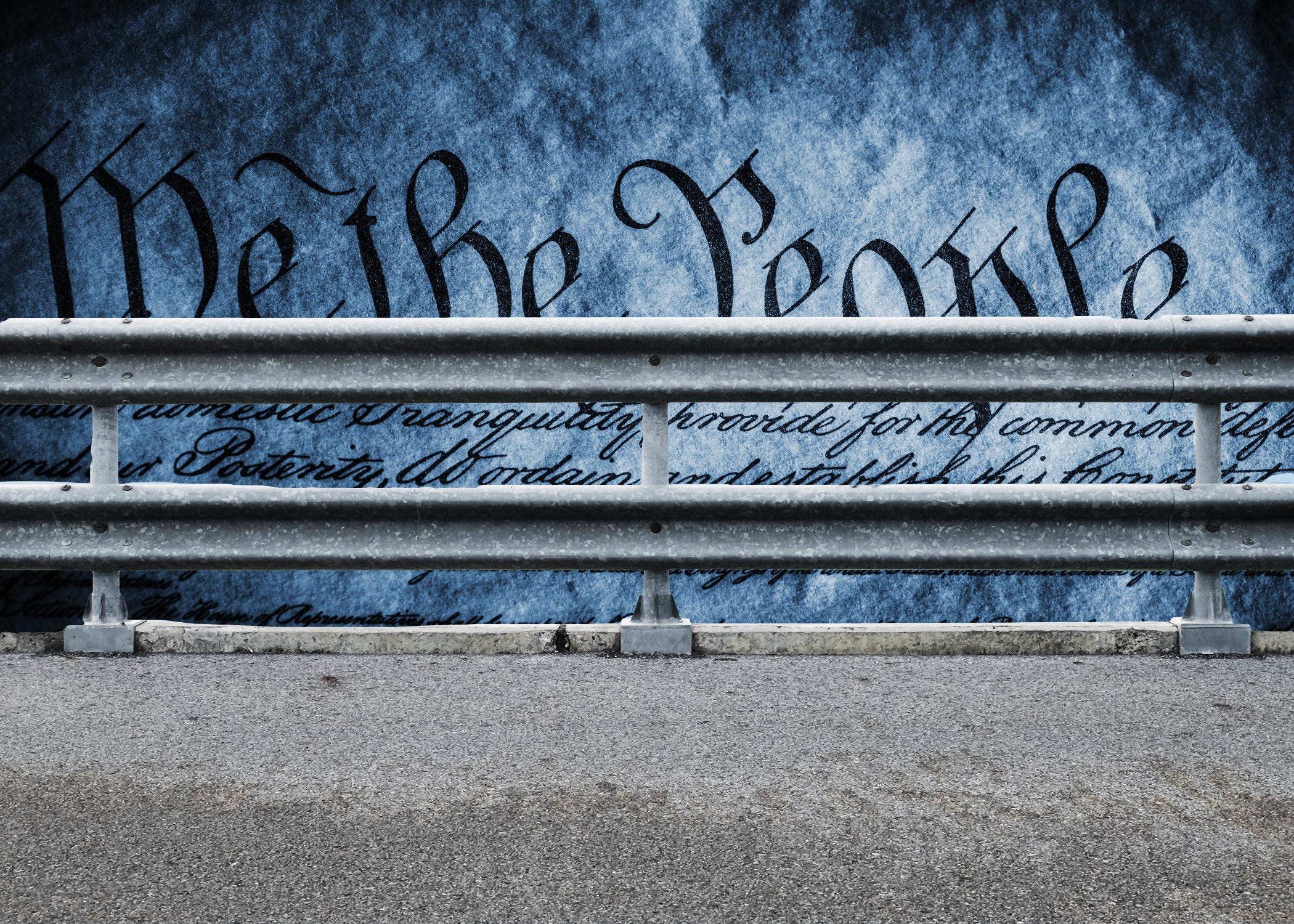
Where Have All the Guardrails Gone?
by William Kristol
In his famous 1914 poem, “Mending Wall,” Robert Frost’s narrator, a New England farmer, remarks that “something there is that doesn’t love a wall.” Indeed, the poem opens with that assertion. But Frost also has the farmer’s neighbor respond—twice—that in fact “good fences make good neighbors,” including in the poem’s last word.
The neighbor, Frost seems to be suggesting, is right. Walls may not be very lovable. But fences (which seem a bit kinder and gentler than walls)—are very useful if we’re to get along with each other.
The American Founders were very much on the side of good fences. Good fences are what we tend to call guardrails. And they make for good, free government. As James Madison explained in Federalist #51,
But the great security against a gradual concentration of the several powers in the same department, consists in giving to those who administer each department the necessary constitutional means and personal motives to resist encroachments of the others. The provision for defense must in this, as in all other cases, be made commensurate to the danger of attack. Ambition must be made to counteract ambition. The interest of the man must be connected with the constitutional rights of the place. It may be a reflection on human nature, that such devices should be necessary to control the abuses of government. But what is government itself, but the greatest of all reflections on human nature?
The fences or guardrails that secure a free government may not be lovely. Yet they are necessary for liberty and justice.
But the guardrails can crumble, and the guardians of the guardrails can falter. And in 2025, they’re crumbling—and we’re faltering.
Party loyalty has overwhelmed congressional resolution to defend its prerogatives against the executive. Foolish and half-baked doctrines have undermined the willingness of the Supreme Court to check the executive. State and local governments have a limited ability to stand up to their big brother in Washington. And it turns out that nongovernmental institutions can be seduced and intimidated into going along with an overreaching executive rather than resisting it.
So the most visible guardrails aren’t doing the guarding. But there is also another set of guardrails, less obvious but crucially important: the internal guardrails of the executive branch.
Once the executive branch becomes large and powerful, it turns out that free government and good government depend on guardrails within the executive that check the excessive centralization, politicization, and personalization of government power.
These include laws and rules and regulations that guard against the politicization of the military, and protect the career civil service. They include norms and traditions of independence or quasi-independence for the Department of Justice, the FBI, and the intelligence community. They include provisions for inspectors general and protections for whistleblowers. We’ve developed a host of procedures and practices within the executive branch that constrain the ability of one man and his political subordinates to accumulate unconstrained power, or to exert such power simply in his own personal or political interest.
The second-term Trump administration understands the importance of these internal guardrails, and has moved aggressively to neuter or dismantle them.
If the general counsel of the CIA or judge advocates in the military have problems with the legality of certain proposed actions? Fire them.
If other senior military officers take too seriously their oath of loyalty to the Constitution rather than to one man? Remove them and replace them with more compliant figures.
If lawyers at the DOJ want to maintain a “wall” between them and the White House, between lawful prosecutions and political vendettas? Engineer a massive purge and replace them with loyalists.
If the FBI director who’s supposed to have a ten-year term to provide some insulation from the president and politics isn’t to your liking? Push him out.
And if the Hatch Act is supposed to prevent government employees from using taxpayer resources for politicking? Ignore it. And then use government resources to produce propaganda both to undermine traditional constraints on government actions (see, ICE), and to try and camouflage what is happening or persuade the citizenry to approve of it.
All of this means that our guardrails are in bad shape. Yes, those grand institutional walls of Congress and the Supreme Court are crumbling. But the less visible fences within the executive branch itself are also being taken down.
As both James Madison and Robert Frost knew, this will not end well. Good fences make for—are needed for—a free government and a just society.
AROUND THE BULWARK
How Anti-Corruption Can Be a Winning Issue for Democrats… It’s a powerful, unifying theme—and it’s tied to the crisis of democracy under Trump, argues DAVID SIROTA.
The ICE Propaganda Campaign Goes Into Overdrive… MAGA commentators are stepping up as soldiers in Trump’s culture war to provoke confrontations against “Antifa” with the backing of DHS, reports ADRIAN CARRASQUILLO in Huddled Masses.
Lawlessness and Danger in Tech’s Brave New World… On the flagship pod, CASEY NEWTON joins TIM MILLER to break down Trump’s TikTok grift, China’s real trade priorities, and Silicon Valley’s delusion that it’s building a “machine god.” Plus: the armed invasion of Chicago, Sam Altman’s reality disconnect, and Tim Cook’s pathetic kowtow to Trump.
Democrats Are Done With Vanity Candidates…In The Opposition, LAUREN EGAN writes that party insiders are very much over running long-shots or no-shots who’ll drain money and energy.
Quick Hits
MAYBE NOT NOBEL-WORTHY: While the administration may be making real, historic progress in bringing to an end the war in Gaza, it appears to be taking indiscriminate, legally-dubious, and morally questionable military action in the Caribbean. For weeks now, the Department of Defense has been dropping bombs on boats that they claim are carrying drugs from Venezuela. And their rationalization for it has come down to: trust us, these are bad guys we’re blowing up. On Wednesday, Colombia’s President Gustavo Petro put out a statement claiming one of the strikes had hit a Colombian boat “with Colombian citizens inside.”
“A new war scenario has opened up: the Caribbean,” the statement, translated from Spanish, read. “Indications show that the last boat bombed was Colombian with Colombian citizens inside it. I hope their families come forward and report it.”
Sen. Adam Schiff’s office disseminated the statement as part of the Senator’s efforts to pass a War Powers Resolution that would block the U.S. military from engaging in hostilities with “any non-state organization engaged in the promotion, trafficking, and distribution of illegal drugs and other related activities” without congressional authorization. The resolution made it to the floor, where it failed in a 48-51 vote. The one Democrat who voted no: John Fetterman. One Republican who voted no was Todd Young, who had this qualifier to offer: “I am highly concerned about the legality of recent strikes in the Caribbean and the trajectory of military operations without congressional approval or debate and the support of the American people.”
—Sam Stein
SLIDE OUT OF HER DMs: We admit, when Donald Trump originally issued his message to Attorney General Bondi—the one that began with, “Pam”—instructing her to indict James Comey, we were pretty sure it was a weird attempt to post something in the form of a DM. It turns out, it actually was a DM. Trump just errantly put it out for public consumption.
The Wall Street Journal breaks the news:
On Sept. 20, Trump meant to send a private message to Attorney General Pam Bondi urging her to prosecute former FBI Director James Comey and his other favored targets, according to U.S. officials familiar with the matter. “We can’t delay any longer, it’s killing our reputation and credibility,” Trump wrote.
Trump believed he had sent Bondi the message directly, addressing it to “Pam,” and was surprised to learn it was public, the officials said. Bondi grew upset and called White House aides and Trump, who then agreed to send a second post praising Bondi as doing a “GREAT job.”
The misfire provided a window into how, through command and chaos, Trump has executed a wholesale transformation of the Justice Department.
There are several layers to unpack here. Plenty of people have accidentally posted DMs before, of course. But one would hope that the president would, I don’t know, take more care before firing off these missives. Maybe check the settings before clicking send. Then again, why is the president sending DMs in the first place? And why is he sending DMs to his Attorney General instructing her on who he wants prosecuted? Did the phone not work? Is he secretly a “just text me” guy? And surely there is a major national security problem to this. After all, what kind of protections is Truth Social offering for government communications? Is Devin Nunes up to this task?
In the end, this entire episode is a good reminder that as the president goes about turning the justice department into his own personal law firm, what may be his undoing is his inability to stop stepping on rakes. Comey will undoubtedly use this as part of his defense, which will undoubtedly be that this is a form of selective prosecution. And he will be right.
—Sam Stein
THE UPSIDE-DOWN: It’s hard to put your finger on the wildest moment from Trump’s clownish, alarming “roundtable” on Antifa yesterday afternoon, in which he promised to take “very threatening” steps against the decentralized anti-fascist, street-protest movement he has denounced as a “terrorist organization.” Was it Trump saying that “we took the freedom of speech away” by announcing—without passing a single new law—that flag-burning is now a crime? Was it Pam Bondi pledging to break down “the organization” of Antifa “brick by brick, just like we did with cartels”? Or maybe it was Trump appearing to nod off while one of the right-wing influencers at the roundtable detailed his own on-the-ground experiences with Antifa.
For our money, the most remarkable moment came when influencer Nick Sortor, who spent the last week in Portland, Oregon, pulled out from under the table an American flag he had grabbed from a protester who had been burning it. This was, of course, a crime—you can’t steal a flag that belongs to someone else, even if you think they’re mistreating it. And flag-burning, as the Supreme Court has affirmed, is constitutionally protected speech.
“I took this flag from that man that was burning it in the street,” Sortor said.
“I saw,” Trump replied. “Do you know who he is?”
“Oh yeah, I know exactly who it is,” Sortor said.
“So why don’t you give it to Pam?” Trump said. “Give it to the attorney general, and let’s start prosecutions.” Seated right beside him, Bondi nodded along.
Cheap Shots

Nobel Prize for Medicine: Donald Trump
(For discovering the source of autism is Tylenol)
Nobel Prize for Chemistry: Donald Trump
(For innovative ways to use/consume bleach)
Nobel Prize for Physics: Donald Trump
(For exceeding terminal velocity when running away from The Epstein Files)
Nobel Prize for Literature: Donald Trump (For the Covfefe Files)
Nobel Prize for Economics: Donald Trump
(For DOGE that saved hundreds of dollars maybe and tariffs that make the Nobel Prize 15% more expensive to import)
And finally Nobel Peace Prize:
Donald Trump
(For The Purge: Insurrectionists - coming 1/6 to a Cracker Barrel near you)
At least Trump's DM to Bondi was about official White House business, i.e. prosecuting a political enemy, and not something like, "You up?"