The Post-Hypocrisy Moment
You best start believin’ in the will to power: you’re living through it.

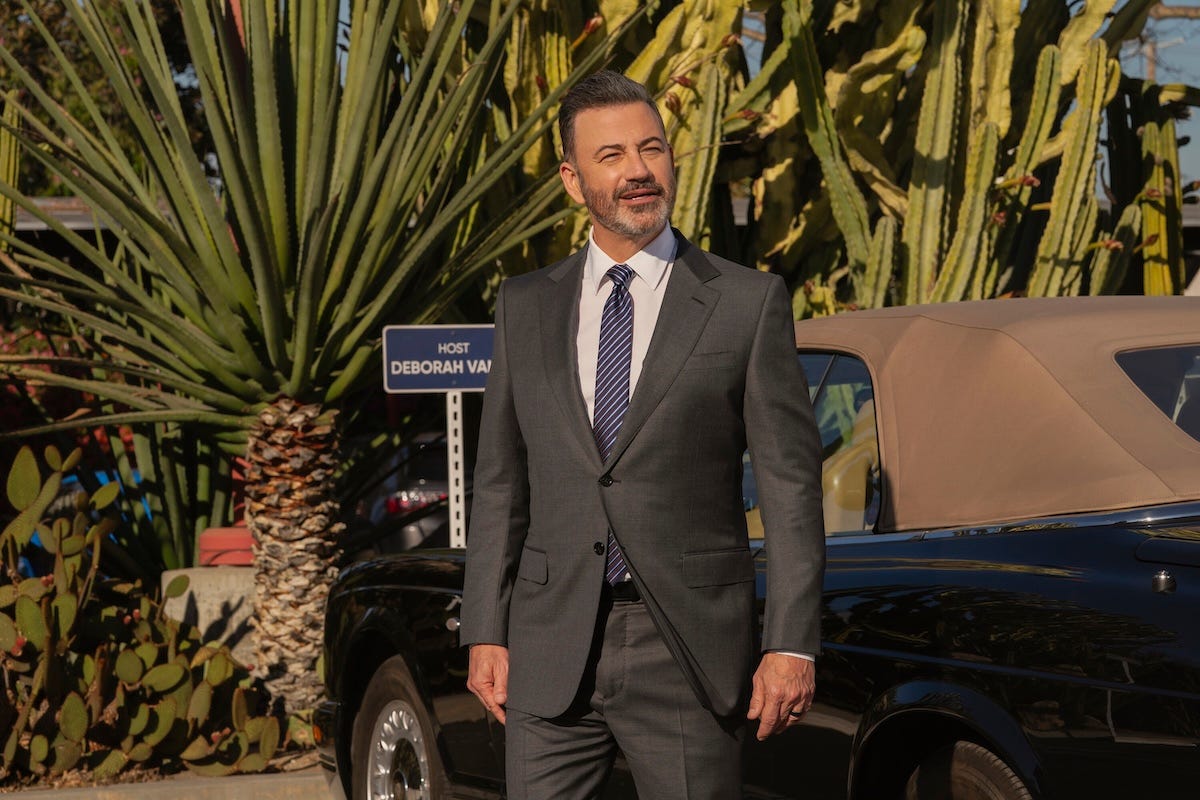
JVL covered the suspension of Jimmy Kimmel in an emergency Triad on Wednesday night; it’s excellent, and the only thing I’d add to it is that the Kimmel situation is a for-real version of the Colbert situation from earlier in the year, one in which federal regulatory authority was leveraged, out loud, in a way designed to assure compliance with the whims of the White House.
Today, I just want to highlight a passage from Neal Stephenson’s The Diamond Age. The plot of his novel, thirty years old this year, is too complex to summarize here; suffice to say it’s a near future in which artificial intelligence and nanotechnology fabricating equipment have radically upended the social order and forced the obsolescence of the nation-state, resulting in something more like corporate societies in which the citizens choose to live by the relatively strict ethical codes imposed by their “phyles” or be condemned to a second-class existence with the unincorporated “thetes.”
One of those societies is the Neo-Victorians; among their distinguishing characteristics is a commitment to standard ideas of morality. Lying is bad, promiscuity is frowned upon, etc. And their reversion to a stricter ideal of morality, we come to understand, is a result of hypocrisy being considered the only sin in an age of moral relativism.
“You see, in that sort of a climate, you are not allowed to criticize others—after all, if there is no absolute right and wrong, then what grounds is there for criticism?” asks a senior Neo-Victorian, rhetorically. “This led to a good deal of general frustration, for people are naturally censorious and love nothing better than to criticize others’ shortcomings. And so it was that they seized on hypocrisy and elevated it from a ubiquitous peccadillo into the monarch of all vices.”
This rather adroitly describes the last few decades of our own public life; as Gawker founder Nick Denton famously put it, “Hypocrisy is the only modern sin.” (That a Gawker comment ban plays a modest part in the recent unpleasantness is fudge icing on the shit cake we’re all eating.) As a result, the default retort to virtually every argument in public life at this point can be summarized in one deeply annoying portmanteau: “Whatabout?”
Which brings me back to Jimmy Kimmel, the suspension of whose show has inspired a particularly stupid brand of whatabouting. “Ah, but whatabout efforts to deplatform people from social media services?” (I wasn’t in favor of most of those—I preferred it when Twitter was the free-speech wing of the free-speech party—but that doesn’t have anything to do with the use of government power.) “Ah, but whatabout the White House sending Facebook things to censor during COVID? The Supreme Court ruled that was totally legal! The lib justices backed it up, lol, bet they regret that now!” (No, the Court ruled 6–3 there was no standing in that case and the conservative justice Amy Coney Barret wrote the decision; months earlier, the Court ruled 9–0 in NRA v. Vullo that “The First Amendment prohibits government officials from wielding their power selectively to punish or suppress speech, directly or . . . through private intermediaries.”) BUT WHATABOUT THE FAIRNESS DOCTRINE? (How old are you? That hasn’t been the law of the land for nearly four decades.)
Let us, however, grant that there has likely been some hypocrisy; we can’t all burn as brightly and as purely on this issue as FIRE, the Foundation for Individual Rights and Expression. But the hypocrisy of the past few years pales in comparison to the hypocrisy we’re seeing now. Like the hypocrisy of Trump lapdog Brendan Carr’s current attacks on the speech of broadcast networks, given his own prior words on the subject. Remember when JD Vance traveled overseas to lecture the Europeans about their own softness on free speech? “Our own government encouraged private companies to silence people. . . . Under Donald Trump’s leadership, we may disagree with your views, but we will fight to defend your right to offer it in the public square.” This was like seven months ago!
But here’s the truth, Ruth: No one actually cares about hypocrisy anymore. I mean, I care, though I’m human and have, thus, undoubtedly been guilty of the ubiquitous peccadillo on this subject at some point or another. You probably care, or at least like to think you care. But the endless scourge of whatabouting and the refusal to remain true to one’s own stated principles—indeed the open rejection of those principles, the sneering at anyone who would be foolish enough to think that the principles mattered—suggests we’ve entered a post-hypocrisy era. The only modern sin has been vanquished.
Theoretically, this could be a good thing. Following an acknowledgment of hypocritical ubiquity, we have a chance to return to first principles: What does freedom of speech mean; how should separation of powers work; how should the state balance social goals and individual liberties, etc. Let’s have a debate and hash it all out, folks! Wouldn’t that be nice? In practice, though, I think we all know precisely what it actually means: pure power politics in which the only thing that matters is having the will to destroy your enemy. And this is likely to be a fight no one winds up enjoying.
On The Bulwark Goes to Hollywood this week, I talked to Matt Roller about his new animated show, Haunted Hotel, which debuted on Netflix hours ago. We discussed some of his influences (he worked on Community and Rick and Morty, among other shows, to give you a sense of his background; I think Haunted Hotel hews a bit closer to the former than the latter), how Netflix judges what counts as a success (spoiler: one thumb up is worse than zero), and why he’s, gulp, reading all the comments. And we broke down the insanely long process of getting an animated show off the ground; from greenlight to debut, it took nearly two years, and that doesn’t count the decade or so he spent pitching it and selling it and reclaiming the rights when it got shelved.
Why 'Haunted Hotel' Is the Perfect Spooky Season Show

On this week’s episode, I’m joined by Matt Roller, the creator and showrunner of the new Netflix animated show Haunted Hotel. We discussed his background in television, how it helped prepare him for the long (shockingly long!) process of creating a full season of animated television, and why he is reading the comments. The show is live on Netflix now an…
Him review

Him is a patently ridiculous movie. It is over the top, ultra campy, hamstrung by a ludicrous religious metaphor, and edited like a TikToker was having a stroke while jabbing at effects buttons.
I kind of dug it?
Click here for the full review.
On Across the Movie Aisle this week, we discussed The Long Walk and Comedy Central’s decision to pull an episode of South Park from the rerun schedule.
The Degrading 'Long Walk'

On this week’s episode, Sonny Bunch, Alyssa Rosenberg, and Peter Suderman discuss Comedy Central’s decision to pull a recent South Park from the rerun rotation after the assassination of Charlie Kirk. Then they review The Long Walk, a movie that is either appropriately brutal or exploitatively violent. Which? Hard to say, …
And in the bonus episode, we discussed the infinitely adaptable Stephen King. So many Stephen King movies and TV shows! Such little time!
Stephen King, Infinitely Adaptable

On this week’s bonus episode of Across the Movie Aisle, we chose some of our favorite Stephen King adaptations in snake-draft format. There’s approximately seventeen million of them, so no risk of running out of good options here.
Assigned Viewing: All Is Lost (Prime Video)

Robert Redford passed away this week at the age of 89; toward the end of my obit, I mentioned an underseen 2013 film he made with J.C. Chandor called All Is Lost. It’s a minor miracle, a 100-some minute movie about a man on a boat slowly sinking in the middle of the ocean that features virtually no other actors, not even their voices, really. Just Redford, dominating the screen, reminding everyone why, even in his late seventies, he was still one of the most compelling people ever to grace the silver screen. If you’re planning a Redford tribute marathon this weekend, I hope you consider adding this to the lineup.
Sonny, Great writing. Well said. Our dear leader thinks he's the chosen one. Therefore he thinks he is without sin. On the other hand, his enablers who if they were blind would have no sin. But since they're going around telling everybody we see, their sin remains.
+1 for the Diamond Age reference about hypocrisy. I need to put that into my winter reread list.