The Rule of Law vs. The Rule of Trump
A crisis moment in the defining debate of our time.


It feels a little strange, leading off with house programming at a moment when Donald Trump is gearing up to march red-state National Guardsmen to blue cities across the country and judges’ houses are burning down. But, well, we are going to be at the Lincoln Theatre in D.C. this Wednesday, and we do hope you’ll come see us there. Let’s be together. Happy Monday.
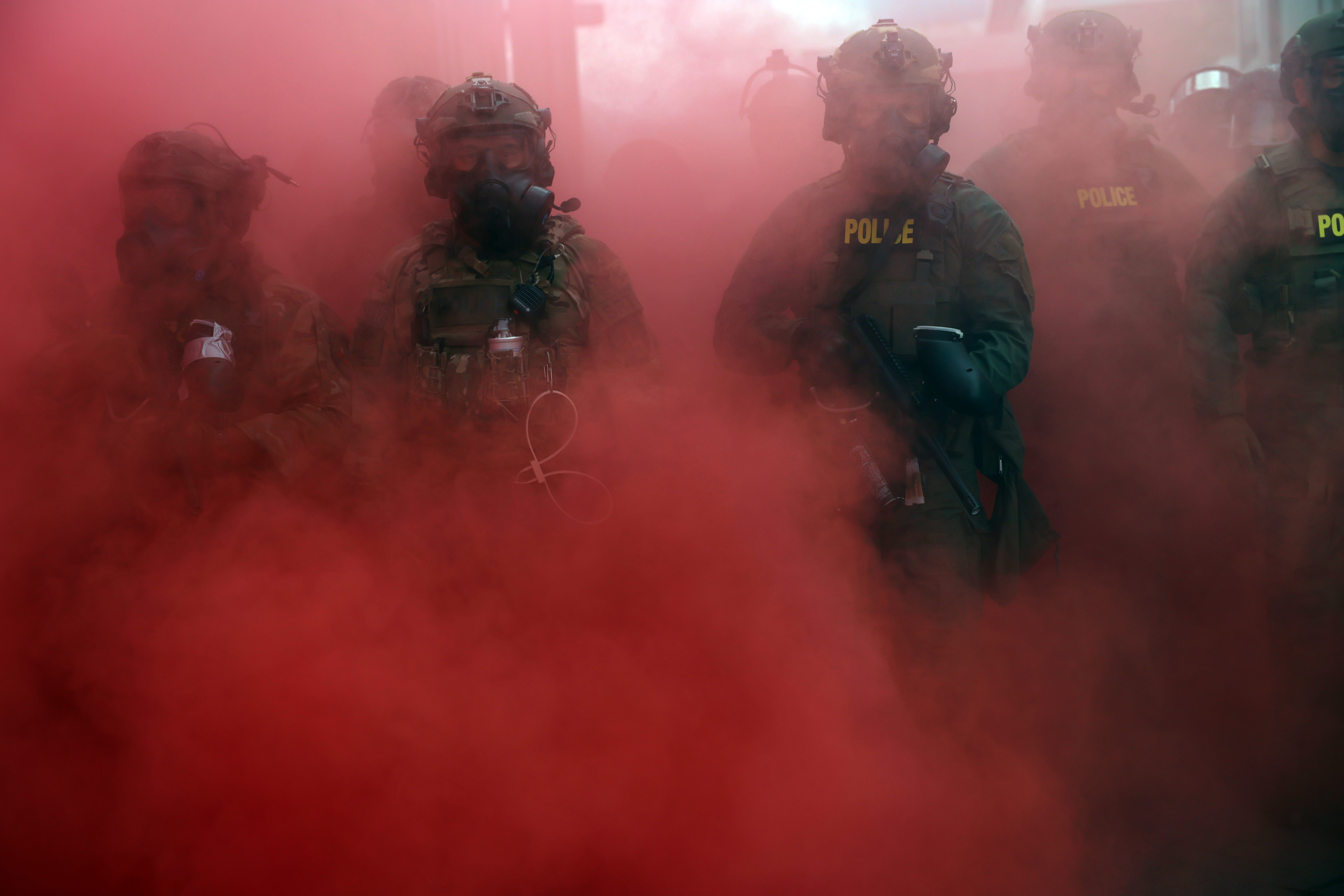
Trench Lawfare
by Andrew Egger
The most important battle in America right now isn’t taking place between Donald Trump and the Democrats in Washington, or between the administration’s military police and protesters in cities like Portland, Oregon. It’s the battle between two visions of what justifies state violence: between the rule of Trump and the rule of law.
The rule of law starts with the acknowledgment that both the armed agents of the state and the people they engage with are human beings. The agents themselves are humans, vulnerable to all the vices and temptations that beset those who wield power. And the people they come in contact with—criminals and noncriminals alike—are humans too, with rights they must respect. What differentiates the two is the laws that govern both: laws that permit certain specified persons to wield force on behalf of the state, but only in specified circumstances against persons engaged in specified behaviors. These laws authorize state violence, but they also restrain it.
The rule of Trump starts from a different place. Under this rule, the conflict between armed men of the state and the people they are deployed against is a conflict between angels and demons. Trump’s military police are heroic patriots by virtue of being in his military police. And the law need concern itself only with getting out of their way as they do what must be done. Meanwhile, the people who object to his will—whenever, wherever—are dangerous insurgents who must be rooted out.
Under the rule of law, the best-case scenario is one in which everyone follows the law and violent clashes between the state and its citizens are not necessary. Under the rule of Trump, the best-case scenario is darker and more nebulous. Ostensibly, it is state-enforced calm. But the absence of conflict is also inherently suspect: The Deep State is still plotting, the demons are still out there, the criminals are still getting away with it.
So Trump goes out of his way to start conflicts. He wildly exaggerates the horrors of daily life in blue cities. He sends the National Guard in a shock-and-awe show of force into those same places. In the protests and clashes that result, he tells them the only way they can err is by pulling their punches. You’ve got to teach these criminals, he says, the only way they understand. They spit, you hit.
And “criminals” are whoever Trump says they are. A left-wing activist brings an American flag to a protest and lights it on fire; a MAGA content creator snatches it away, and a scuffle breaks out. Under the law, it’s the latter who has erred—burning a flag you own is protected speech, and you can’t take someone else’s flag just because you think they’re mistreating it. But under the rule of Trump, it’s another matter. The content creator’s arrest for disorderly conduct sparks the immediate announcement of a civil rights investigation from Trump’s Justice Department, while the content creator jeers that Portland police “made a big freaking mistake.” That night, Trump reminds his troops to remember who the bad guys are and what punishment he believes they should receive: “To ICE, Border Patrol, Law Enforcement and all U.S. Military,” he writes on Truth Social. “Please be advised that, from this point forward, anybody burning the American Flag will be subject to one year in prison. You will be immediately arrested. Thank you for your attention to this matter!”
Trump can’t actually order flag-burners to prison, of course. But his real message doesn’t have anything to do with what happens after the arrest. It’s about signaling to cops which people they should consider acceptable targets as they dispense the on-the-ground violence of the state.
Right now, America is a country governed partially by the rule of law and partially by the rule of Trump. The two are in increasingly open conflict. This weekend, a judge issued a ruling blocking Trump from sending the Oregon National Guard into Portland, ruling there was no statutory justification to deploy federalized troops in the city. So Trump turned around and ordered the California National Guard in instead, prompting a hasty overnight action from the same judge—Karin Immergut, a Trump appointee—to block that, too. At the second hearing, Immergut’s anger with Justice Department lawyers was apparent: “My order was based on conditions in Portland, that there was no legal basis to bring [the] National Guard into Oregon,” she said. “You’re an officer of the court. Do you believe this is an appropriate way to deal with my order?”
Meanwhile, plans were being set in motion in other places to order red-state guardsmen from Texas into blue cities like Chicago—a development Illinois Gov. JB Pritzker denounced last night as “Trump’s invasion.”
And this may be just the first stage of it. Over the weekend, the Minnesota Star Tribune reported on leaked texts between top aides to Secretary of Defense Pete Hegseth and Stephen Miller discussing the possibility of sending the Army’s 82nd airborne division to Portland, which Trump apparently wanted, but which Hegseth was skittish about. “Between you and I, I think Pete just wants the top cover from the boss in case anything goes sideways with the troops there,” the Hegseth aide wrote. “82nd is like our top tier [quick reaction force] for abroad. So it will cause a lot of headlines.” The Hegseth aide made it clear Hegseth wasn’t opposed to the deployment—he just wanted Trump to order it publicly first. Meanwhile, if you take even a cursory glance at Miller’s Twitter feed, you can see him practically salivating over the prospects of this.
So what to make of this moment? It is foreboding, of course. And yet, Trump’s defiance of the spirit—but not the letter—of Judge Immergut’s order is a small consolation, evidence that while the rule of law may be under siege, it has not been defeated. The White House has already backed away from flirting with open defiance of the courts once this term, binning its plans to render migrants by the truckload to foreign prisons without due process when the political blowback became too great. That the same thing happens here is crucial. If Americans shrug at this latest defiance of the courts, they’ll conclude that the rule of Trump trumps the rule of law. We’ve all got to teach these criminals the only way they understand.
No Kings
by William Kristol
The Democrats are so far doing better than expected—probably better than they themselves expected—in the battle over the government shutdown. Their members are sticking together. They’re making their argument about health care pretty effectively. They seem to be winning the battle for public opinion.
So shouldn’t they just keep doing what they’re doing?
No.
Politics as usual may be working well enough for the Democrats in the moment. But politics as usual is no longer enough. We’re in a new situation, and Democratic leaders have to adjust accordingly. As Lincoln famously put it, “As our case is new, so we must think anew, and act anew.”
The character of the new situation we face is obvious. As Andrew suggests above, and as the legal scholar Ryan Goodman explained here yesterday, the Trump administration has taken its lawlessness and authoritarianism to a new level.
Its September 25 National Security Presidential Memorandum claimed national security justification for unleashing the federal government against “domestic terrorism,” defined to include dissent and opposition to the administration and its policies. President Trump’s remarks to senior military officers last Tuesday on September 30, promising to use the military against “the enemy from within,” further upped the ante. And then the administration’s actions over the last few days in Chicago and Portland, along with its attempts to override not just historical practices but court orders to deploy federal troops to Illinois and Oregon, made the administration’s agenda even clearer. Add in the continued use of the military against unarmed boats in the Caribbean without congressional authorization and without regard to U.S. law or the laws of war, and the Trump administration has crossed the Rubicon toward Caesarism.
We no longer face an administration whose primary sin is pursuing unwise and damaging healthcare policies. We are facing a clear and present authoritarian danger.
In these circumstances, can Democrats in Congress continue to take the position that their demand from the Trump administration is simply to restore health care funding?
I don’t think so.
Don’t Democrats need to say, in light of new circumstances, that they will not vote to fund an administration that’s trying to impose martial law at home and to start unauthorized and unjustified wars abroad? Don’t Democrats need to demand that provisions curbing the administration’s authoritarian moves—or at least provisions guaranteeing Congress votes on various aspects of the use of military force at home and abroad—need to be attached to legislation funding the government?
The Democratic party—or other groups, if the party isn’t up to it—should organize daily hearings and forums on the Trump administration’s attempted authoritarian takeover. They could start tomorrow with a forum (it can be virtual, we’re in the modern age) for governors Newsom, Pritzker, and Kotek to explain what’s happening. Then, each day, the party or associated groups can provide occasions for current officials, former judges, ex-senior Justice Department personnel and retired military and defense officials, to explain to the country the dangers of what Trump is doing. These forums should be bipartisan, including retired judges appointed by Republican presidents and officials from previous GOP administrations—and, for that matter, from Trump’s first term.
This effort could build to a crescendo by October 18, when national No Kings protests are planned. By then, members of Congress, governors and state officials, and former officials from both parties and a range of civic leaders could join millions of citizens to present a united front against the attempted usurpations of the Trump administration.
It’s fine for Democrats to continue to make the case for our health care. But they need also now to make the case for our Constitution, and for our republic, and our country.
AROUND THE BULWARK
Courts Keep Smacking Down Trump’s Lawless Attempt to End Birthright Citizenship… But he keeps plugging away—believing his allies on the Supreme Court will ultimately side with him, writes KIM WEHLE.
Can a Repentant, Regretful Republican Thrive as a Dem? Geoff Duncan isn’t just running for governor of Georgia as a Democrat. He’s testing how wide the party’s ‘big tent’ can stretch. LAUREN EGAN reports in The Opposition.
America’s Lawless Wars—From Chicago to Caracas… On The Bulwark on Sunday, BILL KRISTOL is joined by law professor RYAN GOODMAN to discuss the Trump Administration’s expanding use of “national security” at home and abroad.
And at Conversations with Bill Kristol… BILL is joined by JAMES CARVILLE to talk about politics today, 2026, and 2028.
Alliances With Dictators Never Last… On Shield of the Republic, AMB. ERIC EDELMAN welcomes historian TIM BOUVERIE, author of Allies at War: How the Struggles Between the Allied Powers Shaped the War and the World, to Shield of the Republic.
Illegal Immigrants Are Already Getting Health Care Under Donald Trump… The program financing ER care for illegal immigrants has been around for four decades, and not even Trump wants to take it away, writes JONATHAN COHN in The Breakdown.
Are We Really Headed for a Second Civil War? How to Fix It, JOHN AVLON talks with BARBARA F. WALTER, author of “How Civil Wars Start and How to Stop Them,” about the dangerous warning signs in America today.
Quick Hits
On Friday, National Review upended next month’s statewide elections in Virginia with a shocking report: Jay Jones, the Democratic nominee for attorney general, had sent text messages to a colleague joking about murdering Republican legislators.
“If those guys die before me I will go to their funerals to piss on their graves,” he texted back in 2022. “Send them out awash in something.” He went on to joke about then-House Speaker Todd Gilbert:
Three people, two bullets
Gilbert, hitler, and pol pot
Gilbert gets two bullets to the head
Spoiler: put Gilbert in the crew with the two worst people you know and he receives both bullets every time
“Jay please stop,” his correspondent—a Republican state lawmaker—wrote back. “It really bothers me when you talk about hurting people or wishing death on them.” In another exchange, the GOP lawmaker fretted about a past conversation in which Jones had wished death on Gilbert’s children. “Yes, I’ve told you this before,” Jones responded. “Only when people feel pain personally do they move on policy.” He added: “I mean do I think Todd and Jennifer [Gilbert] are evil? And that they’re breeding little fascists? Yes.”
It beggars belief that any politician would think their latest bid for elected office might survive the revelation of such texts, but Jones initially brushed the story off. “Like all people, I’ve sent text messages that I regret and I believe that violent rhetoric has no place in our politics,” he said in a statement, before immediately pivoting to attacking his opponent for “dropping smears through Trump-controlled media organizations.” Later on Friday, as the story grew, Jones seemed to realize that wasn’t going to cut it. “I want to issue my deepest apology to Speaker Gilbert and his family,” he wrote in a follow-up statement. “Reading back those words made me sick to my stomach. I am embarrassed, ashamed, and sorry.”
Stopping the rapid march of Trumpian authoritarianism is a pretty important project. You might hope Democrats could rustle up some non-maniacs to take up that fight.
NO MOTION YET: Congressional negotiators appear dug in for a shutdown long haul, per the New York Times:
In the House, Speaker Mike Johnson has canceled votes for this week, telling his members they could stay home for the third straight week given the shutdown logjam. . . .
Republicans who hold a governing trifecta have adopted a mostly passive posture in the shutdown fight, insisting that Democrats accept their short-term government funding bill without concessions.
Staring down the shutdown deadline, they did not even bother engaging in the typical political theater that often precedes such time-crunch crises on Capitol Hill. In shutdown showdowns past, lawmakers worked late into the evening or the early hours of the morning to at least appear as if they were doing everything possible to head off disaster. This time around, Mr. Thune did not keep the Senate in session much past the dinner hour last Tuesday after a pair of failed votes made it clear that Congress would surely miss the midnight deadline for funding the government.
It’s hard to fault Republicans for being eternal shutdown–curious. After all, every day Congress takes off is one more day Mike Johnson doesn’t have to worry about a vote being forced on releasing the Epstein files. Appearing on Meet the Press Sunday, Johnson called that idea that he was trying to stall on that vote a red herring. Then again, during that same interview, he also claimed Washington D.C. was a “literal war zone” prior to Trump’s national guard intervention.
THE REALITY-DISTORTION FIELD GROWS: Ben Smith of Semafor has an insightful read on one of the big differences between Donald Trump’s brain in Term One and Term Two. His personal information bubble has grown thicker and more distortionary than ever:
Now the president scrolls the adulatory Truth Social rather than the more diverse X; watches a Fox News that is comfortably pro-Trump as well as new MAGA channels; and gets much of his view of the world from a better-oiled operation that’s fronted by an aide with an iPad and printed summaries.
The effects of his filtered, partial view of the landscape are becoming clear across the spectrum. The New York Times reported last week that Trump was “blindsided” when New York’s governor told him the administration had cut spending on law enforcement; the move was quickly reversed. Allies on the right campaigning for a federal crackdown in Portland were disturbed when Trump said he’d told Oregon’s governor in late September, “Am I watching things on television that are different from what’s happening? My people tell me different.”
US business leaders also worry that Trump is not getting accurate and unmediated economic information beyond stock market figures. The Wall Street Journal reported Sunday that Trump’s advisers, “rather than dwell on shaky economic data, have painted a rosy outlook.”
Last time around, Trump always had at least a few people around him who were willing to tell him inconvenient facts he might not want to hear. Now he’s got Truth Social to scroll and Natalie Harp, the “human printer,” to feed him a constant stream of flattering posts. No wonder he’s further out to pasture than ever.
Cheap Shots

It's a rare day when Morning Shots has me so bummed out that I'm looking forward to JVL's Triad for a pick-me-up.
Between Donald Trump's utter lawlessness and initial polling suggesting that slightly more people are blaming Republicans than Democrats on the shutdown...I'm with Bill. Point out the lawlessness and keep things shut down. There's really nothing that Democrats gain from opening up the government without any sorts of concessions, so why bother?