


One great Minneapolis show down, one to go. Bill and the gang had a great time meeting folks in Minnesota last night; Andrew stewed sadly in his FOMO back east. See another chunk of you out there tonight. Happy Thursday.
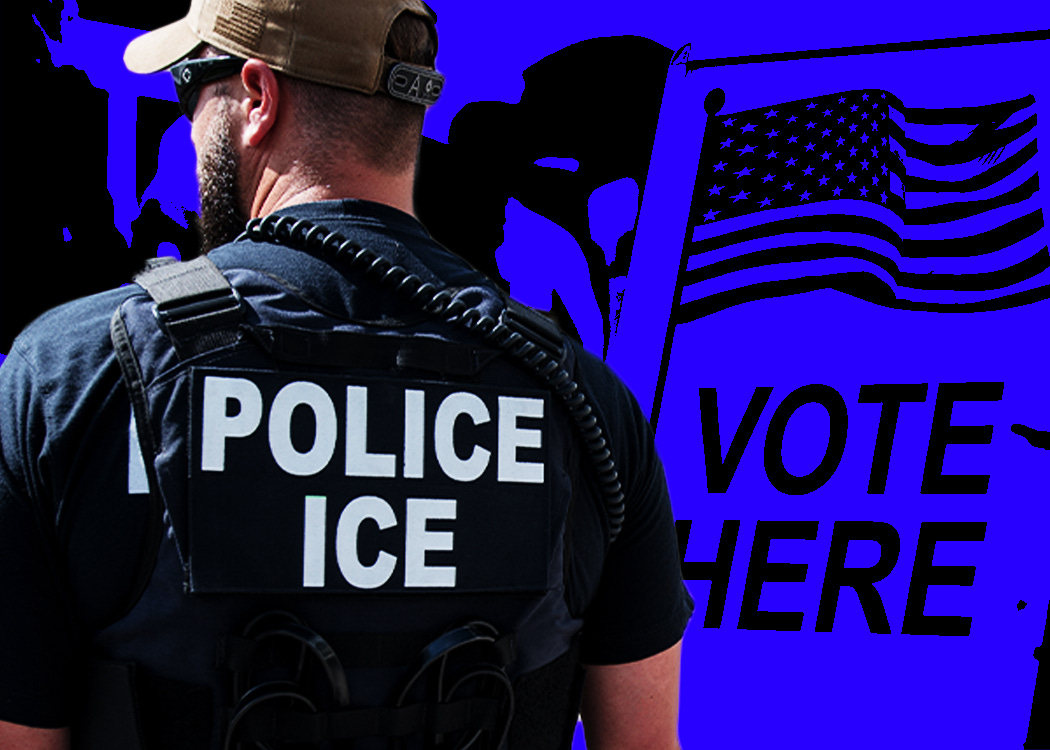
Don’t Call It Intimidation
by Andrew Egger
In 2022, Democrat Katie Hobbs beat Republican Kari Lake in the race for Arizona governor. As a result, Arizonans will not have to walk past ICE agents posted at polling stations to vote in this year’s midterm elections.
Maybe that overstates things a hair. Let’s back up.
This week, two Republican Arizona state senators, Jake Hoffman and Wendy Rogers, introduced legislation that would require county election officials to coordinate with “a federal immigration law enforcement agency” to ensure “a federal immigration law enforcement presence at each location within this state where ballots are cast and deposited.”
In simpler terms: inviting ICE to the polls. The legislation is scheduled to be heard tomorrow in the Senate Judiciary and Elections Committee, which Rogers chairs.
“Arizonans deserve to know that election laws are not just written in statute but actually enforced in practice,” Hoffman said in a statement. “For too long, confusion, inconsistency, and a lack of visible accountability have fueled doubts about how elections are administered. . . . The intent is to deter violations before they happen, ensure existing laws are followed, and protect the rights of every lawful voter.”
Hoffman and Rogers have claimed that their proposal would not interfere with legal voting since it would not allow ICE “to question, detain, or arrest a voter solely for the purpose of determining voter eligibility, except as otherwise allowed under state or federal law.” Because if there’s one law enforcement body with a great track record of refraining from pretextual stops over things like skin color and accent, it’s ICE.
If the goal is just to get more law-enforcement eyeballs on voting precincts, why tap in immigration enforcement in particular? I emailed Hoffman and Rogers yesterday to ask this; neither responded.
Not all state Republicans are thrilled by the proposal. “This is no doubt an attempt at pure intimidation of the Latino voting community,” Arizona GOP strategist Barrett Marson told The Bulwark, adding sarcastically: “From a political standpoint, nothing says ‘We are trying to attract more Latinos into voting for Republicans’ like showing how we can suppress the Latino vote.”
And at least one GOP statewide candidate, secretary of state hopeful Gina Swoboda, has forcefully denounced it: “When the Black Panthers stationed outside Philly polling places the GOP objected—some voters may have felt intimidated,” she said in a statement, referring to an incident during the 2008 general election. “This is no different. The SECOND a voter hesitates to enter a polling place because they are afraid, they have been, by definition, intimidated. That is WRONG.”
Maybe Hoffman’s and Rogers’s proposal will go down in committee tomorrow. Or maybe, like dozens of other election bills over the past few years, it will sail through the GOP-controlled Arizona legislature before running into the brick wall that is Gov. Hobbs’s veto pen.
But even the notion of inviting ICE to the polls is a grim reminder of just how thoroughly Donald Trump’s election-stealing ethos has contaminated the groundwater of state-level GOP politics. Both Hoffman and Rogers are emblematic of the wave of MAGA zealots who hold a growing presence in Arizona and other states around the country. Hoffman, a former Turning Point USA staffer, was indicted for serving as a fake Trump elector in the aftermath of the 2020 election. Rogers built a national reputation in 2020 as one of the loudest proponents of the idea that Arizona’s election had been stolen from Trump and a driving force behind the endless GOP efforts to audit and re-audit the results. For her pains, she now sits atop a key state legislative committee for election-related matters.
One other thing is odd about Hoffman’s and Rogers’s proposal. Rumors have swirled this week in Arizona that the bill could be an early hint at the White House’s midterms strategy—after all, what would be the point of a law ordering county officials to coordinate with ICE for polling-place surveillance if you had no reason to believe ICE would cooperate?
Earlier this month, the White House pushed back on this possibility. “That’s not something I’ve ever heard the president consider,” Press Secretary Karoline Leavitt told reporters on February 5. “I can’t guarantee that an ICE agent won’t be around a polling location in November—I mean, that’s frankly a very silly hypothetical question—but what I can tell you is I haven’t heard the president discuss any formal plans to put ICE outside of polling locations.”
Still, one thing’s for sure: Trump’s got election administration on the mind lately. In recent days, he’s been posting a blizzard of pudding-brained election-conspiracy content to Truth Social, including claims that “in the 2020 election, states using Dominion voting machines allegedly switched 435,000 votes from Trump to Biden and deleted 2.7 MILLION Trump votes, including 1 MILLION in Pennsylvania alone.” (You might recall that the right-wing media outlets that did the alleging have been forced to pay Dominion hundreds of millions of dollars in damages, on account of the fact that the allegations were lies; somehow we doubt that the president will be getting into similar legal trouble.)
And he’s got something cooking. “The Democrats refuse to vote for Voter I.D., or Citizenship,” he posted last week. “They want to continue to cheat in Elections. This was not what our Founders desired. I have searched the depths of Legal Arguments not yet articulated or vetted on this subject, and will be presenting an irrefutable one in the very near future. There will be Voter I.D. for the Midterm Elections, whether approved by Congress or not!”
There are ways to respond to ICE at the polls: governors’ vetoes, lawsuits, voter escorts. But what do you do about the crazy that generates such an idea in the first place?
Really, tell us.
RFK Jr.’s Prescription for Chaos
by Jonathan Cohn
Robert F. Kennedy Jr.’s team appears to have backed off a controversial decision to block a new flu shot from the vaccine maker Moderna. But there’s already been real damage to the future of medical innovation, and there may be more to come.
A quick review: Moderna, which became famous during the COVID pandemic as one of the companies producing breakthrough mRNA vaccines, has been working on a vaccine to combat seasonal flu. It’s a big deal because the flu kills tens of thousands of Americans every year and puts ten times that number in the hospital. And while existing vaccines do a nice job of reducing disease severity, mRNA vaccines could prove more effective—or, at least, easier and more reliable to produce.
Moderna spent years developing this new shot, investing (by its account) more than a billion dollars. Along the way, the company consulted with the Food and Drug Administration over what kind of testing was necessary. After some back and forth, Moderna proceeded with testing that the FDA had said would be “acceptable” and submitted the shot for review—only to have the FDA say last week that, actually, the testing wasn’t good enough, and so it wouldn’t consider the application at all.
The FDA refusing to take an application is rare; doing so at the last minute is pretty much unprecedented. And as it turns out, it wasn’t what senior career scientists had wanted. The decision was at the behest of Vinay Prasad, head of the FDA’s vaccines and biologics division, who came to office pledging much tougher scrutiny of vaccines.
But the decision sparked outrage among pharmaceutical industry leaders, scientists, and consumer advocates, who warned that drug development is a long, inherently risky process, and that without clear, predictable standards for approval, investors won’t put up the money necessary to drive future innovation.
Either that argument or the optics of the decision evidently got the attention of the White House, which according to reporting (first by the Wall Street Journal) met with FDA officials to express Trump’s displeasure. And now the FDA has said it will consider the application after all, with Moderna agreeing to make one modest modification to address the concern Prasad identified.
That small concession smelled like a way to let Prasad save some face. The end result is more or less where the process would have ended up if the FDA had simply agreed to accept the application without the drama. But memories of this mess and its arbitrariness are sure to linger, because it’s not the only time vaccination has come under attack from Kennedy and lieutenants. There were the hundreds of millions of dollars in support for mRNA research that Kennedy pulled, and then the decision to eliminate several vaccines from the list of official recommendations for children. Moves like these have made quite the impression.
“I’m not saying that the vaccine market today is uninvestable,” Craig Garthwaite, a prominent Northwestern University economist who studies drug development, told me Wednesday. “But it’s getting to the point where you’re starting to see people ask real questions of whether this is a place we even want to try and allocate our resources.”
Making things worse is the organizational chaos at HHS, thanks to mass layoffs going back to DOGE and a purging of veteran leadership by Kennedy. The senior ranks of HHS agencies are full of vacancies and officials serving in temporary, acting capacities due to a lack of permanent appointees. All of this hinders day-to-day operations. It also fosters disarray—like, for example, directors making baffling, seemingly impulsive decisions that would never have survived a more orderly process with input from more seasoned hands.
The agency now appears to be undergoing a major shakeup, supposedly to put more grownups in charge, and one result is that Trump has now asked health economist and physician Jay Bhattacharya to serve as acting director of the Centers for Disease Control and Prevention. That sounds like a step toward normality, and by the standards of Kennedy’s HHS it might be. (The current acting CDC director has no formal medical training.) But Bhattacharya is already director of the National Institutes of Health—a demanding full-time job in its own right, and one he evidently is not leaving. The plan is for him to oversee both agencies, at least for the time being. Maybe Marco Rubio can give him some pointers.
AROUND THE BULWARK
A Cautionary Note to Fellow Dems From an AIPAC Target… How big-money super PACs are warping Democratic politics—and how to fix it, by former Rep. TOM MALINOWSKI.
The Predictable, Ineluctable, Intractable ‘Electability’ Argument… And how much does social media savvy matter? In The Opposition, LAUREN EGAN reports on the word dividing Democrats.
Trump Is Launching a Stealth Attack on Obamacare… The administration’s new solution to affordability sounds great—until you get sick, writes JONATHAN COHN in The Breakdown.
Quick Hits
TRUMP VS. NUMBERS: Last week, the Federal Reserve Bank of New York published a paper confirming what everyone already knows: Nearly 90 percent of the economic burden from Trump’s cornucopia of tariffs last year fell on U.S. companies and consumers. The paper didn’t make much of a splash, perhaps because it’s not that shocking to be told what you already know everyone already knows.
The Trump administration, however, doesn’t know what everyone knows. It’s one of Donald Trump’s few actual core beliefs—nearly, for him, a tenet of theology—that foreigners pay the costs of U.S. tariffs. And so when the president’s top economic adviser, Kevin Hassett, was asked in a CNBC interview yesterday to weigh in on the New York Fed paper, there weren’t many reasonable responses available to him. Ultimately, he picked perhaps the least reasonable one of the bunch.
“I mean, the paper is an embarrassment,” Hassett said. “It’s, I think, the worst paper I’ve ever seen in the history of the Federal Reserve system. The people associated with this paper should presumably be disciplined.” It isn’t enough, apparently, to be totally unmoored from economic realities; the White House must make sinister gestures toward the purveyors of economic information, as well.
Hear and understand, number-men! The president isn’t so pleased with the numbers you’ve been turning out. You’d better make the numbers go better next time if you know what’s good for you.
SLOPULISM, INC.: More and more these days, it seems like the regular old English dictionary fails us. For instance: What to name this bizarre new integration of power and social-media froth, this world in which Nick Shirley goes to Minneapolis to cut a video about alleged Somali fraud and an ICE occupation comes hot on his heels? Happily, the broken-brained denizens of the internet are hard at work churning out grim new vocab words to meet our moment. It’s called “slopulism,” and the New York Times has the details:
“Slopulism works by harnessing the excitement and vibe of a moment,” said Neema Parvini, a senior fellow at the University of Buckingham in England who is considered to have popularized the term. He believes it’s a way for populist leaders, like Mr. Trump, to keep their bases content.
“It convinces supporters to invest their emotions in story lines rather than the substantive politics or structure behind it,” he said. “It doesn’t lead anywhere, it’s just entertainment.”
Not to cross the expert, but we’re not sure it’s true that this slopulism doesn’t lead anywhere. After all, many of MAGA’s most important decisionmakers seem just as addicted to their own slop as their most devoted supporters are. Minneapolis is the model here: Shirley went there because the Somali-fraud story was getting big on the right, but his video so magnified the story and the right-wing rage over it that the feds decided they’d better swoop in. A whole federal government, high on its own slopulist supply.
Cheap Shots

Why is the quote from Dave Levitan a "cheap shot?" It seems wholly accurate and shameful, while not being at all funny or ironic, that the British monarchy has become more accountable than your average American billionaire. Or elected president. Seems more like a headline to me.
To dwell on the cheap shot for a moment. The Guardian is reporting King Charles was not given prior notice before his brother was arrested and apparently came as a surprise. Nevertheless the Mount-Batten family, King and Prince of Wales, have backed the investigation in their public statements. Now let’s contrast that to where our would be secret police killed two people on the streets of Minneapolis and the government apparently will not investigate nor turn over evidence to the state. The British just arrested the King’s brother, late in the story, for questioning while we won’t investigate the killing of our own citizens. What a way to celebrate 250 years of freedom.