


Who’s next?
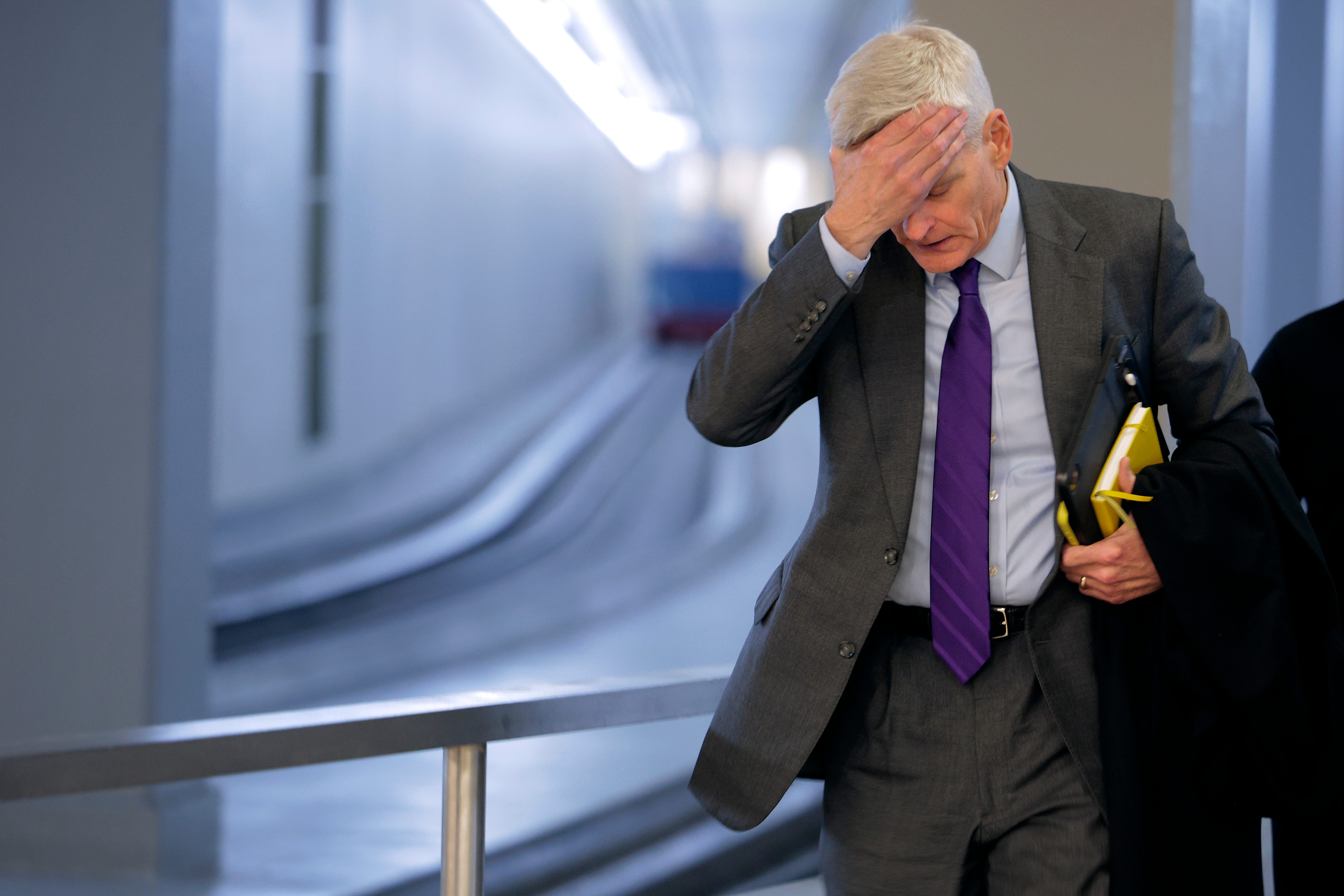
Republican elected officials, GOP operatives and staffers, military officers, and White House chiefs of staff seem to never learn that when they hand over their trust and loyalty to Trump, they can’t count on the president repaying it in kind. Louisiana Sen. Bill Cassidy is the latest to realize this only after the president’s knife has been embedded firmly in his back.
It’s not as though Cassidy didn’t put in the work. The senator voted to confirm the president’s most deranged cabinet nominations, backed his signature piece of legislation, posted fawning messages about him online and introduced a resolution nominating him for the Nobel Peace Prize. Cassidy also took the lead on an attempt to pass a major health care reform on Trump’s behalf, but it failed.1
Cassidy even swallowed his pride when Robert F. Kennedy Jr., Trump’s anti-vaccine HHS secretary, began reneging on commitments he’d made in exchange for Cassidy’s vote for confirmation.
But in the end, it wasn’t enough, because Cassidy made a crucial mistake. He voted to convict Trump for insurrection in the January 6th impeachment trial. And once he did that, it became clear that he was never going to get free of the president’s bad side.
There were ways in which he could have tried a bit more cravenly to do just that. Unlike Vice President JD Vance, who transitioned with ease from musing that Trump might be “America’s Hitler” to offering “America’s Hitler” his unequivocal support, Cassidy remained semi-critical of the administration on issues he cares about: He is not a fan, for instance, of some of Kennedy’s behavior and a number of the Trump administration’s changes to national health policy. These criticisms did not develop into actual pushback on policy, of course; they were just statements of disapproval. But they surely reminded the president that this was a senator who could, on occasion, go wobbly.
On Saturday night, Trump operationalized his grudge by endorsing Rep. Julia Letlow (R-La.) to jump into the Republican primary to unseat Cassidy.
“Should she decide to enter this Race, Julia Letlow has my Complete and Total Endorsement,” Trump wrote on Truth Social. “RUN, JULIA, RUN!!!”
Cassidy responded by offering just the sort of boring, diplomatic remarks that you would expect to hear from someone who is unwilling to put up a fight.
“I’m proudly running for re-election as a principled conservative who gets things done for the people of Louisiana,” Cassidy told Jake Tapper. “I am confident I will win if Congresswoman Letlow decides to run.”
Letlow officially jumped in Tuesday morning. She gave Cassidy a courtesy call in advance. He also was in attendance when she announced her bid.
Cassidy had reportedly been telling his colleagues that he received assurances from White House staffers that Trump would remain neutral in the race, as he has done so far in the Texas GOP Senate primary between incumbent John Cornyn,2 Texas Attorney General Ken Paxton, and Rep. Wesley Hunt.
Senate Majority Leader John Thune even reportedly begged Trump to not endorse Letlow and to instead allow Cassidy, with whom Thune recently campaigned, to run for re-election without the president’s finger on the scales.
But Trump couldn’t resist. And Cassidy now finds himself stuck in a race that looks nearly impossible to win. Although it is not completely unheard of for Republican voters to ignore Trump’s interventions and elevate seasoned politicians over MAGA upstarts in GOP primaries, it certainly is rare. Cassidy’s primary election is May 16, and a runoff in the event no candidate clears more than 50 percent of the vote would occur June 27.
When Trump decides he wants to wade into a Republican primary, it is awfully difficult for more level-headed people in his party to stop him. Cassidy will probably become the latest victim of this swamp monster of presidential resentment, but he certainly won’t be the last. Even so, most Republicans behave as if it could never happen to them.
A more critical Senate race than Cassidy’s is taking place later this year in Maine, where Susan Collins is seeking a sixth consecutive term. Trump called Collins to profanely lambast her after she backed a war powers resolution that would limit his hand in Venezuela. He immediately followed up on the call with a Truth Social post saying she and the several other Republicans who voted in favor of the resolution “should never be elected to office again.”
Like Cassidy, Collins also voted to convict Trump in 2021. He might decide a Senate majority is not as appealing as carrying out a personal vendetta against those Republicans he believes betrayed him. He might decide it’s better, in the end, to leave Maine alone. No matter what, by endorsing Letlow over Cassidy, Trump has made clear that he is still as impulsive and unreliable as ever when it comes to defending his party’s incumbents.
Shaved ICE
Like the Christmas episodes of HBO’s Industry, government funding episodes are an insane congressional tradition that is only growing more insane with each new iteration. Government funding is set to expire once again in just ten days, and as I reported last week, reforming or even dramatically reining in ICE and Homeland Security is probably not going to be a Democratic priority. But that doesn’t mean Republicans are unwilling to make any concessions on immigration policy.
A bipartisan package from House lawmakers does curb ICE’s enforcement and removal operations budget by $115 million (the agency received $75 billion in Trump’s reconciliation bill last year), but it keeps the agency’s overall budget the same. As House Democrats on the Appropriations Committee have pointed out, the bill would also slash ICE detention beds by 5,500 and cut U.S. Border Patrol funding by $1.8 billion.
In a statement, Rep. Rosa DeLauro (D-Conn.), the ranking Democrat on the committee, said, “I understand that many of my Democratic colleagues may be dissatisfied with any bill that funds ICE. I share their frustration with the out-of-control agency.”
“The Homeland Security funding bill is more than just ICE,” she continued. “If we allow a lapse in funding, TSA agents will be forced to work without pay, FEMA assistance could be delayed, and the U.S. Coast Guard will be adversely affected. All while ICE continues functioning without any change in their operations due to $75 billion it received in the One Big Beautiful Bill. A continuing resolution will jettison the guardrails we have secured while ceding authority to President Trump, Stephen Miller, and Secretary Noem.”
Other Democrats are mulling various proposals to put limits of some kind on ICE through bills that could potentially be attached to any final funding package that addresses the DHS budget.
These include bills that would restrict ICE’s ability to detain and deport U.S. citizens, increase and improve oversight of DHS, and mandate proper identification for ICE officers, whose status quo involves masks, fatigues, and excessive force.
Reaching critical Mass
Last July, I made the case that the Trump administration’s increasing hostility toward one of the Catholic Church’s most important demographics could be putting the MAGA movement and the Church on a collision course. We might be seeing the beginning of that collision.
Much of the Church’s opposition to Trump has centered on his brutal immigration policies. But in recent days, abortion, an issue where conservatives have traditionally given Trump a lot of credit, has become a sour topic for many of the administration’s Catholic observers and critics. In the post-Dobbs decision era, abortions have actually increased in the United States, according to data from the Society of Family Planning, a pro–abortion access group.
That’s not all. Trump has also been at odds with the Church over his lust for military conflicts and disruptions of the global order. In a rare joint statement Monday, three cardinals, each close with Pope Leo XIV, wrote the following:
In 2026, the United States has entered into the most profound and searing debate about the moral foundation for America’s actions in the world since the end of the Cold War. The events in Venezuela, Ukraine and Greenland have raised basic questions about the use of military force and the meaning of peace. The sovereign rights of nations to self-determination appear all too fragile in a world of ever greater conflagrations. The balancing of national interest with the common good is being framed within starkly polarized terms. Our country’s moral role in confronting evil around the world, sustaining the right to life and human dignity, and supporting religious liberty are all under examination. And the building of just and sustainable peace, so crucial to humanity’s well-being now and in the future, is being reduced to partisan categories that encourage polarization and destructive policies.
Cardinals Blase Cupich of Chicago, Robert McElroy of Washington, D.C., and Joseph Tobin of Newark all signed the statement. It arrives on the heels of the current U.S. ambassador to the Holy See offering a bad misrepresentation of Pope Leo’s remarks on foreign intervention.
This was not all Cassidy’s fault, of course. Republicans have not been able to accomplish anything on the health care front for years and years.
Another senator constantly debasing himself and betraying previously held principles in the hopes of eking out another statewide victory. Cornyn could easily find himself in a situation like Cassidy. The primary election is March 3.
Bill Cassidy went against his principles and we got RFK Jr. What RFK Jr has done is reprehensible and cruel. Ergo, Bill Cassidy is reaping what he so selfishly and callously sowed.
I simply do not understand how the Republican Senators can be so blind to Trump’s basic nature. He has told them over and over who he is, why don’t they believe him?