Trump > Vance
The president’s not-so-subtle rebuke of his VP places him on the right side of a distinctly American issue.


Things moved pretty fast this weekend. In yesterday’s Bulwark On Sunday show, Bill and Eric Edelman broke down President Trump’s strike on Iran, its likely effects, and the undeniable professionalism with which the operation seems to have been carried out. Meanwhile, Sam Stein interviewed Democratic Rep. Jim Himes on the administration’s decision to keep Congress largely out of the loop on the attacks. Happy Monday.
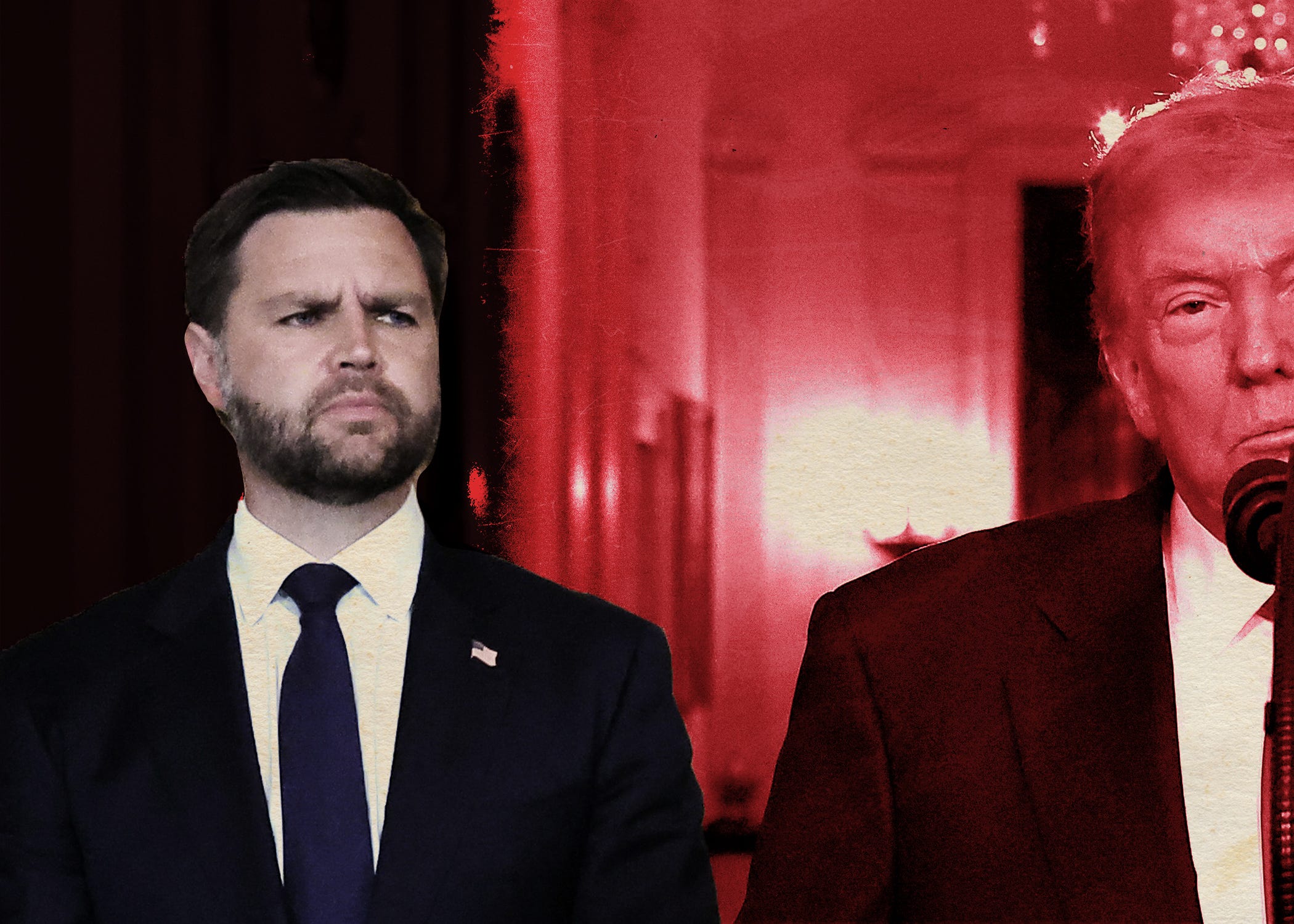
Regime Change Can Be a Good Thing!
by William Kristol
I want to say a few words today about the Declaration of Independence. But first—if it’s not too head-spinning a pivot—I want to tell you how I imagine Donald Trump’s day went yesterday.
Trump wakes up and feels good—as, to be fair, he should—about Saturday night’s military operation in Iran.
He watches the DOD press conference at 8:00 a.m., and he feels good—as, to be fair, he should—about the evident professionalism of his pick for chairman of the Joint Chiefs of Staff, Gen. Dan Caine. Hegseth’s not too bad.
He watches the shows, too. Marco stumbles through. Vance is more adept.
But something Vance says strikes Trump the wrong way. Something about regime change. He has an aide play clips from that morning. Hegseth: “This mission was not and has not been about regime change.” Marco: “This wasn’t a regime-change move.”
Fine.
But JD was a little different. “Our view has been very clear that we don’t want a regime change.”
“We don’t want a regime change”? That, Trump thinks, is kind of weird. Trump knows that JD really hates the neocons. Trump’s no fan either. But still. Those ayatollahs are very bad guys. They’ve killed Americans. And they have been terrible for Iran. Trump knows people who fled Iran in 1979. It was a lot better back then.
Now Trump recognizes that the main purpose of what he did on Saturday wasn’t regime change, and that it’s right to say that. But “we don’t want a regime change”? That was stupid, closed-minded even. Maybe Vance doesn’t want a regime change. But, Trump thinks, as long as we don’t have to put boots on the ground, he’d kind of like to see it happen. And, he believes, the American people would too.
And so Trump spends a bit of time composing the post he launches on Truth Social at 4:55 p.m.:
It’s not politically correct to use the term, “Regime Change,” but if the current Iranian Regime is unable to MAKE IRAN GREAT AGAIN, why wouldn’t there be a Regime change??? MIGA!!
Pretty clever, Trump thinks to himself. He attacks Tucker and his buddies for being “politically correct,” which MAGA hates. He puts Vance in his place. He says something that’s pretty much common sense. And he stirs things up in a way that keeps him on center stage.
And now, if we can somehow pivot out of Trump’s mind and towards the American tradition: It’s worth noting that Trump is basically right.
After all, what will we be celebrating on July 4, 2026?
The 250th anniversary of our declaration of independence.
What led to our independence? What, to use the language of the Declaration, were “the causes which impel the [colonies] to the separation” from Great Britain? What was “the necessity which constrains them to alter their former systems of government”?
The increasingly despotic character of the British regime.
So while the Declaration of Independence is a document of independence for the American people, it’s also a document that argues for the larger principle of freedom from tyrannical governance: “Whenever any form of government becomes destructive of these ends, it is the right of the people to alter or to abolish it.”
Now prudence gets to put in a word of caution here: “Prudence, indeed, will dictate that governments long established should not be changed for light and transient causes,” the Declaration reads. But when “a long train of abuses and usurpations . . . evinces a design to reduce [the people] under absolute despotism, it is their right, it is their duty to throw off such government, and to provide new guards for their future security.”
So, in short: The Declaration isn’t just a document memorializing the divorce from Great Britain; it also points forward. It lays out the outline of the new marriage contract to come. That’s why Lincoln was able to say, speaking at Independence Hall on February 22, 1861, that it was the principles of the Declaration that had helped keep the new nation together: “It was not the mere matter of the separation of the colonies from the mother land; but that sentiment in the Declaration of Independence which gave liberty, not alone to the people of this country, but I hope to the world for all future time.”
Prudence, of course, suggests caution and care in acting to help others in achieving liberty. Making sure we in America sustain liberty here and live up to our own principles comes first.
But it’s also the case that some of the proudest moments of American history are when we did act to help free others. It’s why D-Day means so much to us. And it’s also a fact that some of our greatest achievements at home, like the victories of the civil rights movement in the 1950s and 1960s, coincided with a period when we claimed to be standing for universal principles of liberty abroad. Liberty does better here when we don’t deprecate its importance elsewhere. And it does better abroad when we live up to its principles at home.
Who knows why Trump seems to have been recoiled from Vance’s “we don’t want a regime change” line. That moment of attachment by Trump to American principles was likely just that, one fleeting moment.
But it’s nice to think that he has some lingering sense of what America really means—that for one brief moment Trump was able to glimpse what American greatness really consists of.
Four Lingering Questions
by Andrew Egger
As the dust settles from America’s weekend attacks on Iran, there are more than a few major, lingering questions. Here are four that are top of mind.
1. Where’s the uranium?
When Donald Trump first announced Saturday night that Iran’s nuclear program had been “completely and totally obliterated,” it sounded like a claim that America had destroyed both Iran’s existing enriched uranium stockpile and the facilities necessary to make more. But officials later confirmed intelligence and press reports that Iran had likely moved its most enriched uranium offsite before the attacks on Fordo and other locations. That uranium, according to the International Atomic Energy Agency, is enough to eventually construct about 10 nuclear weapons.
“We are going to work in the coming weeks to ensure that we do something with that fuel, and that’s one of the things that we’re going to have conversations with the Iranians about,” Vice President JD Vance told ABC’s This Week yesterday, arguing Iran’s ability to complete the enrichment of that uranium had been dealt a serious blow in the attacks.
Even as Trump scoffs off such complicating factors—“Obliteration is an accurate term!” he insisted last night—the apparent preservation of Iran’s uranium will clearly complicate the “one and done” philosophy of the original attack.
2. How far will Israel push—and can America hold back?
Israel was already winning the short-term war against Iran before America’s strike. With Trump now unambiguously in his corner, Israeli Prime Minister Benjamin Netanyahu sounded triumphant in Sunday remarks.
“We won’t pursue our actions beyond what is needed to achieve them, but we also won’t finish too soon. When the objectives are achieved, then the operation is complete and the fighting will stop,” he told reporters. Netanyahu added that the goal was to “eliminate the two concrete threats” to his country’s existence: “the nuclear threat, the ballistic missile threat,” and that “we are very, very close to completing them.”
After throwing in fully with Israel over the weekend, the White House now seems back out of step with Netanyahu on the messaging front. Will the United States try to toggle back to diplomacy even as Israel presses forward militarily? Or will Trump again find himself swayed to assist Netanyahu’s war aims?
3. How will the American public react?
Whatever the merits of America’s attack on Iran, there was little apparent public appetite for such strikes going into the weekend. In an Economist/YouGov poll released last Wednesday, 61 percent of respondents said Iran’s nuclear program was either a somewhat serious or an immediate and serious threat to the United States. But only 16 percent said the U.S. military should enter the Israel–Iran conflict, with 60 percent opposed.
That’s not to say the attack will hurt Trump politically: MAGA types who opposed the strikes in theory are far less likely to do so now that Dear Leader has deemed them wise. And the success of the strike may win over some doubters too. But if public opinion remains frosty about further hostilities, and if Iran’s uranium remains elusive, Trump may find himself squeezed between unpleasant options: let a newly enraged Iran carry on toward nuclear-grade enrichment, albeit on a newly prolonged timeline; or strike again, risking both heavier public blowback and deeper military entanglement.
4. What about Congress?
Presidents have long skirted around the constitutional requirement that Congress be the body that declares war, often arguing various military strikes abroad are authorized under decades-old authorizations for the use of military force. Ahead of last week’s strikes, some in Congress were already organizing against that argument, bringing forward a war powers resolution that would direct Trump to remove U.S. forces “from unauthorized hostilities in the Islamic Republic of Iran.”
Unsurprisingly, that resolution’s sponsors condemned Saturday’s attack. Rep. Thomas Massie (R-Ky.) said it was “not constitutional” and Rep. Ro Khanna (D-Calif.) warned that Congress must take up their resolution “to prevent America from being dragged into another endless Middle East war.”
Meanwhile, the White House’s short-circuiting of Congress appears to have gone even farther this time than in the past. Press reports suggest that Trump briefed top congressional Republicans ahead of the strike—but not top Democrats, although the White House has disputed this account.
How Democrats will respond remains to be seen. In recent years, they have sometimes found themselves in the unusual position of being the more hawkish of the two parties, particularly with regard to Ukraine. Now, however, top Democrats seem to be hedging in the opposite direction: Senate Minority Leader Chuck Schumer (D-N.Y.) sounded like he was channeling Khanna in his response to the strikes. “No president should be allowed to unilaterally march this nation into something as consequential as war with erratic threats and no strategy,” Schumer said, while calling the Senate to vote on a new war powers resolution.
AROUND THE BULWARK
Virginia Candidates Show You Can Try to Kill DEI, But You’ll Fail… Talk about a Lost Cause, writes JILL LAWRENCE.
Everyone Is Asking the Wrong Question About Iran… JVL filed an Emergency Triad this weekend: There are three important questions that can be answered right now.
We Should Already Be Planning for Iran’s Response… MARK HERTLING writes: The fundamental question should be: What are we trying to accomplish?
Cuomo vs Mamdani… HARRY SEIGEL joins SARAH LONGWELL on The Focus Group to talk about this “dumb” race and the “dumb attention” it is getting.
Quick Hits
The non-Iran news keeps rolling forward too . . .
THE WHEELS OF JUSTICE: One of the most prominent victims of Trump’s extralegal detention and deportation regime was freed this weekend.
Mahmoud Khalil, the green card holder and Columbia University graduate whose pro-Palestinian/anti-Israel activism put him in the Trump administration’s crosshairs, was released from a Louisiana detention center Friday after months in custody. That came after a judge ruled he was neither a flight risk nor a threat to his community. On Saturday, Khalil arrived in New Jersey, where he was met at the airport by his wife, his newborn baby, and Rep. Alexandria Ocasio-Cortez (D-N.Y.). Deportation proceedings against Khalil are ongoing.
Another man whose detention status was updated this weekend was Kilmar Abrego Garcia. Earlier this month, the White House finally deigned to obey the Supreme Court and retrieve Abrego Garcia, who was wrongfully deported to El Salvador back in April. The administration had refused to get him back until they were ready to bring forward criminal charges of human smuggling against him. Yesterday afternoon, a federal magistrate denied the government’s motion to keep Abrego Garcia in criminal custody pending trial—with a fairly spectacular denunciation of the government’s charges against him. However, the DOJ immediately appealed the decision and he remains detained.
WHICH OF YOU GUYS SPEAKS FOR THE BIG GUY?: Weren’t we supposed to be getting a heap of new trade deals with basically every country on earth about now? Politico reports on some of the difficulties snarling ongoing negotiations, including the fact that “countries don’t know who in Trump’s circle to listen to”:
Commerce Secretary Howard Lutnick, Treasury Secretary Scott Bessent and U.S. Trade Representative Jamieson Greer have all been meeting with foreign officials seeking agreements to stave off the crushing tariffs President Donald Trump has threatened to impose next month.
But Trump’s three-headed negotiating team is often working at cross purposes, or at least that’s how it seems to 11 foreign officials, business leaders and advisers on trade talks, who say they are receiving mixed messages from different departments, in what one person close to the talks described as a contest for Trump’s loyalty. . . .
“We have been shuffled around, there is no doubt about that,” said one diplomat from a country in Asia, granted anonymity to candidly discuss the state of talks. “There is not a singular voice on this or most things from what’s been observed.”
Reminder: Back in April, the White House grandly promised “90 deals in 90 days.” That was 71 days ago.
Cheap Shots
"But it’s nice to think that he has some lingering sense of what America really means—that for one brief moment Trump was able to glimpse what American greatness really consists of."
Well written. Absolutely wrong.
So, I don't agree with almost any of Bill's segment. I'll just state for the record, you do not, under any circumstances, have to hand it to any of the awful people in this administration.