When in Doubt, Blame the Immigrants
No. You’re not experiencing déjà vu. The current Republican government shutdown talking point is the same one they’ve trotted out before.


Donald Trump seems determined to keep on practicing a radical regime of mental hygiene when it comes to the Epstein files controversy, as he goes on pretending that not a single fact about the months-long scandal has yet lodged in his brain. Asked yesterday whether he would consider pardoning Epstein’s accomplice Ghislaine Maxwell—who has been publicly petitioning him for a pardon for months—Trump acted like the idea had never even occurred to him. But he didn’t rule it out. “I will speak to the DOJ. I wouldn’t consider it or not consider—I don’t know anything about it,” he told reporters. “I’ll look at it.”
“But she was convicted of child sex trafficking,” the reporter pressed him. “Yeah, I mean, I’m going to have to take a look at it,” the president replied. Happy Tuesday.
Second Verse, Same as the First
by Will Saletan
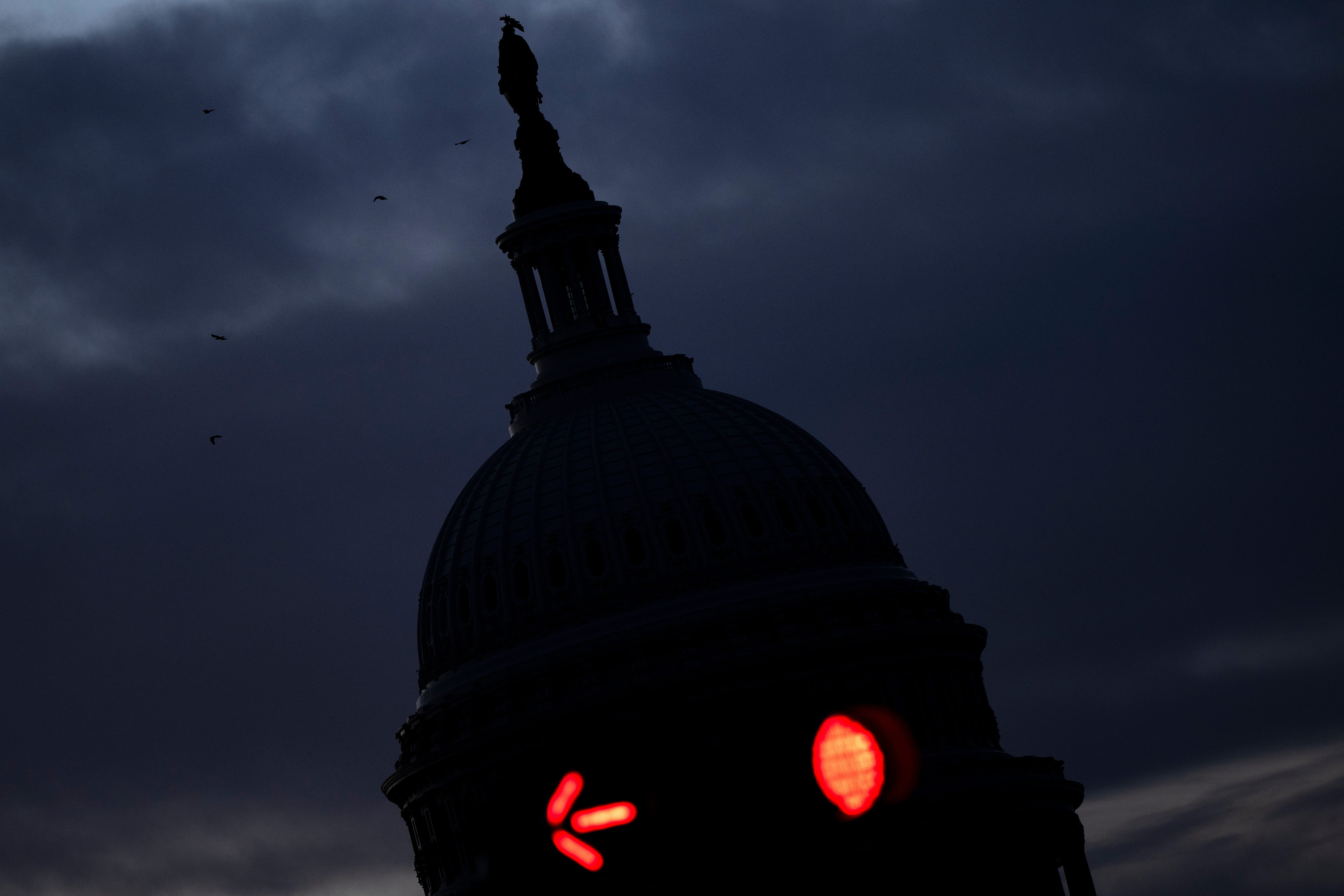
In the fight over the government shutdown, Republicans are testing an insidious political strategy: Can they get a majority of voters to oppose programs that clearly benefit American citizens, on the grounds that a tiny fraction of the money might also end up—through some inadvertent channel—helping illegal immigrants?
That’s the message Republicans have repeated throughout the shutdown. They claim, falsely, that the Democratic position—that expanded Obamacare subsidies should be renewed and that the Republican cuts to Medicaid passed this year should be repealed—is really a demand to provide “free healthcare for illegals.”
The GOP’s argument is dishonest in many ways, as The Bulwark’s Jonathan Cohn has explained. But it should also worry us for a reason that goes well beyond the shutdown: If it succeeds, it will become a template for self-destructive nativist populism. It will prove that Americans care more about choking off aid to undocumented immigrants—even where the aid is already prohibited—than we do about helping fellow Americans.
This isn’t the first time Republicans have played the “free healthcare for illegals” card. Remember when Rep. Joe Wilson of South Carolina shouted “You lie” during Barack Obama’s speech to Congress in 2009? Wilson was objecting to Obama’s assurance—which was true—that the subsidies in the Affordable Care Act “would not apply to those who are here illegally.”
The ACA’s section on subsidies explicitly stated: “Nothing in this subtitle or the amendments made by this subtitle allows Federal payments, credits, or cost-sharing reductions for individuals who are not lawfully present in the United States.” But Republicans said the mechanisms to enforce that exclusion weren’t good enough and that the bill therefore subsidized illegal immigrants.
In 2006, when George W. Bush was pushing for reforms to immigration and Social Security, Republicans accused Democrats of using the retirement program to provide “benefits for illegals.” In 2009, Republicans played the same card as Congress moved to expand the State Children’s Health Insurance Program. From 2021 to 2024, they played it against the American Rescue Plan. Last year, some Republicans used it to rail on a proposed expansion of the Child Tax Credit.
The history of these attacks is instructive. It shows that no matter what lawmakers do to exclude illegal immigrants from a program, the GOP will find a way to claim that some of the money will go to these immigrants. Republicans propose hair-splitting amendments to tighten the rules until they come up with an amendment Democrats will vote against. Then they use that vote—and ignore the Democrats’ other votes to explicitly bar undocumented immigrants from receiving benefits—to accuse Democrats of opening the federal spigot to illegal aliens.
If a bill’s exclusion of illegal immigrants is airtight, Republicans say the enforcement mechanisms are inadequate. They do so even if they previously expressed no objection to the same enforcement mechanisms or if they voted for essentially identical language in Republican legislation.
Many of these tricks are being played again in the shutdown fight. No matter how many times Democrats repeat that they’re not proposing to change federal laws against public funding of healthcare for illegal immigrants, Republicans insist that they are, or that the enforcement mechanisms aren’t good enough.
So far, the GOP isn’t winning that debate. In a CBS News poll taken from Wednesday to Friday, when Americans were asked what the shutdown standoff was about—and were given a list of issues that might answer that question—only five percent selected immigration. By contrast, 36 percent selected health care. Eight percent said taxes or the deficit, and another 29 percent said all of the above.
If that advantage holds—if Democrats can keep the conversation centered on health care, and if the Republican campaign to focus on “illegal aliens” fails—it doesn’t guarantee that the shutdown will end on Democrats’ terms. But it will show that most Americans care more about helping themselves and each other than they do about choking off the last trickle of aid to undocumented immigrants. It will discourage the worst kind of populism—and it could become a template for the best.
Perfect Brew For the Culture War
by Cathy Young
The sentencing last week of the would-be assassin of Supreme Court Justice Brett Kavanaugh in a bizarre 2022 plot related to the then-imminent repeal of Roe v. Wade was perfect fodder for our culture wars. Not only did the relatively light sentence issued by a Joe Biden–appointed federal judge—eight years, compared to the minimum of 30 asked by the prosecution—rekindle claims that “the left” both commits and condones political terrorism; the defendant, a 29-year-old Californian whose legal name is Nicholas John Roske, had also asserted a transgender identity in a recent court filing under the name “Sophie Roske.” What’s more, U.S. District Judge Deborah Boardman cited Roske’s gender struggles as a factor in the low sentence.
You don’t need to be a right-winger in search of outrage bait to wince at some of Judge Boardman’s reported comments explaining her sentencing—for instance, “I am heartened that this terrible infraction has helped the Roske family . . . accept their daughter for who she is.” Attempted murder is not a vehicle for family therapy. And, while there are complex debates around gender dysphoria, this case raises real questions about the validation of all transgender identity claims based solely on self-identification, even when, as here, they coexist with severe mental illness.
Where I think Judge Boardman’s reasoning is defensible is in highlighting the fact that Roske—who had traveled from California to Maryland in June 2022 with the intent of killing Kavanaugh and possibly two other conservative justices—phoned the emergency police line to confess the plot and surrendered. National Review writer Jeffrey Blehar, who asserts that the sentence is a “recipe for judicial assassinations,” argues that Roske did not have a change of heart but simply “called 911 in a rush” after being spotted and tailed by federal marshals outside Kavanaugh’s home, “with a bag full of murder gear.” But Blehar misstates the facts as laid out in the prosecution’s sentencing memorandum: while the marshals did notice Roske and signal their presence, there was no “tailing” and no “rush.” Roske walked past the marshals, and then away from them before calling 911 about 20 minutes later. During that time, Roske’s sister was on the phone persuading the would-be assassin to surrender.
This is not to minimize the gravity of what Roske did. Despite being related to mental illness, the actions taken still amounted to a political murder plot, and they merited a longer sentence. But the sentencing still does not translate into a license to kill as Blehar suggests—especially since the sentence hinges on the fact that Roske did not kill anyone, appears to have voluntarily abandoned the homicidal plan, and made a commitment to mental health intervention. Notably, after release from prison, Roske will remain under lifelong supervision by federal probation officers. And it is, finally, worth adding that in her remarks at the sentencing, Judge Boardman called Roske’s actions “reprehensible” and spoke in strong terms about the harm to Kavanaugh and his family and the need to ensure that judges and public officials do not have to fear for their lives. It was a regrettably light sentence for an admittedly reprehensible act. But it was not condoning murder.
AROUND THE BULWARK
MAGA Turns on Trump’s Top Lawyer… As WILL SOMMER reports in False Flag, Todd Blanche discovered that your place is never totally secure in the modern conservative movement.
Is Trump Considering Pardons for Sex Offenders? Trump’s old friend Ghislaine Maxwell is back in the headlines and once again, he’s pretending he barely knows her. TIM MILLER and SAM STEIN break it down: From Trump’s creepy sympathy for Epstein’s circle to his casual cruelty toward migrants and veterans, his hypocrisy couldn’t be clearer.
The New ‘Fierce Urgency of Now’... Joining TIM MILLER on the flagship pod: BILL KRISTOL and JANE FONDA. Fonda discusses why she is reviving her father’s McCarthy-Era free expression group.
How Bad Is It and How Can We Recover? DAMON LINKER joins MONA CHAREN to share some optimism for climbing out of the abyss.
Quick Hits
NATIONAL GUARD TICK TOCK: Just one day after a Donald Trump–appointed Oregon district judge temporarily blocked the president from deploying out-of-state National Guardsmen into Portland, a Biden-appointed judge in Illinois declined last night to do the same in her own state. Judge April M. Perry said, per the New York Times, that she was “very troubled by the lack of answers” she was getting from White House lawyers about troop deployments in Chicago, but would not issue any orders before a Thursday hearing. In the meantime, troops from Texas are already inbound to Chicago expecting to be deployed within the week.
Back at the Oval Office, Donald Trump was toying once again with the idea of short-circuiting (or, perhaps, rewiring) the whole question of: Hey, can he do that?
“We have an Insurrection Act for a reason,” he told reporters. “If people were being killed and courts were holding us up or governors or mayors were holding us up, sure, I’d do that. I want to make sure that people aren’t killed. We have to make sure that our cities are safe.”
Think about what exactly Trump is saying here. Crime, he says, is out of control in blue cities; he wants to twist the city leaders’ arms to force them to let him parachute troops in to “help out.” But if those leaders resist—and if the courts side with them—then the out-of-control crime transforms, as if by magic, into an insurrection against the government, justifying the use of his most dire emergency powers. If your definition of what differentiates a regular criminal from an “insurrectionist” depends on whether a judge is letting the feds come in, you might be working with a crackpot definition.
Or maybe it isn’t the street criminals who Trump thinks of as the “insurrectionists” at all. Stephen Miller, who has been world-historically On One in recent weeks, type-screamed Saturday night that the Oregon judge who blocked their Portland deployments, Karin Immergut, was engaged in “legal insurrection” against the president. However it goes, just remember: The criminals are whoever Donald Trump—er, Miller—says they are.
THE DEFENSE CALLS: JOHN DURHAM?: The list of ostensible Trump allies who don’t think he’s got a criminal case against former FBI director James Comey is getting pretty long! ABC News reports:
John Durham, the former special counsel who spent nearly four years examining the origins of the FBI investigation into President Donald Trump’s 2016 presidential campaign and its alleged ties to Russia, told federal prosecutors investigating James Comey that he was unable to uncover evidence that would support false statements or obstruction charges against the former FBI director, sources familiar with the matter told ABC News.
Federal prosecutors in Virginia met remotely with Durham in August to understand the findings of his investigation, according to sources familiar with the meeting, and his conclusions raise the prospect that Durham—who was once elevated by Trump and other Republicans believing he would prosecute high-level officials involved with the investigation of the president’s 2016 campaign—could now become a key figure aiding Comey’s defense.
The story shines new light on former U.S. attorney Erik Siebert’s decision to recommend not charging Comey—a decision for which Trump promptly fired him, installing his former personal lawyer Lindsey Halligan to the post instead. In his memo recommending not charging Comey, Siebert leaned on Durham’s own assessment—made after years of poking around the origins of the Russia probe—that the Justice Department would be unable to prove that Comey had lied to Congress. That assessment has proven prescient, given the remarkable flimsiness of Halligan’s indictment, which provoked eye-rolling even from some reliable defenders of the president.
But there’s a particular relish in this assessment coming from Durham, who Trump plainly hoped would carry out his investigation with the same crazy-eyed partisanship and personal loyalty to him that characterizes his current crop of shambolic DoJ lickspittles. Durham turned out, in this respect, to be a careful prosecutor who looked into the matter he’d been given, then turned out a measured assessment. Too bad Trump’s learned his lesson about hiring Durhams.
GETTING AHEAD OF THE STORY: Speaking of Lindsey Halligan’s office in the Eastern District of Virginia, MSNBC’s Carol Leonnig and Ken Dilanian nabbed a notable scoop out of there yesterday:
A top prosecutor in Virginia has informed colleagues she plans to decline to seek charges against New York Attorney General Letitia James, resisting intense pressure from President Donald Trump, according to two people familiar with her discussions.
Elizabeth Yusi, who oversees major criminal prosecutions in the Norfolk office of the Eastern District of Virginia, has confided to co-workers that she sees no probable cause to believe James engaged in mortgage fraud, the two sources told MSNBC. Yusi plans to present her conclusion to the president’s new interim U.S. attorney, Lindsey Halligan, in the coming weeks, they said.
It’s revealing to contrast this story—and the fact that word leaked to the press—with the way Siebert’s firing went down just two weeks ago. In that case, it was Trump, not Siebert, who took the story public. Siebert had tried to go by the book, privately offering his superiors his prosecutorial judgment for why an indictment against Comey should not go forward. When they canned him anyway, prosecutors in the office took the lesson to heart. Now, Yusi—or people close to her—are tipping the press off ahead of time that they see no case against another enemy Trump wants them to indict, Letitia James. If (or, let’s be honest, when) Halligan fires her, we’ll immediately know why.
Cheap Shots

Welcome to America, where one party fears healthcare for immigrants more than assault rifles for the mentally ill.
The 2nd Trump admin is like if you took the corruption of the Harding admin, the stupidity of the Bush Jr admin, and the cruelty of the Jackson admin and rolled it all into a single ball of orange wax.