AI Apocalypse Looms. We’re Already Blowing It.
Surely there are more options than letting AI run wild or shutting it down, right? Right?


Several commercial ships are under fire near the Strait of Hormuz as Iran continues to try to block one of the world’s most important shipping lanes. The U.S. military is trying to prevent the Iranian Navy from laying mines in the key shipping channel. The chairman of the Joint Chiefs of Staff reported that the Iranians are already “adapting” as they target American air defenses and hotels frequented by U.S. service personnel.
And it seems like just last month Trump was boasting about low gas prices. Happy Wednesday.

Everybody Hates AI
by Andrew Egger
In the few short years since generative AI arrived on the scene, the technical capabilities of large language models have quickly gone from cool to remarkable to astonishing. As at any disruptive, revolutionary moment, the public-policy challenges are going to be massive. The laws governing AI use are non-existent; the political pressure to come up with some is massive and growing. After a decade-plus of general policy paralysis amid endless referendums on the person of Donald Trump, it’s not hard to imagine a world in which the 2028 election hinges instead on the future of American AI regulation.
It’s hard to overstate, too, just how wide open the political terrain is. An NBC News poll released this week asked voters which party they most trusted across a number of different policy issues. Most were basically unsurprising: By a wide margin, Republicans were more trusted to deal with border security, immigration, and crime, while Democrats were favored for dealing with health care, protecting democracy, and protecting Americans’ constitutional rights. But when it came to AI, practically nobody had any confidence that either party had the edge. Just look at this graph:
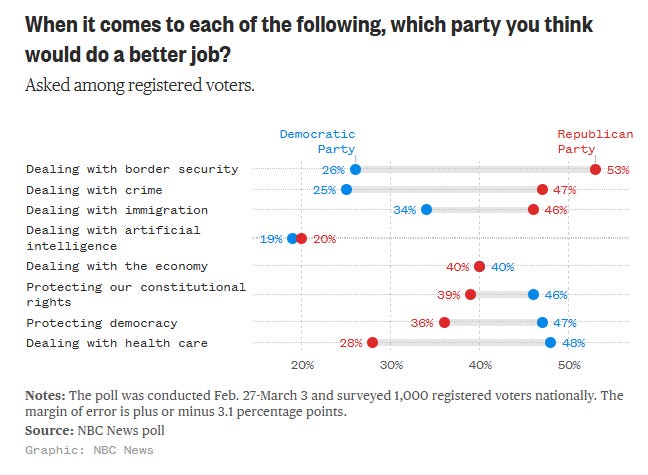
That’s what opportunity looks like. The party that can win the argument over AI is set up for a political windfall—and then will be tasked with shepherding the country through massive disruption toward a prosperous rather than a dystopian AI-integrated future, if possible. No pressure.
But so far it seems like basically everybody is blowing it.
If the question politicians are asking themselves is merely “how can I reap a political benefit from AI policy,” there’s increasingly one answer that is unfortunately straightforward. At the moment, most people hate AI—which isn’t very surprising, since their exposure to its benefits has been much more muted than their exposure to its drawbacks. If you’re not an active AI user today, then AI isn’t much for you but a machine that spits out the deluge of scams and uncanny clickbait that clogs your social feeds, the slop that fills up online product reviews, and the glitchy chatbots you’re forced to dodge around if you want to speak to an actual customer service person—oh, and which you worry may be coming to take your job soon.
So for most populists—left and right—there’s an easy answer to the AI-policy debate: Just quit letting it happen. From Sen. Bernie Sanders to Florida Gov. Ron DeSantis, there’s a growing chorus of voices eager to strangle generative AI in the cradle, typically by banning the construction of the data centers that constitute its brains. “Why would we subsidize something,” DeSantis asked last year, “that could potentially cause problems for folks?” (For more establishment-ish types, there’s of course a different easy way to reap a political benefit: Just become an industry cheerleader and soak in the campaign cash.)
Many other legislative attempts to regulate AI are just as blinkered in their approach. Take just one state-level example. In New York, a bill that just sailed through a Senate committee would forbid AI chatbots from giving “any substantive response, information, or advice” about knowledge related to any field for which the state credentials practitioners—doctors, lawyers, engineers, therapists, social workers. A chatbot can’t replace a doctor or a lawyer, of course—but that doesn’t make it sensible for a legislature to try to wall off entire fields of knowledge out of fears that AI being able to inform you about them could theoretically harm existing professional groups. Ludicrously, the bill would also be enforced by a private right of action—meaning that if you could trick a chatbot into giving you medical or legal advice in New York, you’d be allowed to sue whoever made the chatbot.1
But if some state attempts to regulate have been ham-handed, so too has been this White House’s approach. The Trump administration has attempted to prevent states from regulating AI altogether, and has in fact treated the very idea of doing anything to direct or restrain AI’s development and deployment as an unacceptable obstacle to winning the AI race against China. Under their accelerationist framework, even AI companies’ own internal controls are an intolerable barrier to speed. This month, Defense Secretary Pete Hegseth declared war on the AI company Anthropic over its refusal to allow its products to be used for mass surveillance of Americans or to control autonomous lethal weapons systems.
And we shouldn’t have much hope that it will be enough for the companies to regulate themselves. There’s too much of a race-to-the-bottom dynamic here, as the Pentagon dustup also demonstrates: Although Anthropic was willing to take an enormous financial hit to its business rather than bend on its redlines, other AI labs were waiting in the wings. Elon Musk’s xAI and Sam Altman’s OpenAI were all too happy to step up in Anthropic’s place on the terms Hegseth desired.2
I could go on and on, but you get the idea. At an existential moment that demands bold thinking and policy innovation, we’re stuck with the same old broken toolset: a paralyzed Congress in which even the simplest compromises, let alone groundbreaking policy work, seems impossible, a whipsawing White House that wants to encourage AI development until the moment it decides to burn an AI company down out of pique. Maybe they’ll surprise us all and rise to the moment. Maybe someone new will show up to fill the void they’re leaving. I’m not holding my breath.
What kind of AI regulation would you want to see? And how much likelier would you be to vote for a politician if they had a smart idea about AI? Share your thoughts.
End the War. End Mass Deportation. End the Tariffs.
by William Kristol
The Trump administration is in disarray.
In this election year, the task of the opposition is to turn the administration’s disarray into Republican defeat—a defeat as dramatic, as complete, and as debilitating to the Trump administration as possible.
The disarray is in plain sight. Yesterday, for example, Secretary of Energy Chris Wright announced that the U.S. Navy had successfully escorted an oil tanker through the Strait of Hormuz. Markets rallied. Wright’s claim was quickly discovered to be false. He had to delete the post. Markets plunged.
It was yet another instance of an administration at war that doesn’t seem to know what it is doing. It’s also an administration that didn’t understand what it was getting into when it went to war. On February 18, ten days before Trump started the war, Wright had said he wasn’t concerned that a Middle East war might disrupt oil supplies and drive oil prices up.
Well, they’re up a lot. And probably heading higher. And it’s the Republicans in Congress that blocked efforts to force the administration to get congressional approval for this ill-considered war.
At about the same time yesterday that Secretary Wright was sharing fake war news, White House Deputy Chief of Staff James Blair was telling Republican members of Congress to spread fake domestic news. Stop talking about mass deportation until the midterms, was the order of the day from the White House.
Presumably left unsaid—because it didn’t need to be said, was:
Of course we’re still going to be doing mass deportation. We ran on mass deportation. We distributed signs at the 2024 Republican National Convention calling for “mass deportation now.” And the architect of mass deportation—indeed, of Trump immigration agenda writ large—Stephen Miller, is still in the White House. Yes, mass deportation was the reason for the enormous increase in funding for ICE and the Border Patrol you voted for in the 2025 reconciliation bill. Yes, those funds are paying for all the new personnel and equipment and warehouses needed for mass deportation. And yes, most of those removed from the country last year seem to have had no criminal conviction at all. But just pretend all of that isn’t true. Just ignore it. Talk about other things.
The trouble is that if mass deportation is no longer the goal, then the administration doesn’t need even more funding for ICE or the Border Patrol. If mass deportation is no longer the goal, congressional Republicans could simply accept the Democrats’ proposal not to give more money over the next few months to the agents of mass deportation and instead to fund the non-problematic parts of DHS like TSA. But they won’t. Because in fact mass deportation remains central to the administration’s agenda that congressional Republicans support.
Meanwhile, after the Supreme Court struck down Trump’s illegal tariffs, the administration insisted on imposing new tariffs under different legislative authorities. The administration had a chance to back off from imposing burdens on our slowing economy. It didn’t take it. And the Republican Congress has gone along with the administration on this, as on almost everything else.
Democrats have a tendency to overthink everything. They should resist the temptation and keep things simple: It’s Trump’s war. It’s Trump’s mass-deportation regime. These are Trump’s tariffs. Republicans have supported and enabled them all.
End the war. End mass deportation. End the tariffs. End Republican control of Congress.
A MESSAGE FROM UNITEDHEALTH GROUP
Lowering costs, simplifying care

UnitedHealth Group is helping simplify how patients navigate care by investing in transparency tools that make it easier to locate nearby providers and compare costs.
Transparent pricing can save patients hundreds of dollars annually.
AROUND THE BULWARK
This is Why America’s Institutions Are Failing… On The Illegal News, SARAH LONGWELL talks with former federal prosecutor ANDREW WEISSMANN about his new book: Liar’s Kingdom.
Are Democrats Reaganmaxxing? Prospective 2028 presidential candidates are proposing major tax cuts. They belong to a different party than you might expect, reports JOE PERTICONE in Press Pass.
Trump’s Surgeon General Pick Needs a Spine Implant… A recent exchange revealed a troubling lack of political courage—but the job practically demands it, observes JONATHAN COHN in The Breakdown.
Quick Hits
YOU’RE IN GOOD HANDS: The war goes on, and the planning and execution are going as well as you’d expect. Worries that America is blowing through its state-of-the-art weapons systems at a shocking rate are only growing. The Pentagon told Congress this week that it had burned through $5.6 billion in munitions in just the first two days of the conflict, and the Washington Post reported yesterday that the military has moved parts of THAAD missile-defense systems and Patriot interceptors to Iran from the Indo-Pacific—a worrisome drawdown of weapons that would be needed if China were to launch an attack on Taiwan.
Meanwhile, the White House gave us an unintentional object lesson in just how badly the conflict is rattling oil markets. As Bill mentioned above, the entire commodity market seemed to breathe a sigh of relief after Energy Secretary Chris Wright tweeted that the Navy had “successfully escorted an oil tanker through the Strait of Hormuz to ensure oil remains flowing to global markets.” Oil prices tumbled—until Wright deleted his post and it became clear that no such escort had taken place. (A Department of Energy spokesperson attributed the falsehood to a captioning error by DOE staff.) Oil prices surged upward again.
Apropos of nothing, the Trump administration’s official explanation of why previous wars went wrong is that we had stupid people in charge.
NO FILIBUSTER FOR YOU: Donald Trump is used to getting pretty much whatever he wants from congressional Republicans. But Sen. Majority Leader John Thune seems determined to withhold the one thing Trump wants most from him at the moment: his permission to kill the Senate’s legislative filibuster to pass Republicans’ SAVE America Act. Politico reports:
Thune is at the center of a relentless pile-on from prominent figures in the GOP’s MAGA wing who want Senate Republicans to force a “talking filibuster” to smoke out and ultimately defeat Democratic opposition to the bill known as the SAVE America Act — a tactic Thune believes doesn’t have enough support from his members.
President Donald Trump declared the bill his “No. 1 priority” going into the midterms Monday, and House Republicans are vowing to gum up their own chamber in a bid to squeeze the Senate GOP. An intense online campaign reached a crescendo this week with tech mogul Elon Musk joining online calls to remove Thune as leader.
Thune, confident of his support from fellow Republican senators, brushed off the criticism in an interview Tuesday.
“It just kind of comes with the territory,” he said. “You just roll with it, you know. It’s the times in which we live.”
Because we live in Hell, the one thing Thune has a spine about is the one possible dispute between the two men where we actually agree with Trump. Still, respect.
YOU’RE IN HIS POCKET: If “shocking but not surprising” was the standard cliche for stories during the first Trump term, it’s starting to look like “predictable but still infuriating” is the winner this time around. Last year, at the height of DOGE, Wired reported extensively on the way Elon Musk’s gang of boy hackers was making mincemeat of the government’s data-security systems, helping themselves to, for instance, Americans’ closely held personal data at the Social Security Administration. Now, the Washington Post reports a whistleblower complaint that one of the DOGEbros in question tried to carry a massive trove of that data along with him to his next private-sector job:
According to the disclosure, the former DOGE software engineer, who worked at the Social Security Administration last year before starting a job at a government contractor in October, allegedly told several co-workers that he possessed two tightly restricted databases of U.S. citizens’ information, and had at least one on a thumb drive. The databases, called “Numident” and the “Master Death File,” include records for more than 500 million living and dead Americans, including Social Security numbers, places and dates of birth, citizenship, race and ethnicity, and parents’ names. The complaint does not include specific dates of when he is said to have told colleagues this information, but at least one of the alleged events unfolded around early January, according to the complaint. While working at DOGE, the engineer had approved access to Social Security data.
According to the complaint, he allegedly told the whistleblower that he needed help transferring data from a thumb drive “to his personal computer so that he could ‘sanitize’ the data before using it at [the company.]” The engineer told colleagues that once he had removed personal details from the data, he wanted to upload it into the company’s systems. He told another colleague, who refused to help him upload the data because of legal concerns, that he expected to receive a presidential pardon if his actions were deemed to be illegal, according to the complaint.
Pretty much everybody involved—the government, the company, the onetime DOGEbro—denies that anything untoward happened. Read the story and make of it what you will.
Cheap Shots

A spokeswoman for New York Gov. Kathy Hochul declined to say whether she would sign the bill, while telling The Bulwark that the governor “has implemented nation-leading regulations to ensure safe and responsible AI use in New York State.”
As we wrote yesterday, Anthropic is fighting back in court.
‘End the war. End mass deportation. End the tariffs. End Republican control of Congress.’
Did Bill Kristol get reincarnated as a 60’s antiwar hippy? The Bill Kristol of the early 2000’s Bush era needs a time machine as I doubt that Bill Kristol would believe what he is writing now. Seeing Bill Kristol stick to his convictions, beliefs and values has been one of the true girts of an otherwise bad era and worth the price of admission to the Bulwark.
I look at this poll and I truly wonder who these people are, if they pay attention to what is going on around them, do they go to the grocery store. The economy is tanking and absolutely everything trump has done since he took office has caused this. He is well on the way to crashing our economy like he did in his first term. Biden fixed that left us the best economy in the world. Remember W crashed the economy and Obama fixed it, the stupidity of Reganomics caught up with Bush I, Clinton fixed it and left us a balanced budget. Why in the name of all that is sane do people trust republicans more with the economy.