

Amateur Hour At 1600 Pennsylvania Ave.
The White House is in free fall. How long will it last?



The New York Times notes that the Trump administration’s habit of buying ownership shares in companies it likes now involves $10 billion in taxpayer funds and “shows little sign of slowing.”
Remember, kids: Government ownership of the means of production turns out to be good, but socialism is still bad. Happy Tuesday.
The Trump Train Jumps the Tracks
by Andrew Egger
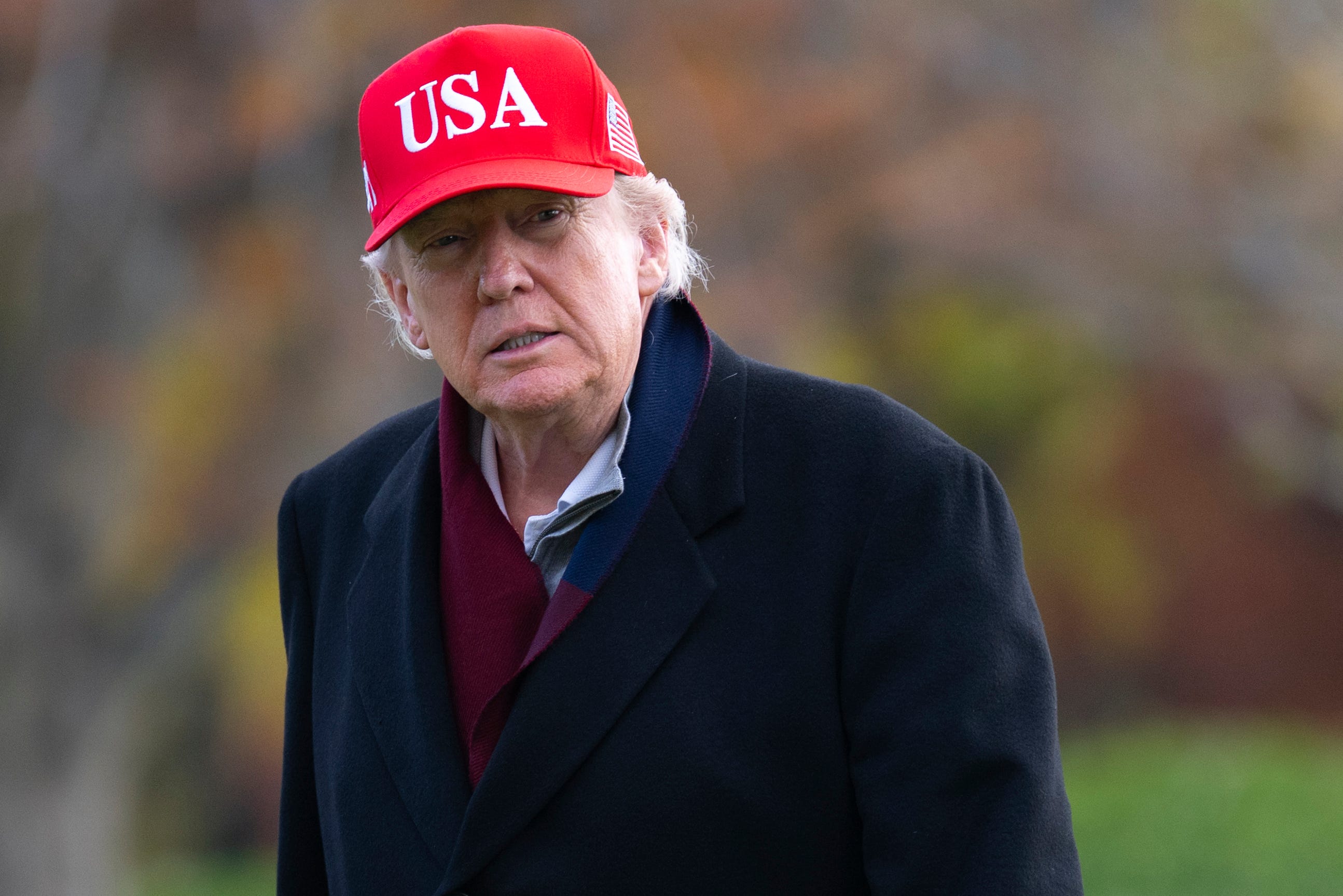
Ben Wittes famously summed up the spirit of the first Trump presidency as “malevolence tempered by incompetence.” But earlier this year, it looked like Trump might be rewriting that formula.
He had roared back into office with two things he didn’t have the first time: a sweeping set of actual plans and a vetted group of true believers who were determined to help him put them into action. For months, Trump rampaged through the government—purging “disloyal” intelligence and law enforcement officers, shuttering agencies, tearing up federal contracts, ramping up deportations without due process, pardoning J6 rioters, slinging around tariffs, flirting with open defiance of the courts, and so on. The overwhelming feeling was of sudden, surreal descent into lawlessness—into Hannah Arendt’s totalitarian world where “everything was possible” and “nothing was true.” Worse, it all felt deliberate, planned, rolled out on a schedule. What would be next? Would he actually deport U.S. citizen criminals for imprisonment in El Salvador? Would he try to seize Greenland, or the Panama Canal? He was doing the rest of his wish list—why stop there?
It wasn’t long before you could feel that overwhelming momentum start to slow. In retrospect, the Supreme Court’s slapdown of his lawless deportations to El Salvador was one inflection point; his shambolic rollout and subsequent panicked walkback of his “Liberation Day” tariffs was another.
But now, in the wake of the government shutdown, we seem to be hitting a third phase in Trump’s second term, in which his forward momentum is in danger of stopping altogether. And in that environment, the incompetence so endemic in term one is making itself known again, with a vengeance.
Suddenly, everywhere you look, you see a White House flailing.
Trump’s poll numbers are near historic lows, with many of the coalitions who helped him back to the White House last time, including young people and minority voters, expressing remarkable levels of buyer’s remorse. Meanwhile, his greatest political strength—the remarkable depth and durability of the MAGA base’s passion for him—suddenly appears less impregnable after MAGA zealots in Congress forced him to blink on the Epstein files.
His hamfisted tinkering with U.S. trade has put a pillow over the face of many American businesses, slowing hiring, spreading uncertainty, and creating the conditions for an economy whose health relies nearly entirely on the speculative AI sector, even as anxiety about a possible AI bubble continues to grow.
His policy agenda is adrift without sail. Consider his recent muddled attempts to triangulate on healthcare. After insisting for months that the government should not re-fund expiring Obamacare subsidies—to the point of being willing to shut down the government rather than give Democrats concessions on the issue—Trump seemingly had a change of heart. Yesterday, he planned to roll out a proposal to extend those subsidies temporarily while making some changes, like stricter income phase-outs. But he was forced to turn on a dime when congressional Republicans got wind of the plan and sent him an unambiguous message: No way are we supporting this. The White House, having apparently not thought to get congressional buy-in before floating the plan publicly, had to hurriedly cancel the rollout. It’s no longer clear when a plan will be introduced.
Even the stuff Trump cares about most deeply—wielding the might of government to punish anyone who has ever wronged him—is blowing up on the launchpad. The president was willing to move heaven and earth to get criminal indictments against former FBI Director James Comey and New York Attorney General Letitia James. He even handed an entire U.S. attorney’s office over to an insurance lawyer on his staff with no prosecutorial experience because she was the only person he was confident would bring charges against the pair. But those indictments didn’t even manage to last two months. Yesterday, a judge threw them both out on the grounds that Trump’s lawyer, Lindsey Halligan, had been wrongfully appointed to the interim U.S. attorney post. This may have come as a relief to Halligan—none of the embarrassing, amateurish errors she was making in prosecuting the cases ended up mattering—but it remains a major embarrassment to Trump.
In theory, Trump could recognize the futility and cut his losses. After all, his failing attempts to get retribution are damaging him politically. Polls keep showing that strong majorities believe Trump is leaning on the Justice Department to file unjustified charges against his foes. And those foes aren’t even getting punished! Look at James Comey over there on Instagram, talking over the dismissal of his case! He’s positively glowing! The desired effect is not occurring!
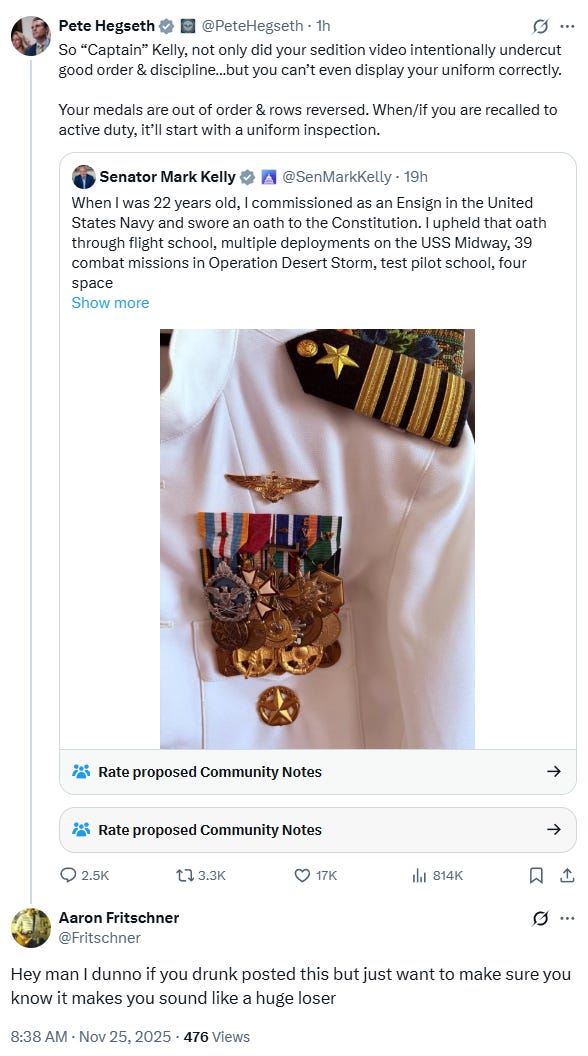
But Trump seems only to be doubling down. As his ongoing political prosecutions fall apart, he is reaching more and more erratically for crazier and crazier forms of retribution against increasingly outlandish targets. After Democratic lawmakers shot a video reminding U.S. troops of their obligation not to obey unlawful orders, Trump appeared to order Defense Secretary Pete Hegseth to crack down. Yesterday, Hegseth obliged: The Defense Department announced it had opened a military investigation into Sen. Mark Kelly for actions “intended to interfere with the loyalty, morale, or good order and discipline of the armed forces.” Elevating a retired Navy captain whose wife survived an assassination attempt was a peculiar choice. One congressional Republican called it “amateur hour.” A top conservative commentator was left perplexed, as well.
But that’s been the best word to describe the second half of the first year of Trump’s second term—perplexing. Here is a White House that spent weeks portraying Zohran Mamdani as a communist boogeyman only for the president to welcome him with open arms in the Oval. Here is a president who introduced a “peace plan” for the Ukraine war without, apparently, getting the buy-in of anyone in Congress (or maybe even his own Secretary of State). Here is an administration that turned so fast on Marjorie Taylor Greene for her heresy of demanding the Epstein files be released that now a number of other House Republicans are quietly saying they may follow MTG’s lead and resign, as well.
Trump could, in theory, take a different course. He could triangulate. He could retreat and regroup, finding a new strategy to bring into the midterms. Voters have short memories; there is plenty of time.
But the obstacle isn’t time. It’s Trump himself. He didn’t get where he is today by triangulating—he got here by always being fully, undeniably himself. It looked like it was working for a while this time. But now the Trump Train is starting to jump the tracks.
A Historian Speaks
by William Kristol
Last week, the American Enterprise Institute honored with its annual Irving Kristol Award the distinguished professor emeritus of history at Brown University, Gordon Wood. Wood is a preeminent American historian, especially well known for his detailed studies of the American revolution and founding.1
Wood’s extensive and impressive scholarship doesn’t fit into easy political categories, and in his long career, he has largely avoided opining on contemporary politics. At the AEI dinner, Wood pulled off the impressive feat of keeping the attention and interest of a D.C. audience for half an hour while never mentioning such passing preoccupations as Donald Trump, MAGA, JD Vance, Joe Biden, Kamala Harris, or Zohran Mamdani. Wood limited his political remarks to noting that he had been an Adlai Stevenson voter in his first presidential election in 1956, but that, over the next couple of decades, he’d been “one of those liberals mugged by reality.”
Though he didn’t explicitly address today’s controversies, Wood had something important to say to us about today. He delivered his core message up front:
There has been some talk recently that we aren’t and shouldn’t be a creedal nation—that beliefs in a creed are too permissive, too weak a basis for for citizenship and that we need to realize that citizens with ancestors who go back several generations have a stronger stake in the country than more recent immigrants.
I reject this position as passionately as I can.
Wood went on to describe the efforts of American statesmen, especially in the early years of the republic, to deal with the fact that the United States was never “a nation like other nations.” He quoted John Adams’s doubts about this new nation where there was nothing like “the patria of the Romans, the Fatherland of the Dutch, or the Patrie of the French.” He noted Adams’s lament that the U.S. featured “such a Hotch potch of people, such an omnium gatherum of English, Irish, German, Dutch, Swedes, French, &c. that it is difficult to give a name to the Country.”
Immigration continued after the founding period, and the country became even more ethnically diverse. Yet Americans devised a way—thanks especially to Abraham Lincoln, “who found in Jefferson’s Declaration a solution to the great problem of American identity”—to forge “a bond that holds together the most diverse nation history has ever known.”
And so Wood concluded, “To be an American is not to be someone, but to believe in something. That is why we are at heart a creedal nation, and that is why the 250th anniversary of the Declaration next year is so important.”
(Do watch the talk or read the whole text here, or read excerpts published in the Wall Street Journal here.)
I’ll take the liberty of taking Wood’s conclusion one step further. If “to be an American is to believe in something,” then it is both urgent and important for us today to reject the nativism and ethnonationalism that has reared its ugly head. And it is both right and proper, as we celebrate the last Thanksgiving of our first 250 years, to be thankful that we live in an exceptional nation, conceived in liberty, and dedicated to the proposition that all men are created equal.

AROUND THE BULWARK
New X Games: Legitimate Groyper or Bangladeshi Bot? The ragebait in your timeline may be coming from abroad, reports WILL SOMMER in False Flag.
How Much Did Trump Stooge Ed Martin Blab to Alex Jones? The InfoWars chief was hardly discreet in hinting he knew about DOJ’s “retribution” investigations. New from THOMAS JOSCELYN and SUSAN CORKE.
An Ignominious End to a Lawless Prosecution. The collapse of the malicious, incompetent case against James Comey, writes law expert KIM WEHLE.
A Letter from Clausewitz to Secretary Rubio. Channeling the author of On War on the U.S. pursuit of peace in Ukraine. The latest from GEN. MARK HERTLING.
How Trump Plans to Bury the Epstein Files. Reflections on Dick Cheney’s funeral, Trump’s attacks on Democratic veterans, the continuing Epstein files fight, and the Comey case unraveling: SARAH LONGWELL and GEORGE CONWAY discuss all this and more on the latest episode of GEORGE CONWAY EXPLAINS IT ALL.
The Cracks in Trump’s Power Are Showing. Listen to the latest episode of The Bulwark Podcast with TIM MILLER and BILL KRISTOL, featuring a look at some of our merch—available in our store now!
MTG’s Exit is a Bigger Problem Than Trump Thinks. TIM MILLER joins MSNOW’s Deadline’s NICOLE WALLACE to talk about the growing alarm inside the GOP as Trump racks up losses.
The Story Riley Gaines Doesn’t Want to Tell. On Bulwark+ Takes, TIM MILLER and PABLO TORRE break down how Riley Gaines went from a college swimmer to a full-blown MAGA political figure.
Quick Hits
MIKE’S GLASS JAW: House Speaker Mike Johnson has held his tiny-majority GOP coalition together as well as anyone could have expected since he first took the gavel in 2023 as the “I guess he’s fine” fourth choice of a conference that had just defenestrated then-Speaker Kevin McCarthy. But his fragile control is weakening. Politico reports on the mechanism of the discharge petition and how “the arcane legislative mechanism once known only to Capitol Hill obsessives is now a routine part of life in the Republican House majority”:
The GOP’s slim majority is an obvious contributor to the burgeoning popularity of the maneuver. The discharge process is set into motion when 218 members sign on to a petition, meaning only a handful of Republicans need to cross leadership if Democrats are united in support.
But the recent spate of successful discharges also reflects careful groundwork Democrats laid to quickly seize on the procedure, along with a sentiment among many Republicans that Johnson is stifling the will of the House to appease Trump and small GOP factions — including hard-liners who successfully ousted Johnson’s predecessor, Kevin McCarthy.
KASH’S OVERPROTECTIVE STREAK: For reasons we cannot begin to comprehend, Kash Patel’s aspiring MAGA-influencer/country-star girlfriend has been in the headlines a lot lately. But few of those headlines have been wackier than this Times one from yesterday: “Patel Under Scrutiny for Use of SWAT Teams to Protect His Girlfriend.” The Times reports on Alexis Wilkins’s unusual entourage when she sang at a National Rifle Association convention in Atlanta this year:
The two agents, members of a specialized unit trained to storm barricaded buildings and rescue hostages, had been sent there on Mr. Patel’s orders. But seeing that the event at the Georgia World Congress Center had been secured, and that Ms. Wilkins was in no apparent danger, they left before the event was over, according to six people with knowledge of the incident.
She noticed. So did her boyfriend.
Soon after, Mr. Patel ripped into the team’s commander, saying that his girlfriend had been left without taxpayer-funded defenders, and slamming what he saw as failure to communicate their movements up the chain of command during her time on the convention floor — where she sang and chatted with attendees, the people said.
Who says chivalry is dead?
Relatedly, while Patel may be under fire for using the FBI jet to head off to non-work-related functions (including Watkins’s performance at a wrestling match in Pennsylvania), he appears unbowed. NBC News’s Sahil Kapur posted this screen shot of the FBI director at the F1 paddock in Las Vegas over the weekend.
JD’S SPIRITUAL GUIDANCE: Reasonable people can disagree about how many political cues a Catholic vice president should be taking from the pope, even an American pope—even a Bulwark pope. But maybe we can all agree JD Vance would be better off lending an ear to Leo XIV than to certain other self-styled religious authorities. Over at his Letters from Leo Substack, Catholic writer Christopher Hale notes that Vance’s old mentor Peter Thiel has been encouraging him to keep his papal contact to a minimum:
The place that I would worry about is that he’s too close to the pope. And so we have all these reports of fights between him and the pope. I hope there are a lot more.
By the way, I’ve given him this feedback over time. And so when JD Vance said that he was praying for Pope Francis’s health, it’s as a command, as a necessary thing. OK. . . . perhaps all you have to do to be a really good Catholic is pray for the pope. You don’t really need to listen to him on anything else. And if that’s what JD Vance is doing, that’s really good.
Some people look to the gospel for guidance. Others look to Palantir. Read the whole thing.
Cheap Shots
>>> "To be an American is not to be someone, but to believe in something. That is why we are at heart a creedal nation, and that is why the 250th anniversary of the Declaration next year is so important."
Run on this Dems. Take a page from the folks who bring the stars and stripes to the No Kings and Hands Off protests.
The more evidence we see, the easier it is to conclude that the current administration has lost control of itself and the government, with no master plan for how to recover much less move forward. It is the ultimate proof that dependence on one person and his personal agenda -- whims, really -- was a very, very bad idea from the start.
No matter how much we disliked how things have worked since January, at least there seemed to be a plan to it at first. Not a good one, but a plan. But the administration seemed and seems utterly unprepared for any opposition, and roadblocks to simply getting its way, to the point of just grasping at straws now, clueless as to what approach to take and what it really intends to do other than play the aggrieved victim, be a bully, and feel sorry for itself. It's bad enough to conclude that we have a President who is utterly untethered from reality and with no idea what to do next. It's worse still when we realize that the Millers and others lurking behind the scenes have such a flawed game plan and likewise have no clue about how to formulate effective public policy that is both inclusive and willing to compromise on any level, despite all mounting evidence that their plan isn't working and will eventually burn the house down, with them in it too.
I'd say what could possibly go wrong, but each day a little more we see that for ourselves, and more. It isn't working. It won't work. It never had a chance of working. Yet we are stuck with at least three-plus more years of it. Mommy, make it stop. Daddy, make the bad men go away.