Donald Trump Wants to Bullshit the Economy Into Greatness
The president insists he’s scored $21 trillion in foreign investment. It’s gobbledygook.


Well, here we go. Donald Trump signed the bill compelling him to make most of the government’s Epstein files public last night—a remarkable development, given how hard he was working just days ago to prevent the bill from ever getting a vote in either chamber. It’s all coming out now; or rather, it’s all coming out except the stuff Pam Bondi thinks she can get away with holding back.
One quick piece of bookkeeping: Yesterday, in a fit of unkindness, Andrew made a crack about the “crayon-drawn world” of Donald Trump’s psyche. Upon further reflection he would like to apologize for this injudicious remark. Everyone knows Donald Trump is a Sharpie guy. Happy Thursday.
The Economy of His Dreams
by Andrew Egger
As thunderheads gather over the U.S. economy, Donald Trump has fallen back on a familiar claim: Trillions of dollars in foreign investment are pouring into the U.S. thanks to his dealsmanship. And they’re adding rocket fuel to our HOT new Golden Age.
This week, we got to watch the sausage-making on that foreign investment happen in real time.
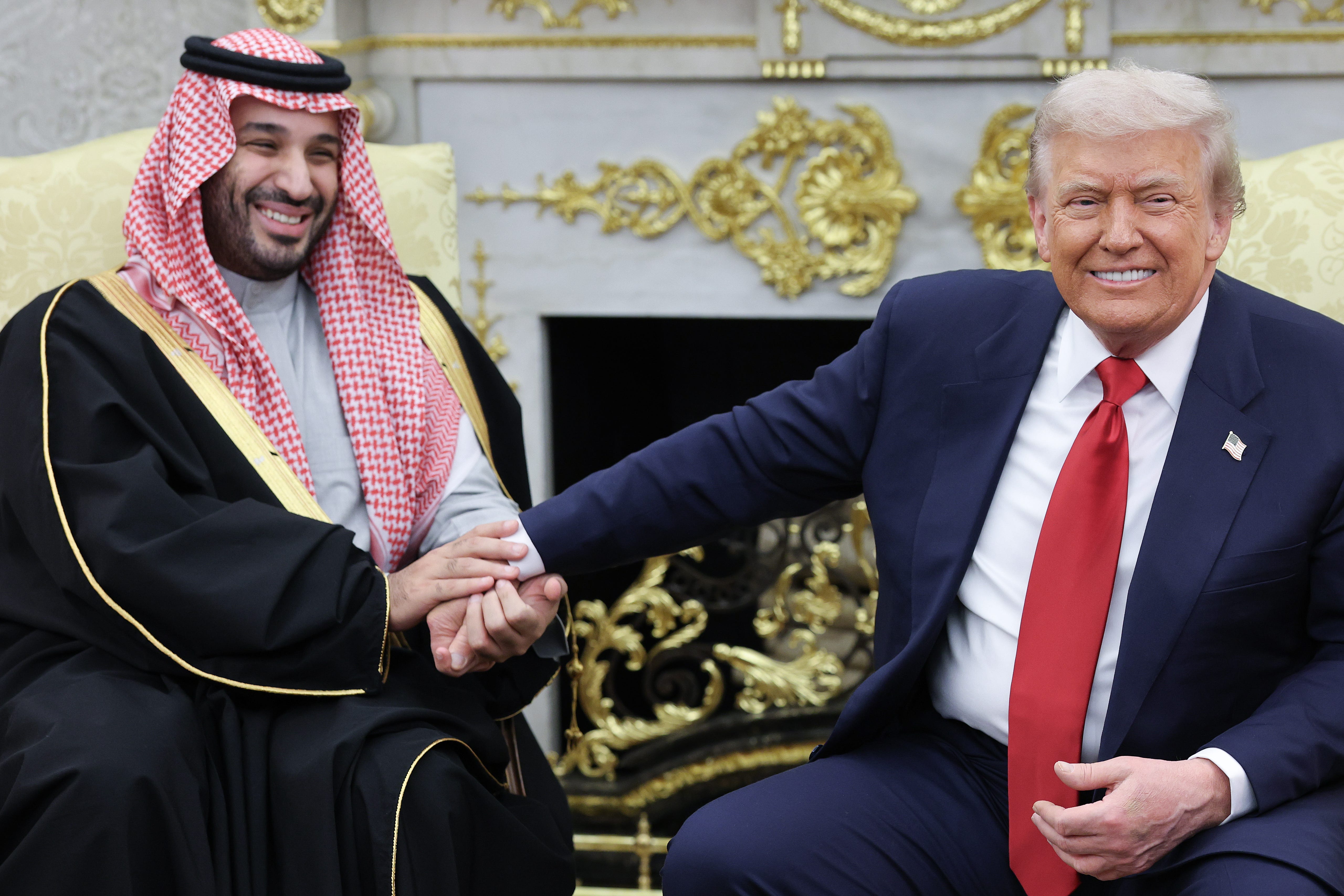
It went down Tuesday, during Trump’s goopy bilat with Saudi Arabia’s Mohammed bin Salman. Trump was waxing lyrical about all the foreign money pouring in: “We expect to be around $20 trillion, $21 trillion in one year, and that’s many times bigger than—in history the highest number was $3 trillion, and we’re going to be at $21 trillion.”
He then turned to MBS: “And I want to thank you, because you’ve agreed to invest $600 billion into the United States. And because he’s my friend, he might make [it] $1 trillion, but I’m going to have to work on him. But it’s 600—we can count on $600 billion, but that number could go up a little bit higher yet.”
Now, MBS didn’t get where he is today—the personal best friend of the president of the United States—with just a few bonesaws. No. He recognizes that you have to tell Donald Trump what he knows he wants to hear. “We believe in what you’re doing, Mr. President,” he replied, “and tomorrow we’re going to announce that we are going to increase that $600 billion to almost $1 trillion of investment.”
“So you are doing that now?” Trump said, in apparent surprise. “You’re saying to me now that the $600 billion will be $1 trillion? Good, I like that very much.”
Donny Deals does it again, folks! An extra $400 billion. And all he had to do was ask.
The important thing to understand here is that both these numbers—the $600 billion and the cool $1 trillion—are fake. They’re monopoly-money promises. Saudi Arabia is a staggeringly wealthy country, but its entire GDP is something like $1.2 trillion. The country’s sovereign wealth fund contains an estimated $925 billion. The idea that MBS plans to sink the entirety of his nation’s accumulated petro-lucre into building factories in the United States is laughable on its face.
And yet the White House’s messaging apparatus treated MBS’s fanciful promise as though it were a check they’d already cashed. “This massive $1 TRILLION investment will drive business in the United States, maintain American national security, create jobs and support American needs,” the official White House account tweeted. “The Dealmaker-in-Chief is at it again.”
The faithful right-wing infotainment apparatus was happy to play along too. “America is the hottest country in the world,” exulted former Trump adviser Larry Kudlow in his show on Fox Business. “MBS comes here and he’s going to pony up another trillion dollars. . . . That doesn’t happen during the Biden years. What does that tell you that money is pouring in here and that Trump has such an easy time persuading people to invest in America?”
It’s all like this, of course. In the months since his Liberation Day tariffs, Donald Trump and his allies have gone around the world shaking a hat, and world leaders—either eager to curry favor or just to find a way to get Trump’s tariff boot off their neck—have been happy to throw large numbers around for his enjoyment.
India, for example, was said to have pledged a $500 billion investment. But it turned out that was a goal for a bilateral trade agreement between the countries. And as for the $21 trillion aggregate figure, that was actually $17 trillion according to Trump himself just a month and a half ago. As CNN’s Daniel Dale noted, the White House website, at the time, had the figure at $8.8 trillion—though it appears that page has been removed.
Now of course there is nothing wrong with foreign investment! In general, increased investment is a sign of strength for the American economy—that we’re growing, and the world’s wealthy want a piece of the action. Maybe some of this promised investment will even materialize.
But you’d be hard-pressed to find a more speculative, less reliable indicator of actual future economic prosperity than these sorts of vague promises, as anyone who remembers the Foxconn boondoggle of Trump’s first term could tell you. Meanwhile, the investment promises Trump is extracting from other world leaders are about as abstract, gauzy, and speculative as it’s possible for a handshake agreement to be. This summer, when Trump struck a tentative trade agreement with Japan, the White House printed off documents for the announcement event boasting of $400 billion in promised Japanese investments in America. Then, before the event started, someone—Trump himself?—crossed out “400” with a Sharpie and wrote “500” down instead. When Trump took to Truth Social to spike the football, the number became $550 billion. The rules are made up and the points don’t matter; when the point of the exercise is just to get Trump in a good mood, you’ll let him say any number he likes. This behavior is not limited to foreign leaders: Earlier this year, Mark Zuckerberg made up a $600 billion Meta investment on the spot to please a nearby Trump, and then got caught on a hot mic admitting it.
All this would be more ridiculous than alarming if it weren’t for a simple fact: This most contingent and ephemeral of all economic indicators is the only economic indicator Trump seems to trust is real. In recent weeks, Trump has repeatedly scoffed at the idea that the economy is worsening, suggesting that polls showing American economic anxiety is on the rise are fakes cooked up by his adversaries. Every time he does, he makes the same pivot—would a bad economy have all this investment coming in?
“I don’t know that they are saying [they’re anxious about the economy],” Trump told Laura Ingraham this month. “I think polls are fake. We have the greatest economy we’ve ever had—we will have over $20 trillion coming into our economy.”
By all appearances, Trump has cut himself off from every source of information that could theoretically undermine this total certainty. He is, of course, in no position to feel any worsening of the economy personally. He has enclosed himself in a hermetically sealed information chamber in which aides try hard only to tell him information that they know he’ll find flattering. He has sealed his own mind off from macroeconomic indicators, which he believes are cooked. And, of course, his personal family businesses (real estate and crypto) are going gangbusters as the same people and countries touting fake investments in the U.S. are making real investments into his ventures.
But eventually, reality has to set in. September’s jobs report dropped this morning after a brief blackout due to the shutdown. The headline numbers were . . . okay: Payrolls up 119k, which is enough to quell recession fears. But the unemployment rate ticked up ever so slightly. Revisions to prior months showed payrolls came in worse than initially reported. And there are real signs that the labor market is not in a good place.
September’s inflation reports are expected in the days ahead. And if we get more black news on that front, it would present a remarkable contrast with Trump’s everything-is-great rhetoric.
Then again, last time he got a jobs report he didn’t like, he just fired the director of the Bureau of Labor Statistics. Trump seems unlikely to be shaken out of his beautiful fantasy that the golden age is already upon us. And until he is, there’s little reason to think he’ll take his foot off the gas.
AROUND THE BULWARK
Kamala Harris: This Is Our Country… Before a live audience in Nashville Tuesday, KAMALA HARRIS joined TIM MILLER to discuss what it takes to fight back against Trump. But she also threw punches—against a corrupt and callous administration trying to gaslight Americans about Jeffrey Epstein, and the tech titans who are bending the knee to a tyrant.
Throw Everything at the Wall… After the Epstein vote, Dems have debated shifting from just ‘kitchen table’ issues to an ‘even the kitchen sink’ approach, LAUREN EGAN reports in The Opposition.
Has Epstein Stopped the Trump 2028 Train? On The Next Level, JVL, SARAH, and TIM break down Trump’s awful month—from the botched Comey indictment to the Epstein files exploding, Trump snapping at reporters, his dictator cosplay with MBS, rumblings inside a panicked Trumpworld, and growing signs that the MAGA machine just isn’t running like it used to.
Bondi and Halligan’s Spectacularly Bad Lawyering for Trump… The Department of Justice’s inappropriate, unethical, and incompetent actions in the case against James Comey are veering toward “uncharted legal territory,” writes KIM WEHLE.
A Trump Peace Plan for Ukraine—or Just a Phantom? CATHY YOUNG provides some reasons for skepticism.
Quick Hits
ANTIVAXXERS IN CONTROL: Until yesterday, the Centers for Disease Control and Prevention website had a pretty straightforward assessment of the link between vaccines and autism: There wasn’t one. “Studies have shown that there is no link between receiving vaccines and developing autism spectrum disorder (ASD),” the page read. “No links have been found between any vaccine ingredients and ASD.”
Yesterday, that quietly changed. “The claim ‘vaccines do not cause autism’ is not an evidence-based claim because studies have not ruled out the possibility that infant vaccines cause autism,” the new page reads. “Studies supporting a link have been ignored by health authorities.”
This is nonsense. The supposed connection between vaccines and autism has been studied exhaustively and at length. Beyond that, there have been exhaustive studies on the studies. No such connection exists. And yet . . . the new page goes on:
It is critical to address questions the American people have about the cause of autism to ensure public health guidance is adequately responsive to their concerns. Approximately one in two surveyed parents of autistic children believe vaccines played a role in their child’s autism, often pointing to the vaccines their child received in the first six months of life . . . This connection has not been properly and thoroughly studied by the scientific community.
Vaccine skeptics spent years telling parents that vaccines cause autism. Many of those parents came to believe it was true. And now the vaccine skeptics, suddenly in charge, are turning around and using the fact of those parents’ deception as proof that they need to keep running studies until they manage to find (or perhaps hallucinate) a vaccine-autism link.1 What a dark place.
YOU HATE TO SEE IT: The government’s criminal case against James Comey is falling apart at breakneck speed. The team of crack prosecutors led by deeply respected and universally beloved interim U.S. Attorney Lindsey Halligan already had a slog on their hands, given the obviously political nature of their prosecution and the remarkably flimsy pretext for their charges against the former FBI director. But somehow they keep managing to make matters worse for themselves.
Yesterday’s hearing in the case was supposed to be an opportunity for Comey’s lawyers to make their argument that Halligan’s prosecution was rooted in political retribution. But the proceedings soon became more explosive following a startling revelation from Halligan: The substitute indictment on which Comey was charged was not seen by the entire grand jury that ostensibly approved it.
Prosecutors had originally sought a three-count indictment against Comey. When the grand jury declined to return one of the three charges, Halligan—working against the clock, since the statute of limitations for Comey’s alleged crimes was about to expire—quickly prepared a substitute two-charge indictment.2 But Halligan admitted in court Wednesday that only two members of the grand jury, including its foreperson, ever actually saw that replacement two-charge indictment before it was filed with the court.
Comey’s defense attorneys were quick to pounce on the blunder. If the full grand jury hadn’t seen the final indictment, they argued, “there is no indictment”—which means Comey shouldn’t be able to be prosecuted at all. If the judge were to buy that argument, it could be game over for the Comey prosecution before it even really begins—since we’re now past the expiration of that statute of limitations, there would likely be no way for prosecutors to amend their mistake. All in all, just another spectacular, no-notes day on the job for Halligan.
DON’T KILL FEMA: Donald Trump’s dream of dismantling FEMA has suffered a small setback, per the New York Times: The “Give me a pretext for killing FEMA” panel Trump set up has now recommended saving it instead. The Times reports:
Many of the people appointed by the president to the FEMA task force hail from red states in the South that are vulnerable to hurricanes and reliant on FEMA aid. They include officials from Florida and Texas, two of the states that receive the most federal disaster assistance.
The task force has presented Ms. Noem with a draft report that calls for reforming but preserving the agency in some form, the four people briefed on the matter said. The panel failed to release its final report by Sunday as required by an executive order Mr. Trump issued in May.
The final report is now expected by the end of the year. It could ultimately suggest a compromise intended to appease the White House, such as renaming FEMA or eliminating the agency “as it exists today” or “in its current form,” two of the people briefed on the matter said.
It’s hard to imagine many politicians thundering that an agency is totally compromised and must be rooted out—and then ultimately settling for a couple fig-leaf reforms and an agency name change. But isn’t “we changed the name so it’s good now” one of Trump’s signature moves?
Cheap Shots

There’s a dark parallel here to another recent American mass delusion. In the wake of the 2020 election, Trump and his allies spent weeks spreading lies about a stolen election to his supporters—and Republicans then turned around and treated the mere fact that millions of people believed these lies as sufficient reason to treat them as deserving of serious respect.
“The important thing to understand here is that both these numbers—the $600 billion and the cool $1 trillion—are fake. They’re monopoly-money promises. Saudi Arabia is a staggeringly wealthy country, but its entire GDP is something like $1.2 trillion. The country’s sovereign wealth fund contains an estimated $925 billion. The idea that MBS plans to sink the entirety of his nation’s accumulated petro-lucre into building factories in the United States is laughable on its face.”
Of course it’s laughable; just like the $600 billion Zuckerberg agreed to invest in America. That’s larger than Meta’s book value.
Just the thought of $21 trillion is ludicrous. The total amount of the world’s currencies amount to $8.3 trillion. The M1 money supply, which includes physical cash plus checking deposits, is estimated at around $65 trillion globally.
The M2 money supply, which includes M1 plus savings accounts and money market funds, is estimated to be around $123 trillion. So $20 trillion represents approximately 16% of the world’s total liquidity, and we aren’t getting that much investment ever!
Furthermore, where exactly could anyone invest $20 trillion in the US? Maybe in treasuries, however, that’s just buying our debt; it’s not an investment in America itself. We certainly don’t have the infrastructure currently to support an investment that large. IMHO…:)
Might it not be a good idea to bring Treasury Secretary Bessent before a Congressional committee and ask him to explain where that money is or will go and how Congress is responsible for spending it?
Sorry. What was I thinking? It's 2025 and it's none of our business.