The Arrogance of a Kennedy
RFK Jr.’s testimony on Thursday was filled with quackery and confrontation. But it was defined by egotism.


August job numbers dropped just as we were putting this newsletter to bed, and hoo boy—the economy added just 22,000 jobs last month, short of the 75,000 economists had expected. Outside the health care sector, which added 31,000 jobs, the numbers for rest of the economy actually slipped downward.
Much more on this from JVL later today. Happy Friday.
RFK Jr. Goes Mask-Off
by Andrew Egger
During his confirmation hearings before the Senate HELP Committee1 earlier this year, Health and Human Services Secretary Robert F. Kennedy Jr. was a soothing, solicitous presence. Don’t you worry about a thing, he breathed to those Republican senators skittish of his lengthy history of anti-vaccine crackpottery. I won’t make waves. I won’t cause a fuss. Why pick a fight with Donald Trump over little ol’ me?
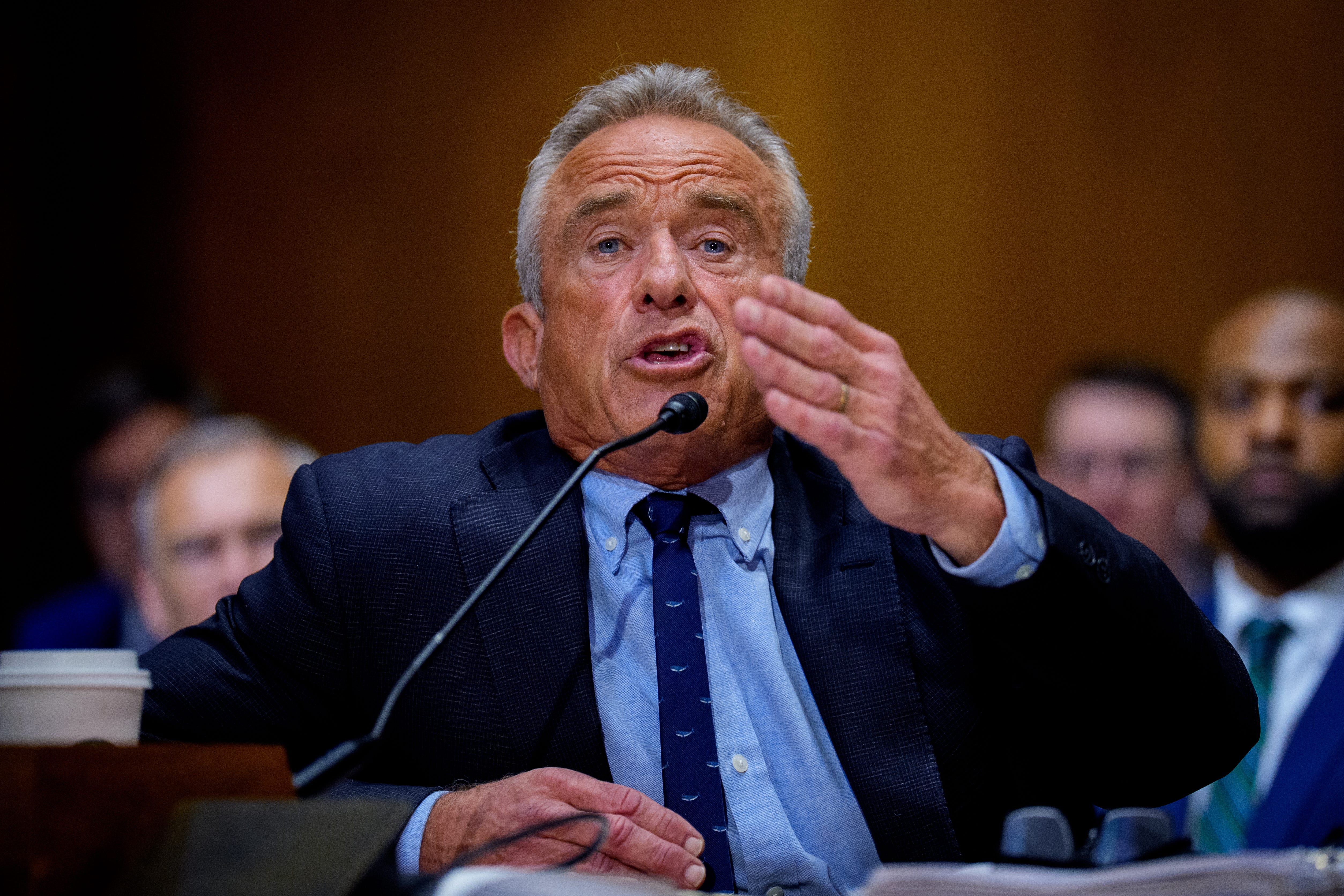
Yesterday, Kennedy—long since confirmed and busily taking a torch to America’s public-health agencies—came to the Senate again. This time, he cut a different, far more arrogant figure.
In testimony before the Senate Finance Committee, he scoffed at the deep concerns of Republican senators, issuing a torrent of wild denunciations and ridiculous claims. The CDC, Kennedy said, had been perhaps the most corrupt agency in the entire federal government up until his arrival. It was impossible to know how many people had died during the COVID pandemic, “because there was so much data chaos coming out of the CDC.” He said he was personally ensuring that U.S. vaccine guidance would be “clear, evidence-based, and trustworthy for the first time in history.” Forget about making HHS great again—Kennedy insisted he was making it great for the first time ever.
Meanwhile, many of his claims failed to pass the smell test. Susan Monarez, whom Kennedy forced out as CDC director last month after less than a month on the job, had published a fiery Wall Street Journal op-ed earlier in the morning accusing Kennedy of pushing her out because she wouldn’t sign off on unscientific mumbo-jumbo.
Kennedy had, uh, a different recollection. “I told her that she had to resign because I asked her, ‘Are you a trustworthy person?’ and she said no,” he insisted to Sen. Elizabeth Warren (D-Mass.). “If you had an employee who told you they weren’t trustworthy, would you ask them to resign?” (As everyone knows, untrustworthy people always admit to their untrustworthiness when you ask them point blank. It’s in their code of ethics.2)
While several Republican senators tried to hold Kennedy’s feet to the fire, the testiest questions came from Sen. Bill Cassidy (R-La.), a physician. This was unsurprising, given how openly Kennedy played Cassidy for a chump during the confirmation process. Among other things, Kennedy had explicitly pledged to Cassidy not to meddle with the work of the government’s top advisory committee of vaccine experts. Then, once confirmed, he fired the entire panel.
Cassidy started by asking Kennedy whether he believed his boss Donald Trump deserved the Nobel Peace Prize for Operation Warp Speed, the federal-funding program that helped accelerate the development and deployment of the COVID vaccines.
Working for Trump means accepting certain basic dogmas, and Trump should have about eleven Nobel Peace Prizes by now is one of them. What was Kennedy supposed to say? No? Kennedy said yes. Cassidy went on:
As lead attorney for the Children’s Health Defense, you engaged in multiple lawsuits attempting to restrict access to the COVID vaccine. It surprises me that you think so highly of Operation Warp Speed when as an attorney, you attempted to restrict access to the COVID vaccine.
Cassidy pressed Kennedy about apparent conflicts of interest among his handpicked nominees to the CDC’s vaccine advisory panel and wrapped up with testimony he’d received from doctors and patients about the difficulties even immunocompromised people were now having finding COVID shots. “I would say effectively we are denying people vaccines,” Cassidy said. “You’re wrong,” Kennedy shot back blandly.
What Cassidy was trying to do here was inarguably clever. If he wants Trump to cut Kennedy loose, there’s basically no stronger argument than trying to convince Trump that Kennedy doesn’t appreciate his many great achievements.
But the exchange was also infuriating. Kennedy’s anti-COVID vaccine advocacy was a widely discussed matter of public record before he was confirmed—as was his longtime rabble-rousing against other vaccines, and his dabbling in other lunatic conspiracy theories like chemtrails, and on, and on, and on, and on, and on. Cassidy knew all this. He could have blocked Kennedy’s ascension without having to resort to clever Trump-coddling psychological tricks after the fact. But he didn’t. So here we are.
Clever or not, it’s not clear Cassidy’s little trick is paying off much. Speaking to reporters later in the day, Trump said he hadn’t watched the hearings, and spouted off a few content-free endorsements of Kennedy’s performance: “I heard he did very well today,” the president said. “It’s not your standard talk, I would say that, and that has to do with medical and vaccines. But if you look at what’s going on in the world with health and look at this country also with regard to health, I like the fact that he’s different.”
Still, it’s not totally clear Trump is fully on board with Kennedy and co.’s hard charge to the anti-vax side. Earlier this week, after Florida’s crank surgeon general announced that the state would end all vaccine mandates, including for schools, I asked the White House whether Trump was on board with the plan. They haven’t responded.

Tim, Sarah, and JVL are going live in NYC on October 11.
Tickets go on sale for Bulwark+ members at noon EDT today (9/5) and for everyone else on Monday (9/8).
Visit TheBulwark.com/events for more information and to buy tickets.
What’s in a Name?
by William Kristol
The “Department of Defense” has existed for over three-quarters of a century. In 1947 Congress passed the National Security Act merging the Navy and War departments and a newly established Air Force into one organization called the National Military Establishment, headed by a secretary of defense. In 1949 Congress renamed the agency the Department of Defense.
Harry Truman knew a fair amount about war. After enlisting in the Army in 1917—at the age of 33 he was too old for the draft—he served in combat in the World War I, commanding Battery D of the 129th Field Artillery Regiment in the 35th Division. As president, Truman presided over the end of the World War II and ordered troops into combat in Korea. He championed and signed the legislation establishing and naming the Department of Defense.
Most of Truman’s successors over the next four decades, from Dwight D. Eisenhower through George H.W. Bush, served in World War II. So far as I know, they too expressed no dissatisfaction with the name Department of Defense. To the degree they considered the question, they may have appreciated a name that seemed to convey the fact that in the modern world, the United States needed a permanent and robust national security establishment that could both prepare for war but also deter future ones.
President Trump, whose bone spurs prevented him from serving in Vietnam, begs to differ. He doesn’t like the name Department of Defense. He prefers the name from the good old days, the Department of War.
Why? Well, as Trump explained in August, “We had an unbelievable history of victory when it was Department of War,” citing the two world wars. This week, Secretary of Defense Pete Hegseth echoed his boss, telling Fox & Friends: “We won World War I and World War II, not with the Department of Defense, but with the Department of War.” World War I and World War II—those were the good old days!
Now Donald Trump can’t actually change the name of the Department of Defense. That would require action by Congress, and his administration apparently doesn’t want to go to Congress to secure the name change. As the Washington Post reports:
Based on the document describing the change, the administration may be seeking to circumvent congressional action by saying the action would use the Department of War “as a secondary title for the Department of Defense.” However, it would authorize Hegseth and the department to “use secondary titles such as ‘Secretary of War,’ ‘Department of War,’ and ‘Deputy Secretary of War’ in official correspondence, public communications, ceremonial contexts, and non-statutory documents within the executive branch,” the document says.
But if this name change is so important to Donald Trump, why not go all the way? Why accept a second-class status for his cherished “Department of War” moniker? Why not go to Congress to make his case for a fully codified return to the days of World War I and World War II?
Is he scared of a debate where decorated combat veterans like Arizona Sen. Mark Kelly or Massachusetts Rep. Seth Moulton can say whether they were hampered by service in a military that was part of a Department of Defense rather than Department of War? Is he scared of testimony from former secretaries of defense—like Leon Panetta and James Mattis—as to whether they would have been better at their jobs if they’d been called secretaries of war? Is he scared to defend his childish nostalgia for the days of world war?
Or would he beg off that debate—perhaps because of bone spurs?
AROUND THE BULWARK
It’s Not Yet Too Late to Save Our Democracy… The window is closing fast—but a handful of senators and Supreme Court justices could check Donald Trump’s autocratic ambition, argues STEVEN PEARLSTEIN.
A Jane Austen–Style Romance in a Dark Web World… BILL COBERLY reviews Elaine Castillo’s new novel of love amid the internet sewage.
District Judges Are Standing Up to Trump, but Will SCOTUS? GEORGE CONWAY explains the week’s most important legal news to SARAH LONGWELL—from the Epstein files and Harvard’s lawsuit to Trump’s use of emergency powers, tariffs, and the fight for Fed independence.
Grand Juries Aren’t ‘Nullifying’ Anything. They’re Doing Their Jobs. Just because they’re often rubber stamps for prosecutors doesn’t mean they should be, writes GREGORY L. POE.
Quick Hits
THE GALAXY-BRAIN APPROACH TO MASS SHOOTINGS: Looks like the Trump administration may finally have found a gun-control policy it can get behind: The Justice Department is currently weighing proposals that could limit transgender people’s right to bear arms. CNN reports:
The talks, described as preliminary in nature, appear to build on an idea that has gained some currency in conservative media since the Minneapolis shooting that killed two children and injured 21, most of them children, at Annunciation Catholic Church, an attack that police say was carried out by a 23-year-old transgender woman. . .
Justice Department leadership is seriously considering whether it can use its rulemaking authority to follow on to Trump’s determination to bar military service by transgender people and declare that people who are transgender are mentally ill and can lose their Second Amendment rights to possess firearms, according to one Justice official.
Another senior Justice Department official cautioned that any such proposal, should it gain steam, would likely run into legal complications. Millions of Americans have mental health issues and many take medications, but are not a danger to society and therefore cannot have their rights infringed upon.
If the White House were ultimately to advance such a proposal, it would be a remarkable about-face from the GOP’s longstanding gun-policy posture, which has tended to be that anything that makes it more difficult for Americans to get guns is unconstitutional, period. Even red-flag laws—under which people’s right to buy or own guns can be temporarily restricted if a court finds they are suffering a crisis and are potentially dangerous to themselves or others—have been anathema to the core Second Amendment crowd.3 It wasn’t too long ago that the Senate rejected a measure to stop sales to people on the terrorism watchlist. Meanwhile, federal law does not restrict firearm possession by people for simple mental illness—only illness that, again, causes a person to present a danger.
It remains to be seen whether the administration will find any of that compelling—or whether transgender Americans may prove the one group they hate more than they love guns.
POCKET RESCISSION: Office of Management and Budget Director Russell Vought is always on the hunt for good new ways to wrest federal spending power away from the legislative branch. But his latest “pocket rescission” strategy to cancel billions in foreign aid appropriated by Congress just got a slapdown in district court.
The “pocket rescission” tactic, which has never been previously tried, is an attempt to exploit a quirk in the Impoundment Control Act, which permits the president to request Congress cancel specific funds it already appropriated. The law does not permit the president simply to decline to spend money he doesn’t want to spend, but he is permitted to temporarily pause spending for forty-five days while Congress considers the request—if the authorizing statute permits it. What Vought is trying to do is to smash that rescission request up against the end of the fiscal year, so the funds expire during the forty-five-day-pause window and Congress ultimately doesn’t get a say in whether or not they are spent.
U.S. District Judge Amir Ali wasn’t impressed. “There is not a plausible interpretation of the statutes that would justify the billions of dollars they plan to withhold,” he wrote in his ruling this week. The administration, of course, has already appealed.
KNOCKING ON HEAVEN’S DOOR: Donald Trump’s fundraisers have many tried-and-true dishonest tactics. Telling his supporters their contributions will get a “10x match”; saying Trump has been asking after them and is personally crestfallen they haven’t given yet; promising a shot at all sorts of prizes and perks that never materialize.
This week, however, they debuted a new one: soliciting donations to help Trump reach his eternal reward.
“I want to try and get to Heaven,” Trump says in the email pitch sent this week by his leadership committee, Never Surrender Inc. It goes on:
Last year I came millimeters from death when that bullet pierced through my skin. My triumphant return to the White House was never supposed to happen!
But I believe that God saved me for one reason: TO MAKE AMERICA GREAT AGAIN!
I wasn’t supposed to beat Crooked Hillary in 2016 — but I did.
I wasn’t supposed to secure the border and build the greatest economy in history — but I did.
I certainly wasn’t supposed to survive an assassin’s bullet — but by the grace of the almighty God, I did.
SO NOW, I have no other choice but to answer the Call to Duty, but I can’t do it alone.
God, the email seems to suggest, is weighing Trump’s eternal fate on a scale: Will he make America great, or won’t he? One thing’s for certain: A $10 donation sure won’t hurt. Pray on it, will you?
Cheap Shots
It’s always the ones you least expect. Breaking this morning:

That’s the Senate Committee on Health, Education, Labor and Pensions.
Not to mention, if Monarez were really so inherently untrustworthy, how could Kennedy take her at her word that she is so? Think it through, Bobby, damn!
Texas Rep. Dan Crenshaw introduced a bill to prevent future federal red-flag laws earlier this year.
So, a dope fiend, an idiot, a steroid abuser and a perjurer walk into a bar, and the bartender says, “what’ll it be, Secretary Kennedy?”
"What Cassidy was trying to do here was inarguably clever. If he wants Trump to cut Kennedy loose, there’s basically no stronger argument than trying to convince Trump that Kennedy doesn’t appreciate his many great achievements."
Perhaps so, but one might also argue that what Kennedy was doing was inarguably clever as well: showing the world how he played Cassidy and the other GOP doctors in order to get confirmed and exposing their judgment as incredibly poor and lacking, and their ability to think independently and put health care above politics as essentially nonexistent. I'll ask it out loud: based on what Cassidy has shown us, would you want for him to be your doctor when you need an honest assessment and treatment?