The Epstein Saga Has Only Just Begun
The next phase will involve ensuring Trump complies with the disclosures. Let us distrust and verify.


This morning, a remarkable vibe-shift data point out of Marist College: Their latest poll gives Democrats a whopping 14-point lead among registered voters on the national generic ballot, 55–41, up from a 48–48 split in their poll last year. The pollster notes that it’s the first time in more than three years that Democrats have had any notable generic-ballot advantage in their poll. Happy Wednesday.
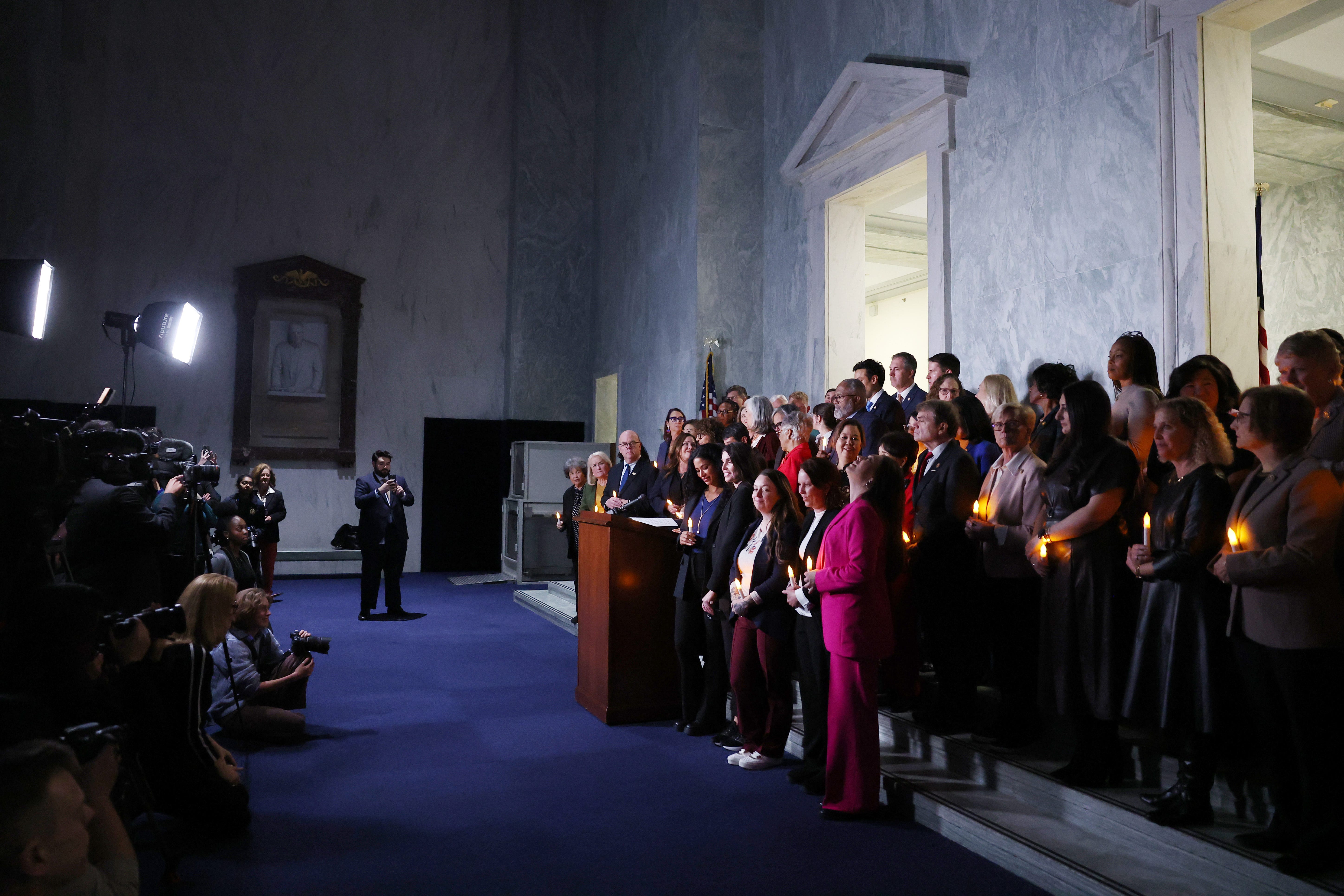
‘The Epstein Class’
by William Kristol
Who says Congress never gets anything done?
It was only a week ago that newly sworn in Rep. Adelita Grijalva (D-Ariz.) provided the final signature needed on the discharge petition to force a vote on The Epstein Files Transparency Act. Yesterday, the House approved the act by a vote of 427–1. About three hours later, the Senate deemed it passed by unanimous consent. The legislation will be transmitted to the White House today. President Trump has said he will sign the bill into law.
This act requires that the Justice Department make public within thirty days all the unclassified records, documents, communications, and investigative materials in its possession related to any of Jeffrey Epstein’s criminal activities, civil settlements, immunity, plea agreements, and investigatory proceedings. It specifies that “no record shall be withheld, delayed, or redacted on the basis of embarrassment, reputational harm, or political sensitivity, including to any government official, public figure, or foreign dignitary.”
The authors of the legislation tried to make sure any exceptions were narrowly drawn. The attorney general can only withhold or redact information from personal or medical files—the disclosure of which would constitute a clearly unwarranted invasion of personal privacy—or information that would jeopardize an active federal investigation or ongoing prosecution, “provided such withholding is narrowly tailored and temporary.” The law requires that all redactions must be accompanied by a written justification in the Federal Register.
Obviously, there is no guarantee that Donald Trump’s attorney general will carry out these legislative instructions in good faith. Pam Bondi could try to turn tight and reasonable exceptions into wide open loopholes. Her boss, the president, has already ordered up an investigation of Democrats tied to Epstein—and she quickly said she’d comply. Could that be a predicate for withholding documents?
But would she even bother to cite that investigation? There are, after all, no assurances that the attorney general won’t try to simply withhold documents and information without telling us she’s done so.
And so “distrust and verify” should be the motto going forward. Congress, the media, the survivors—everyone committed to having the truth come out—needs to be prepared to keep the pressure on throughout, and to scream from the rooftops if there seems to be evasion or stonewalling.
But here’s a wild suggestion: Donald Trump’s attorney general should do the right thing. Especially since no less august a figure than the Speaker of the House reminded us yesterday that as “[President Trump] has said himself, he has nothing to hide.”
Donald Trump said it himself! It must be true!
Yet for a guy who has nothing to hide, Donald Trump seems strangely perturbed about recent developments. In the Oval Office yesterday, he lashed out at a reporter who asked about the legislation, saying, “You’re a terrible person and a terrible reporter.” He added, “As far as the Epstein files, I have nothing to do with Jeffrey Epstein.”
The record suggests this is—how to put it?—a lie.
Trump had a lot to do with Jeffrey Epstein. He had a lot to do with the review of the Epstein files in the first months of his second term. He was briefed on the fact that his name appears in those files. He opposed the legislation requiring the release of the files. He has chosen throughout not to release the files. He has denounced the whole issue as “a hoax.”
We’ll see what Donald Trump’s attorney general releases. And if we don’t see documents and files—if the administration goes into a true cover-up in the face of the legislation the president will have signed—I think we’ll be able to see that, too.
So, as I wrote Monday, we’re only at the end of the beginning of the Trump administration’s Epstein drama.
And I think we’re also only at the end of the beginning of a broader reckoning about the meaning of the Epstein saga. That meaning goes beyond the involvement of Donald Trump. As Ro Khanna, the Democratic congressman who took the lead on the discharge petition, told the New York Times yesterday:
I was going to places like Johnstown, Pa., and I was going to places like Warren, Ohio. When I was there, the issue would come up about “the Epstein class”—that’s what they called it. They said, well, are you on the side of the forgotten Americans or on the side of the Epstein class?
“Are you on the side of the forgotten Americans or on the side of the Epstein class?”
That seems to me a powerful challenge and a fair question.
And while politics today is unpredictable—as the twists and turns of the Epstein saga have shown—I think one safe prediction is that this question won’t go away. It will be there, on or beneath the surface, in 2026 and in 2028.
What comes after Trump? A party, a movement, and a candidate with a compelling answer to this challenge and to this question.
DJT ❤︎ MBS
by Andrew Egger
Seven years ago, President Donald Trump traveled to Finland for a bilateral meeting with an important adversary: Russia’s Vladimir Putin. Special Counsel Robert Mueller’s investigation into Putin’s interference in the 2016 election was then in full swing, and only days before, the Justice Department had filed charges against 12 Russian intelligence officers for participating in the hacks of the Democratic National Committee and Hillary Clinton’s presidential campaign. The question leading up to the summit was whether Trump would hold Putin’s feet to the fire.
It came as little surprise when he didn’t. What was surprising, as the two leaders stood up there on the Helsinki stage, was the lengths to which Trump went to cover for Putin.
“Why should Americans and why should President Trump believe your statement that Russia did not intervene in the 2016 election, given the evidence that U.S. intelligence agencies have provided?” one reporter asked Putin. But Trump butted in instead: “It came out as a reason why the Democrats lost an election . . . We ran a brilliant campaign, and that’s why I’m president . . . I have President Putin, he just said it’s not Russia. I will say this: I don’t see any reason why it would be.”
I was a baby reporter for The Weekly Standard at the time, and I remember watching in real horror. I knew plenty well by then who Trump was, of course. And yet I could barely believe that his perversities and insecurities could take him this far. He was so consumed by his grievances against the U.S. media and the U.S. intelligence community that he couldn’t lay them aside even for a day to focus on a global adversary. Even more, that global adversary found it ludicrously easy to get in Trump’s good graces by playing off those same grievances. It felt then—sweet summer child that I was—like a low-water mark for Trump’s presidency.
Yesterday, seven years on, Donald Trump sat down in the Oval Office for another bilat with another world leader: Mohammed bin Salman, the crown prince of Saudi Arabia. Once again, expectations were pretty low. Unlike Russia, Saudi Arabia is a complicated U.S. ally. And if Trump has always seemed fascinated by Putin, that fascination pales in comparison to his gushing bromance with MBS, whose deep, shameless flattery Trump loves and whose eye-popping petro-largesse Trump finds both awe-inspiring and personally enriching. It seemed unlikely that Trump would take even gentle issue with MBS’s autocratic impulses or porous human-rights record. It was hard to imagine he’d bring up the crown prince’s authorization of the audacious 2018 murder of one of his loudest international critics, Saudi dissident and Washington Post journalist Jamal Khashoggi.
But somehow Trump maintains the ability to shock. The mutual tongue-bath between the two world leaders was astonishing. Trump leered as he pressed MBS to pay him ever more theatrical compliments1; MBS obliged with a smile. Trump, meanwhile, couldn’t seem to find words strong enough to express his admiration for the crown prince: “fantastic,” “brilliant,” “extremely respected,” a “very good friend of mine.” He wasn’t finished! “I’m very proud of the job he’s done,” Trump said. “What he’s done is incredible in terms of human rights and everything else.”
But Trump quickly became hostile when reporters started interrupting the geopolitical circlejerk with impertinent questions. When ABC News’s Mary Bruce asked MBS about the killing of Khashoggi, Trump jumped in—just like he had with Putin years ago—to answer for him: “A lot of people didn’t like that gentleman that you’re talking about,” Trump said of Khashoggi, who, again, was murdered in the Saudi embassy in Turkey at the authorization of top Saudi officials. “Whether you like him or didn’t like him, things happen. But [MBS] knew nothing about it, and we can leave it at that. You don’t have to embarrass our guest by asking a question like that.”
Later, when Bruce asked a question about the Epstein files—if you’re in favor of Congress’s effort to force you to release them, why not just release them now?—Trump boiled over. “You’re a terrible person and a terrible reporter,” he told her, saying that ABC should have its broadcast license revoked.
Donald Trump is an uncomplicated person. His crayon-drawn world is peopled by great friends and terrible enemies, and this distinction—their enmity toward or allegiance to Trump—is to him the only fact worth knowing about them. When he instinctively sides with the bloody autocrat who flatters him over the American journalist who holds him politely to account, he doesn’t even seem to realize he’s doing anything outlandish. What’s important isn’t that they’re allies, or adversaries, or fellow world leaders. What’s important is that they’re his bros. And of course he’s going to stick up for his bros.
AROUND THE BULWARK
‘The Great Task Remaining Before Us’: Lincoln’s Vision at Gettysburg… On the anniversary of his address, MARK HERTLING offers a reminder that democracy requires dedication.
Pope Leo and Theaters as Cathedrals… The power of Christ compels you (to go to the movies), writes SONNY BUNCH.
“Military” and “Foreign Policy” Are Not Magic Words to Give the Government Unrestrained Power… And the courts should make that clear, argues ANTHONY SANDERS.
The Not-So-Impressive “New” Health Care Ideas Republicans Want to Rush Out… In The Breakdown, JONATHAN COHN breaks down what GOP leaders are missing in their mad scramble to remake health care policy.
In Major Rebuke to Trump, House Passes Epstein Files Resolution… Trump’s grip on his party is beginning to loosen because of a group of renegade Republicans, reports JOE PERTICONE in Press Pass.
Quick Hits
LIVE FROM NASHVILLE: Kamala Harris sat down with our own Tim Miller at the historic Ryman Auditorium on Tuesday night as part of her post-election book tour. Perched on one of Music City’s most iconic stages—where greats like Dolly Parton and Johnny Cash have performed—Tim asked the former VP about the loyalty that she felt toward President Joe Biden, and whether that was ultimately a trap. They also touched on the future of the Democratic party, and what curse word she meant to call Donald Trump during that viral debate moment.
On Rep. Marjorie Taylor Greene’s recent political evolution, Harris said, “I don’t think anyone should be criticized when wisdom finally arrives.” She said there was no reason for Democrats to be afraid of Zohran Mamdani and commended him for energizing voters. She disagreed with critiques from the left that her campaign was too cozy with corporate America. She argued that the Biden White House should have had different legislative priorities. . . . And more. You can catch the full conversation on The Bulwark Podcast later today. Seriously, it’s a newsy one.
As for the broader context of the interview: There’s been a lot of conversation among the D.C. political class about whether Harris’s political appeal has expired. She decided earlier this year to not run for governor of California, and people close to her say she hasn’t ruled out a 2028 presidential run. But it’s clear that Harris can still pull a crowd. The line to get in the door snaked around the auditorium, spilling over into the downtown honky-tonk crowd. Before the event, the backstage of the Ryman was a who’s who of Tennessee Democratic politics as folks waited to get a photo with the former vice president. And state Rep. Justin Pearson, who is primarying Rep. Steve Cohen in Memphis, was spotted working the audience as they waited for the event to begin.
—Lauren Egan
GREAT WORK, PAUL: Donald Trump spent months this year trying to prevent a congressional vote on the Epstein files—but Epstein turns out not to be the only alleged sex trafficker whose criminal actions this administration is oddly uncurious about. Earlier this year, phones belonging to Andrew and Tristan Tate—the “manosphere” influencers currently facing sex-trafficking charges in three countries—were seized by Customs and Border Protection officials in Florida. But then, reports ProPublica, a White House official intervened:
Interviews and records reviewed by ProPublica show a White House official told senior Department of Homeland Security officials to return the devices to the brothers several days after they were seized. The official who delivered the message, Paul Ingrassia, is a lawyer who previously represented the Tate brothers before joining the White House, where he was working as its DHS liaison.
In his written request, a copy of which was reviewed by ProPublica, Ingrassia chided authorities for taking the action, saying the seizure of the Tates’ devices was not a good use of time or resources. The request to return the electronics to the Tates, he emphasized, was coming from the White House.
Readers of this newsletter will remember Ingrassia—who, for what it’s worth, denies the ProPublica story—as the Trump-loving chud with a self-described “Nazi streak” whose nomination to lead the Office of Special Counsel ran aground a few weeks ago after his theatrically racist group-chat texts were leaked to Politico. But Ingrassia wasn’t banished. Far from it. He remains in his role as White House liaison to DHS—where he will no doubt continue to perform invaluable tasks like scolding federal officials for investigating alleged sex traffickers.
TEXAS MAP GOES DOWN: Republicans’ and Democrats’ insane gerrymandering war got a wild plot twist yesterday: A panel of federal judges in Texas slapped down the state’s new redrawn maps, saying in a 2–1 decision2 that they appeared to constitute an illegal race-based gerrymander. The New York Times reports:
In the Texas court’s 160-page opinion written by Judge Jeffrey V. Brown, who was appointed by Mr. Trump in 2019, the judges found that “substantial evidence shows that Texas racially gerrymandered the 2025 Map.” The court cited a July letter from the Justice Department to Texas lawmakers, focused on the racial makeup of districts, in which federal prosecutors said the state’s 2021 map was unconstitutional because it included districts where no ethnic group had an outright majority. The court said that was a “legally incorrect assertion.”
Gov. Greg Abbott has already pledged to appeal the ruling to the Supreme Court—which already seems poised to rewrite the rules around race-based redistricting in a separate case coming out of Louisiana. How it will all shake out is anyone’s guess. But if the ruling holds, House Democrats may actually end up ahead of where they would have been relative to Republicans in next year’s elections if the gerrymandering war had never occurred at all. Either way, it’s all clearly just how the founders envisioned our democratic experiment running.
Cheap Shots
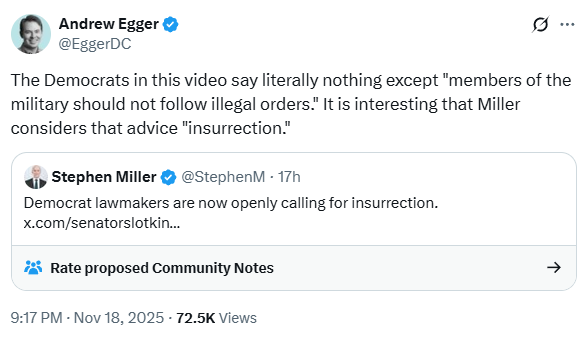
I had not realized before that Trump’s favorite description of his tenure—that America was a “DEAD” country under Biden that has now become “HOT” again under Trump—was an MBS original. Now I do, since Trump obliged him to repeat it for the cameras in the Oval. Trump also asked him jovially to weigh in on whether, compared to all other U.S. presidents, “Trump blows them all away”—MBS said something obliging that was drowned out by Trump’s laughter. What’s better than this? Guys being dudes.
For those keeping score, it was one Trump judge and one Obama judge in favor of slapping down the new map, and one Reagan judge in favor of allowing it to go forward.
We cannot let up. The Epstein victims and survivors have shown courage beyond all comprehension with their willingness to go public and demand justice. We owe it to them, no matter whose names are in the files, starting with the current president of the United States, Donald John Trump.
The display in the Oval Office yesterday was absolutely grotesque.
Trump belongs in The Hague.
We are now in Phase II of The Epstein Files. Phase II will be characterized by a deep dark conspiracy among Bondi and all of Trump's personal attorneys working in the DOJ and Kash Patel and the FBI agents he can trust "to do the right thing" to enter into "The Big Cover-Up" as they proceed to review files and remove all traces of connections to Trump under DOJ euphemisms for what should never see the light of day.
A totally independent counsel should be appointed to oversee the search through this sewage. It's the only way the American people could rely on the integrity of the findings.