The Psych-Ward Presidency
The president has no moral core. And, according to his own chief of staff, he’s surrounded by amateurs, opportunists, and drug users.


Another tranche of sour economic data came down from the Bureau of Labor Statistics today. Jobs rose by 64,000 in November, but fell in October by 105,000, thanks in part to DOGE-induced federal layoffs that finally took effect. Worse: The economy is now losing blue-collar jobs—for the first time since the pandemic— and the unemployment rate ticked up more than expected, to 4.6 percent, the highest in four years. Happy Tuesday.
The President Is Morally Sick
by Mona Charen
Yesterday, the world reacted in horror to the news of the murder of Rob Reiner and his wife, apparently at the hands of their own troubled son. Donald Trump had a more unique response.
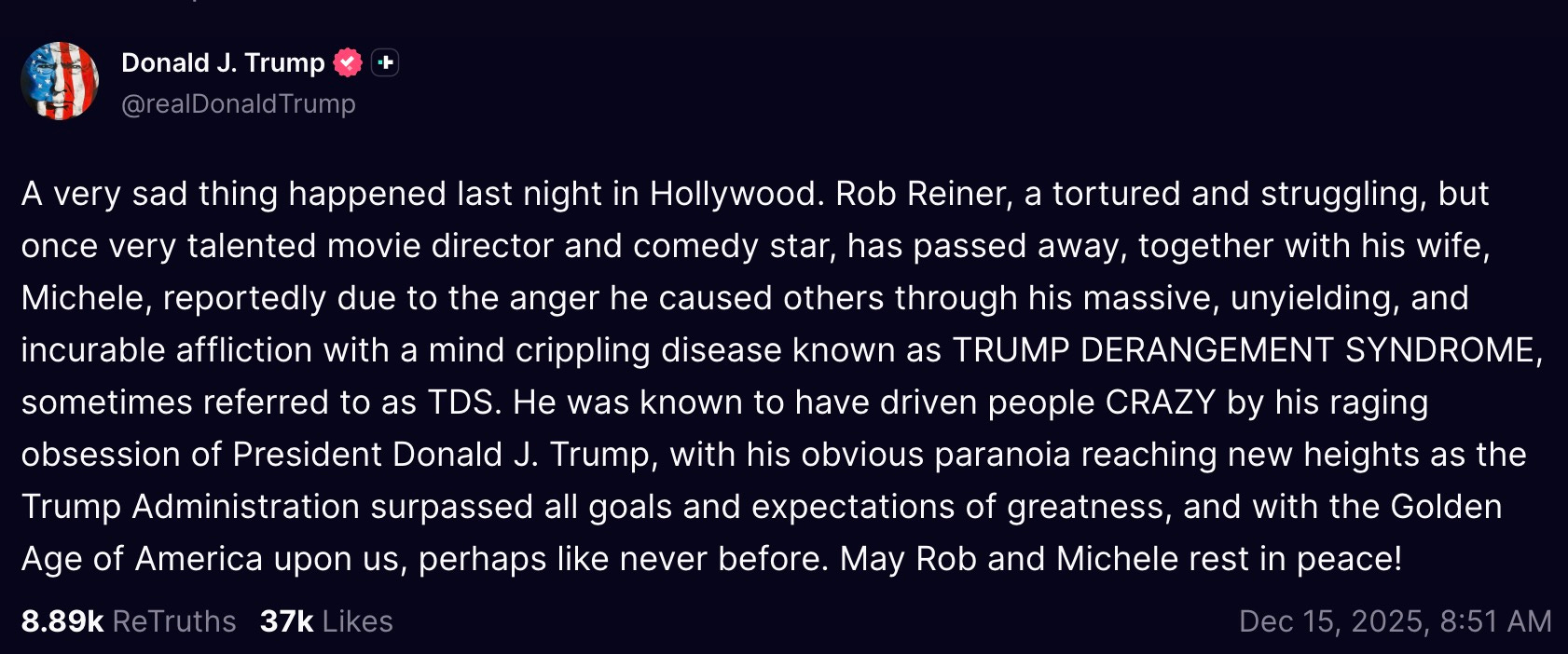
The post is deranged, pathologically narcissistic, crude, stupid, and cruel. No human adult outside a psych ward expresses such thoughts. To have them at all is evidence of a twisted soul.
A couple has been murdered in their own home, their throats slit. Rob Reiner was a Hollywood giant who played a huge part in American culture for half a century and brought pleasure to millions around the globe. One might think that Trump’s admiration for fame and money alone might have stayed his hand in celebrating this tragic crime. But no. Reiner was a Democrat and an opponent of Trump, so our commander in chief, who evidently fantasizes about the violent death of every critic, took time out of his busy TV-watching schedule to gloat that Reiner had been murdered because of his “raging obsession” with Trump.
Take a minute just to marvel at this. For most people, the idea of political violence committed by one’s own side is so psychologically uncomfortable that many would prefer to pretend it doesn’t exist. When such violence does break out, many prefer to retreat into comfortable lies rather than face the fact that their allies might stoop to such lows. And when the evidence is overwhelming that their confederates have done something despicable, they reach for crutches like “false flag.”
Trump is the opposite. So powerful is his thirst for political violence that he not only fails to recoil from it when it breaks out; he fantasizes that it’s taking place even when it isn’t. There’s zero reason to believe Reiner’s murder had anything to do with his political opposition to Trump. But the president says this is true for the same reason he says many false things are true: because he wants it to be true.
Has there ever been a simpler encapsulation of the Trump era? We suffer through daily reminders of the weakness of the president’s mind, but the United States has muddled along with other dim presidents. Where Trump occupies a category all his own is in his breathtaking moral depravity.
And witness the devoted cheering section who insist upon overlooking this man’s monstrousness. Trump’s immorality has been on vivid display for a decade, but the response by his defenders has always been to treat attention to the matter either as pure partisanship or as class condescension. For those whose minds were not nailed shut, however, the brutality of his actions comes as no surprise. Yes, a man who could rouse a crowd to murderous fury to attack Congress and his own vice president can assassinate people in boats, starve and kill hungry mothers and children in poor nations, pardon powerful drug runners, and send hapless immigrants to foreign gulags.
During these ethical swamp years, Trump’s denizens have fallen back again and again to excusing his evil as a matter of manners. Sorry, no. This is not a matter of style. The man is a moral abomination, and so are his defenders.
Not only that—notice how he continually makes his lackeys worse. Before Trump weighed in yesterday, most of the right wing’s social media discourse over Reiner was taking place in an odd, sanctimonious register—genuine shock and mourning over the tragedy paired with a million self-congratulatory little soliloquies about how Republicans, unlike those deranged leftists, don’t dance on the graves of their opponents. But then Trump posted, and the tone swung round at once: Suddenly dancing on Reiner’s grave was very much in style.
It is hard to be surprised. When you’ve spent ten years allowing your conscience to atrophy, there’s no muscle left.
Ukraine Is Still Fighting to Win
by Mark Hertling
Despite the waning attention of many Americans, the war in Ukraine continues unabated. And the events of each day shape how—and whether—it can end.
This weekend, Ukraine reported damaging a Russian submarine at the port of Novorossiysk with a sea drone. Open-source reporting confirms that Ukraine appears to have damaged a Kilo-class diesel-electric submarine tied to a pier in that port. The name of the sub has not been confirmed, but the identity matters less than the role the platform plays.
Kilo-class submarines assigned to Russia’s Black Sea Fleet are designed to operate quietly in confined waters. They can launch cruise missiles against land targets, and that’s largely the role they’ve played in this war. They allow Moscow to hit Ukrainian cities while limiting risk to the Russian Navy’s surface fleet and the Russian Air Force’s long-range bombers.
Even if the Ukrainians didn’t sink the sub, just damaging it could have strategic implications. A damaged boat tied to a pier does not launch missiles, threaten shipping, or force Ukraine to divert air defenses. But it does represent one less instrument available to attack Ukraine. And that matters.
The port’s location matters, too. Novorossiysk, 500 kilometers east of Crimea, is where the Russian Black Sea Fleet fled to after previous rounds of Ukrainian attacks made its desired home port, Sevastopol in Crimea, unsafe. A successful strike in Novorossiysk undermines Russian assumptions about fleet security and forces Moscow to allocate more resources to defending its own assets. It also reaffirms that Ukraine can fight and win in the Black Sea, which is vital for its exports and its future economic viability.
Contrast Ukraine’s strike against a missile-launching submarine and other military targets with Russia’s actions over the same weekend.
Russia continued to launch waves of strikes against Ukraine’s civilians, battering energy infrastructure and towns with no military significance. These were not battlefield strikes. They are continuing and deliberate efforts to degrade electricity and heat, specifically targeting civilians in winter—and meeting the definition of a war crime according to the Geneva Convention. This pattern is not accidental. It reflects the continuation of a campaign that is central to the Russian approach, aimed at making the daily life of Ukraine’s citizens so difficult that resistance weakens and pressure builds for concessions. It is also designed to create the appearance of victory where none exists, a deception intended as much for the Russian public as for the White House.
This distinction between Ukraine’s and Russia’s strategies is essential. One side is attacking the war-fighting capacity. The other is attacking society.
This is where those emphasizing a “deal”—including American envoys who are former business negotiators—get it wrong. Calls for Ukraine to accept military disadvantage in the name of cessation of hostilities assume Russia will respond with restraint. But experience suggests the opposite. Anyone who has dealt with Russia on any issue knows when they gain breathing room, they use it to escalate pressure. Concessions are interpreted not as goodwill but as opportunity.
Most wars do not end because both sides want peace. They end when one side can no longer achieve its objectives at an acceptable cost. While envoys talk, Russia continues to strike civilians—and Ukraine attempts to dismantle the machinery that makes those strikes possible. That contrast hasn’t changed. We’ve just stopped paying attention to it.
AROUND THE BULWARK
It’s Still Not Too Late to Do Something About Those Obamacare Premiums… People are already seeing price spikes—and many will have to give up health insurance. But Congress could enact a retroactive fix, reports JONATHAN COHN in The Breakdown.
Remembering The Best of Rob Reiner… In a special livestream, SONNY BUNCH, BILL KRISTOL, RICHARD RUSHFIELD, and DAVE WEIGEL celebrate the life and work of Rob Reiner.
Forget ‘Double Tap.’ The First Strike Was a Crime… Georgetown professor ROSA BROOKS joins MONA on The Mona Charen Show to discuss the legality (or the lack) of Trump’s drug boat attacks as well as the bonkers National Security Strategy document.
America Is an Unserious Country Filled With Unserious People… In The Triad, JVL shares some stories about revealed preferences and who we really are.
Don’t Blame the Australia Attack on Palestinian Statehood… Advocates for Israel are claiming that support for Palestinian statehood entails violence against Jews. That’s wrong—and it’s a recipe for terrorism, writes WILL SALETAN.
Quick Hits
SUSIE SAID WHAT?: Perhaps the defining trait of Donald Trump’s chief of staff, Susie Wiles, is that she’s reclusive. Arguably the most powerful person in the White House apart from the president, she rarely if ever sits down for interviews. So when we saw this morning that Wiles had agreed to talk to Vanity Fair over a series of months for a two-part article, we were surprised, even though the interviewer was with longtime chief-of-staff-chronicler Chris Whipple (he literally wrote the book, folks). When we saw what Wiles actually told Whipple on the record about her boss, his top aides, and the tent-pole agenda items they’ve pursued, we were gobsmacked. Here’s a smattering.
On Trump: He “has an alcoholic’s personality.”
On J.D. Vance: His conversion to MAGA was “sort of political,” and he has been “a conspiracy theorist for a decade.”
On OMB Director Russ Vought: “a right-wing absolute zealot.”
On Elon Musk: “He’s an avowed ketamine [user]. . . . And he’s an odd, odd duck, as I think geniuses are. You know, it’s not helpful, but he is his own person.”
On the cuts to USAID: “Elon’s attitude is you have to get it done fast. If you’re an incrementalist, you just won’t get your rocket to the moon,” Wiles said. “And so with that attitude, you’re going to break some china. But no rational person could think the USAID process was a good one. Nobody.”
On Kilmar Abrego Garcia being deported against a court order: “I will concede that we’ve got to look harder at our process for deportation.”
On deporting a four-year-old was being treated for stage 4 cancer: “I can’t understand how you make that mistake, but somebody did.”
On the tariffs: “it’s been more painful than I expected.”
On AG Pam Bondi’s handling of the Epstein files: “I think she completely whiffed on appreciating that that was the very targeted group that cared about this.”
On the cases against James Comey and Letitia James: “I don’t think he [Trump] wakes up thinking about retribution. But when there’s an opportunity, he will go for it.”
On Venezuela: “If he were to authorize some activity on land, then it’s war, then [we’d need] Congress.” (Mark that one down!)
On herself: “Not patting myself on the back, but just recognizing the reality of this president at this time . . . I’m just not [sure] who else could do this.”
The entire interview is extraordinary, and we encourage people to spend some time reading it in full, as it provides the most unvarnished look at the White House to date. It also gives you a deeply honest, sort of unnerving portrait of Wiles, who sees herself far more as a facilitator for Trump than a check on his worst impulses or even a strategist on his payroll. As she tells Whipple: “I’m not an enabler. I’m also not a bitch. I try to be thoughtful about what I even engage in. I guess time will tell whether I’ve been effective.”
EV-B-GONE: After years of pouring resources into its electric-car division, Ford is making a major shift. The automaker announced yesterday it would scale back plans for electric-vehicle production and shift more resources toward gas and hybrid models, taking a $19.5 billion bath in the process. The New York Times has more:
The announcement amounted to an admission by Ford that it had overestimated demand for battery-powered vehicles and underestimated the staying power of vehicles powered by gasoline and diesel.
The move was also the result of a reversal in government policies since President Trump took office in January. His administration has slashed government incentives for electric vehicles while promoting fossil fuels. . . .
A new factory in Tennessee that had been expected to produce an electric pickup truck will instead produce a gasoline model, Ford said. The company will cancel plans for an electric commercial van and instead build new gasoline and hybrid models in Iowa.
None of this is much of a surprise. In a zero-subsidy vacuum, most consumers today still prefer hybrids to electric vehicles. After Trump’s Big Beautiful Bill killed the subsidies this summer, automakers were going to need to scale back EV plans. This was, of course, the point of EV subsidies in the first place: to nudge the U.S. vehicle market in a less fossil-fuel-dependent direction.
Reasonable people can debate whether those subsidies were good or bad policy. But three years after they went into place, they had already become part of the regulatory status quo around which companies had made multi-year production plans—plans they now must spend big-time money to adjust. In fat economic times, that might not be such a big deal. But with the labor market already lagging and prices already jumping, economic inefficiencies like this just add to the burden.
GIVE BACK WHAT YOU STOLE!: The big legal fight over tariffs is on a glide path for now, with the White House and American businesses waiting breathlessly to see whether the Supreme Court will strike down Trump’s huge, global “liberation day” tariffs. But Politico reports that there’s a separate legal battle underway as well, involving companies fighting to prevent the government from depositing their tariffs irretrievably in the U.S. Treasury before the Court can rule on whether they were legally collected:
The Trump administration is racing to deposit the money it’s raised from tariffs into the U.S. Treasury, a tactic that could make it harder for companies to get refunds for duties the Supreme Court may strike down in the coming months.
That has triggered a flurry of lawsuits in recent weeks, with companies ranging from wholesaler Costco to canned tuna seller Bumble Bee looking to preserve access to potential refunds for tens of billions of dollars worth of tariff fees. And it foreshadows the messy legal battles likely to play out if the high court rules President Donald Trump overstepped his legal authority when he imposed his steep “reciprocal” tariffs and other duties on major trading partners.
According to court filings and half a dozen people familiar with the cases, Trump’s Customs and Border Protection is denying requests to delay finalizing tariff payments and transferring the funds to the Treasury. In some cases, the agency is even fast-tracking that process, according to attorney Brett Johnson, a partner at the law firm Snell & Wilmer, who spoke Thursday during an advisory webinar for importers.
Cheap Shots
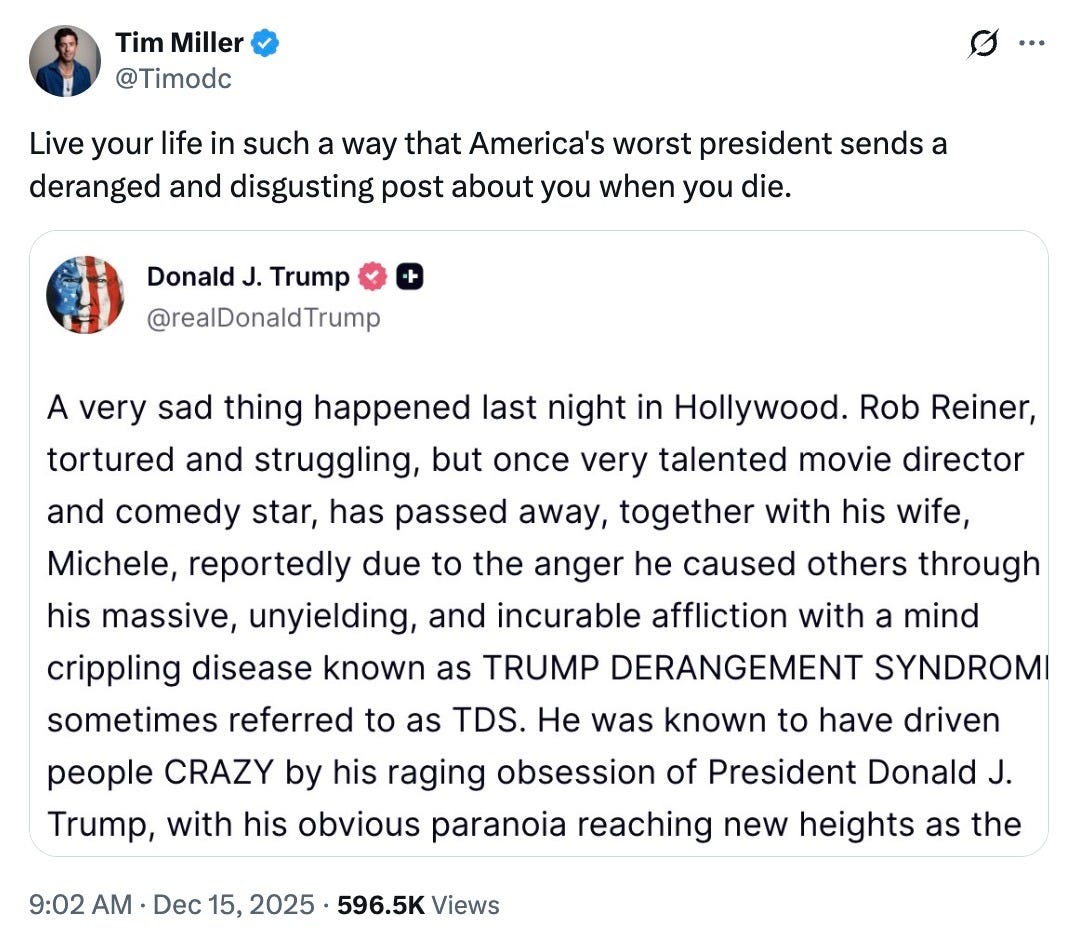
I hope Susie Wiles lives the life she deserves, having enabled a man she knew was manifestly unfit to assume the most powerful position in the world. May god forgive her, because I won't.
Trump's a psychopath. He has no regard for anyone or anything but himself, probably not even for his fucked up family.