

Trump’s Chilling Weaponization of Confidential Government Records
Remind me—who else in history made lists of Jewish intellectuals and people with disabilities?

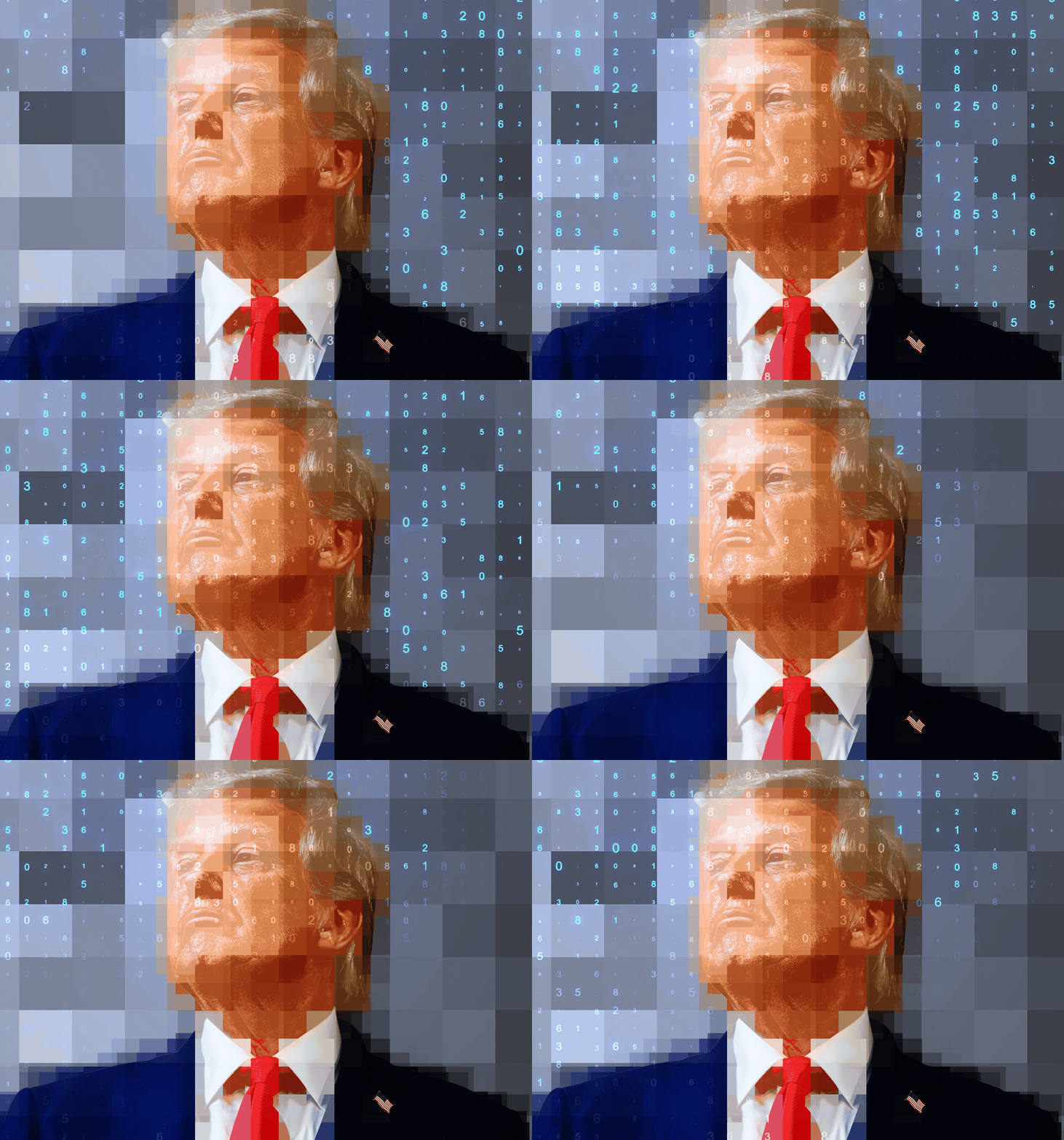
THE TRUMP ADMINISTRATION has been compiling lists. There are lists of immigrants, lists of people with developmental disabilities, lists of dissidents—and lately, even lists of Jews.
All ostensibly in the name of public safety.
Over the past year, I’ve been tracking the Trump administration’s use and abuse of federal data. For the most part, this has involved deletions of records that the regime finds inconvenient, or other forms of censorship. For example, the administration has stopped publishing certain statistics on climate change, hunger, trade and sexual orientation. It has also deleted photos of nonwhite people serving in the military. When Trump found the official jobs reports insufficiently flattering, he fired the head of the statistical agency that produces those figures, after having already slashed the agency’s staffing by 20 percent.
But now it’s becoming clearer that some of the most disturbing developments don’t involve data the administration is suppressing, but rather data it’s collecting—in some cases illegally—and the ways those data can be weaponized against perceived enemies.
For example, the Trump administration recently sued the University of Pennsylvania to force it to hand over a list of Jewish faculty, staff, and students. The government is demanding the school release these records without first obtaining consent from Jewish community members themselves; authorities say they need the university to produce this Jewish registry to help the government “combat antisemitism” on college campuses.1
The University of Pennsylvania has refused to cooperate, to its credit. But not every school has done the same. Last year, Barnard College complied with a similar demand. Barnard faculty and staff were shocked to receive unsolicited text messages asking them to fill out a questionnaire bearing the logo of the U.S. Equal Employment Opportunity Commission (EEOC), confirming whether they were indeed Jewish.
This should go without saying, but these days it apparently needs to be said: There’s good historical reason to worry that an authoritarian government leader collecting a registry of Jews, under the pretext of protecting Jews, while that leader has referred to Jews as “disloyal,” and that leader’s coalition has many outspoken Jew haters and Holocaust deniers, may not end up so well for Jews.
“Against a backdrop of rising antisemitism, white supremacy, and other forms of hate, the danger that lists of Jews or other groups could fall into the wrong hands looms especially large,” reads a filing this week from five groups affiliated with UPenn.
What might these groups mean by “the wrong hands”?
Well, even if you give the EEOC the benefit of the doubt and assume that it intends to use this information in a purely benevolent way, someone else in government might try to access Jewish data registry for more nefarious purposes. Such as, say, whoever over at the Department of Homeland Security has been using openly white-nationalist slogans and imagery in its recruiting.
THE POSSIBILITY THAT THESE DATA could be misused is not just a baseless, hypothetical concern: Again and again the Trump administration has been caught sharing data and breaching confidential records for purposes other than the stated reason for why those confidential records were collected in the first place.
For instance, last year a whistleblower alleged that DOGE had unlawfully accessed private Social Security data and copied it into a less-secure cloud environment, where it could be more easily manipulated and exposed. In court filings, the administration insisted that DOGE employees had done only what was necessary to fulfill Trump’s commands to “modernize technology and to ‘maximize efficiency and productivity’” within the Social Security Administration.
But the whistleblower, Charles Borges, was worried about data security all the same, and was troubled that SSA employees were directed not to talk to him when he started asking questions.
“I’m not alleging any particular nefarious intent or that any data was actually compromised,” Borges, who was SSA’s chief data officer, told me in an interview last week. “But the way that the environment was structured, even if data had been compromised, it’s entirely possible we would never know. That’s a huge risk.”
Borges was right to worry.
Shortly after we spoke, the government finally acknowledged that the DOGE workers at SSA had communicated with an unidentified political advocacy group about using Social Security data to help overturn election results in certain states. In fact, “one of the DOGE team members signed a ‘Voter Data Agreement,’ in his capacity as an SSA employee, with the advocacy group,” the government said in a court filing.
These kinds of abuses of confidential government records are happening across government.
Last year the Internal Revenue Service agreed to share confidential tax records with ICE to assist immigration-enforcement efforts—despite having assured immigrants for decades that their compliance with tax law would never be weaponized against them.2 A judge blocked the IRS-ICE agreement in the fall, but similar (possibly illegal) data-sharing agreements are being allowed elsewhere. Last month a federal judge ruled that ICE can use Medicaid data in immigration enforcement, for example, while a legal challenge works its way through the courts.
“They’ve been sucking up data from all across government for immigration enforcement purposes, like basically anything that might have names, familial relationship, address, any geographic information,” said Bethanne Barnes, who until October had served for six years as the chief data officer for the Administration for Children and Families at Health and Human Services. “Just assume it’s all getting sucked in.”
Barnes quit, she told me last week, in part due to some “funny business” related to the government’s matching up of information on immigrant children with a national database of employment records. She said she worries not only about how data like these are being misused today, but the amount of distrust these revelations are fostering—which might make the public less willing to report information honestly (or pay their taxes, or cooperate with law enforcement) in the future.
“If you start violating all those protections, especially at scale, eventually it harms the quality of the data, right?” she said. In the past, data-sharing among government agencies has often been uncontroversial—beneficial, even. Matching up records can help officials spot patterns, solve problems, identify failed policies, and improve people’s lives. But when you have an administration that doesn’t respect privacy safeguards and that clearly doesn’t care about improving outcomes for people, then sloppy, secretive, and nonconsensual new efforts at data-sharing should be met with healthy skepticism.
Or sometimes, for that matter, fear.
When the National Institutes of Health director announces his agency will create a “disease registry” of people with autism—to be compiled without consent, via confidential private and government health records—some members of the autism community understandably heard it as a threat. After all, the announcement came a mere week after his boss, HHS Secretary Robert F. Kennedy Jr., stated that children with autism will never lead productive lives. And elsewhere, the president and various political appointees have mocked people with disabilities. NIH subsequently walked back the comments after public outcry from the autism community, but the recent “MAHA” report and other government documentation suggested similar efforts may still be in the works.
Meanwhile, Tom Homan, Trump’s border czar, has threatened to create his own “database” of people who protest ICE, which sounds an awful lot like twentieth-century government databases of Commies, wrongthinkers, and other political enemies. Or perhaps worse historical analogues, from Europe, also implemented in the name of keeping the public safe from the enemies within.
So I ask you, my fellow Americans: Do you feel safer yet?
Ramparts
— On the point about data suppression: The Trump administration is also intimidating anyone in the private sector who might deign to produce credible alternative numbers. That’s what happened this week when an analyst at Deutsche Bank wrote a client note about how many bonds are held by Europeans (who are obviously pretty mad at us right now). Treasury Secretary Scott Bessent said that the bank’s CEO apparently called to apologize and to say the bank did not stand by the note. If you had assumed that the private sector would step in to fill statistical voids left by government deletions, this should give you pause.
— Last week I wrote about how Trump was driving our allies into the arms of China. This week, French President Macron said: “What we need is more Chinese foreign direct investment in Europe in some key sectors to contribute to our growth.”
— OpenAI board chair Bret Taylor says that AI is “probably” a bubble, and that he expects a correction in the coming years. Points for candor, I guess.
— A senior CDC official says the loss of measles elimination status in the United States would just be a “cost of doing business.” Lord Farquaad would like a word.
— New research concludes the Trump administration’s policies could cut legal immigration in half over the next four years.
UPenn was one of the universities that saw considerable student activism and protests over the war in Gaza. Its president resigned following 2023 congressional testimony regarding campus antisemitism.
Thanks for this information. So much is going on that important details such as this get buried. The stealing of our data will plague us for years, decades. That evil genie won’t go back in the bottle. Nothing good will come of this, and probably a whole lot of bad will.
Incredibly disconcerting...