Trump’s Pathetic Little Nothingburger of a Speech
In the absence of a plan, the president chose to pretend that things are going well.


Lots to discuss today, but one big headline before we do: We’ve got a DHS deal. The partial government shutdown looks likely to end after House GOP leadership suddenly agreed yesterday to accept the Senate’s proposal to fund everything in DHS except ICE and the Border Patrol—itself a package Senate Democrats had suggested long before Senate Republicans finally agreed to it last week. More on this below. Happy Thursday.
Oh, the War? Don’t Worry. It’s Over. Almost.
by William Kristol
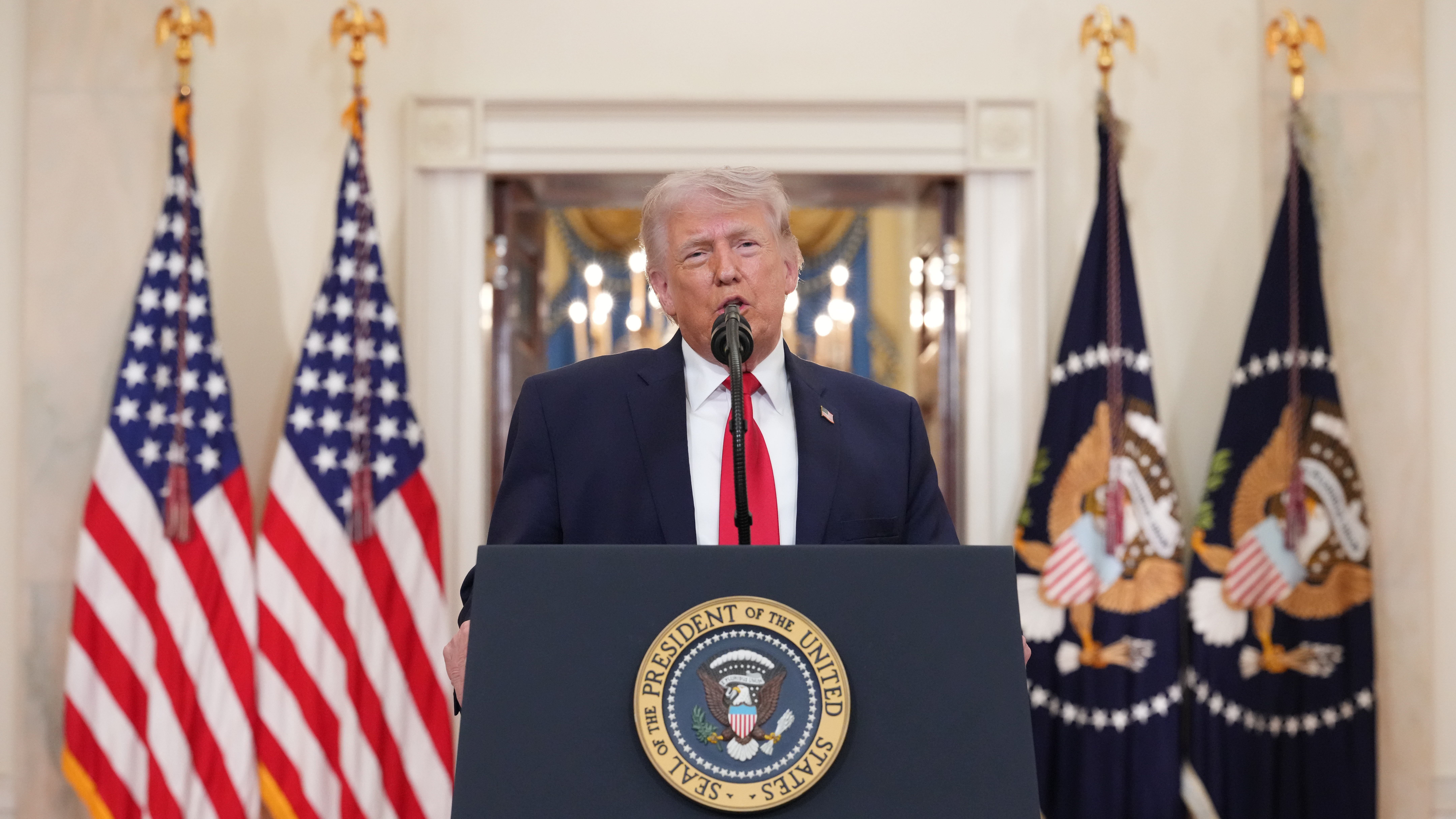
What was the point of Donald Trump’s sad and lackluster speech to the nation last night?
The main point—really, the only point—was that his Iran war is basically over. Of course it’s not quite over. But, he wants us all to understand, it’s going to be over soon. Very soon.
“We are going to finish the job and we’re going to finish it very fast.”
“We are on track to complete all of America’s military objectives shortly, very shortly.”
Why is Trump so very eager to have the American people understand that his war is so very much “nearing completion”? Because, as Nate Silver and Eli McKown-Dawson put it, in the last two weeks Trump’s “popularity has taken something of a nosedive.” So Trump wants out. Last night he promised us over and over again that we’ll be out soon.
Trump doesn’t want the American people to think too hard about the lack of justification for the war. He doesn’t want anyone to dwell on the fact that there was no imminent threat from Iran, or that Trump didn’t obtain authorization to go to war from Congress. He doesn’t want the American people to focus on what his administration’s conduct of the war has shown about its lack of character and competence. And he wants to divert attention as much as possible from the real-world consequences of his war for the American and global economy.
And by the way, what about all those U.S. troops steaming toward the region for possible ground operations—to take Kharg Island or reopen the Strait of Hormuz or seize the nuclear material? What about all those plans for putting “boots on the ground,” something that Trump boasted just a few days ago that he wasn’t afraid of?
Fuhgettaboutit. The prospect of the use of ground troops was never raised in last night’s update. The term “ground troops” was never uttered.
Trump did go out of his way, however, to tell us that this war was not going to last as long as World War I or World War II or Vietnam. So that’s something. And he told us that even though we’ve already “completely decimated Iran,” that we’ll be doing some more decimating on our way out the door. “We are going to hit them extremely hard over the next two to three weeks. We’re going to bring them back to the Stone Ages [sic], where they belong.”
So we won’t succeed in preventing the Iranian regime from closing international waters in the Strait of Hormuz, and we won’t be doing anything to help liberate the people of Iran from that oppressive regime. But we’re going to continue to rain down death and destruction on the nation of Iran.
Our founders hoped that the United States might herald a Novus Ordo Seclorum, a new order of the ages. In Trump’s America, we’ve given up on that promise. Instead we boast that we’re going to bomb people back to the “Stone Ages, where they belong.”
NASA vs. the Internet
by Andrew Egger
For the first time in more than half a century, we’re heading for the moon. Yesterday evening, the Artemis II mission launched successfully from Florida’s Kennedy Space Center, sending four astronauts—Americans Reid Wiseman, Victor Glover, and Christina Koch and Canadian Jeremy Hansen—on a ten-day mission to circumnavigate the moon. The mission’s path around the moon’s dark side is expected to take it farther from Earth than humans have ever gone.
Watching the launch was surreal and awe-inspiring and, especially for Americans old enough to remember the Apollo program, a throwback to a vanished American age. This was especially true, I suspect, for people who watched the launch via a terrestrial TV newscast. “So impressed that CNN has stuck with coverage of Artemis II, giving it the attention it deserves as a major milestone in human history,” Peter Baker of the New York Times tweeted. “Compelling television that is about courageous people taking risks on behalf of all of us instead of those trying to divide us.”
Being a digital native myself, however, I didn’t watch Artemis II’s launch on TV. I streamed it on YouTube. In the main window of Fox’s LiveNOW stream was the same sublime, breathtaking footage. But that wasn’t all. Over in the sidebar raged the other distinctive characteristic of the streaming internet: the infinite gibbering scroll of the live-video comments feed. It wasn’t clear everyone was feeling particularly exalted. Pepe-avatar trolls crowing that the whole thing was obviously faked, people arguing about whether the Earth is flat, squabbles about preposterously off-topic matters like the death of Charlie Kirk, commenters offering fervent prayers for the mission, others asking NASA to turn the rocket to give them a better view: It all raged past, faster than you could read, at the speed of the internet’s id.
Later, I saw a viral clip from the Daily Wire’s stream of the launch: Host Michael Knowles, who was on site, got so fed up with commenters accusing him of being on a green screen that he unclipped his lav mic, took out his earpiece, and ran into the background of his shot, doing jumping jacks and pulling up clumps of grass.
It’s always been a bit like this, of course. The Apollo missions were a noble, audacious endeavor, a triumph of the human spirit that lifted the nation in a glorious common purpose—and they were also the genesis of one of the first big internet-style conspiracy theories. The idea that America faked the moon landings, that the powerful interests who controlled our information streams could hoodwink the public into believing in entirely fictional events through the magic of SFX, was an idea ahead of its time. Tinfoil-hat types would find many more applications for this sort of thinking later.
The mechanism of this sort of conspiratorial thinking has evolved. During the Apollo program, all the footage Americans saw—the ones who weren’t physically there, that is—came through a handful of institutional channels: the big news organizations and, of course, NASA itself. Today, the situation couldn’t be more different. Panning shots of the crowds who gathered near the Kennedy Space Center to watch the Artemis II launch in lawn chairs showed pretty much everybody with their smartphone out, documenting the rocket launch for themselves. Several viral videos were captured by observers with a particularly lucky viewpoint: They happened to be on flights where they could see and tape the rocket’s flight through the plane window.
We now live in a world where events like the Artemis II launch are better documented than ever, with hundreds or thousands of independent observers capturing them in HD.
But we also live in a world where every image, every video, every story, every take comes to the remote observer through the delivery mechanism of the internet algorithm. He is pelted with it—the real and the fake, the truths and the lies, all mixed together, raw, unmediated, context-collapsed. There is more to know than ever, if only he could figure out which bits to grasp. Instead, a certain type of internet user retreats into himself, dismissing it all with the same general-purpose sneer. Elaborate explanations of central-channel fakery—NASA falsified the footage to help us win the Cold War!—are no longer really needed. One-size-fits-all cynicism that we can really know anything about anything is enough to suit his purposes.
AROUND THE BULWARK
APRIL FOOL… SAM STEIN, JVL, and MARK HERTLING were live, reacting to President Trump’s April 1 address on the war in Iran.
How Big Is the Democrats’ ‘Big Tent’? In The Opposition, LAUREN EGAN takes on on the creation of the Hasan Piker litmus test.
Why Quitting NATO Would Be a Huge Mistake… MARK HERTLING on how to understand the value of the alliance.
Trump Is Doing Structural Damage to American Intelligence… The issue isn’t just his disregard for facts. It’s that he’s reshaping the government in his image, writes JOHN SIPHER.

ICYMI: Our next Bulwark Founders Town Hall will be April 13. Upgrade to a Founders Membership today to join JVL and Sarah for this exclusive virtual town hall.
Quick Hits
DHS DEAL: Here’s the bad news up front: With their limited leverage in both the House and the Senate, congressional Democrats have not yet been able to force Republicans to acquiesce to any of their civil-rights demands about ICE enforcement, from banning masks to mandating badges, body cameras, and uniforms.
But when it comes to the procedural wrangling, it’s been shocking how effectively Democrats have driven the negotiating process from the beginning. First, they succeeded in striking a deal that would fund the whole federal government except for the Department of Homeland Security over their demands that Congress codify ICE reforms. Now, they’ve held firm until Republicans caved on funding everything in DHS except ICE and the Border Patrol.
Until about two seconds ago, Republicans were denouncing this solution as ludicrous. Sen. John Cornyn scoffed last month that it was “not acceptable.” Then he voted for it. Last week, House Speaker Mike Johnson called it a “joke.” Now he’s on board, too.
Republicans still think they have a path to re-fund ICE without giving Democrats an inch on their demanded reforms. They hope to jam the funding into a party-line reconciliation bill later this year. But that leaves them at the mercy of the Senate parliamentarian, who decides what can and can’t qualify for simple-majority legislation. And meanwhile, it leaves the fight exactly where Democrats want it, with TSA and FEMA funded, and the only remaining question a straightforward one: Before ICE gets its money, will Republicans agree to make them take the masks off?
BIRTHRIGHT CITIZENSHIP: Donald Trump wants to unilaterally end the constitutional guarantee of birthright citizenship. Now, as the Supreme Court considers the matter, he’s doing everything he can think of to tilt the scales in his favor. Which is to say: He’s trying to bully the court into it with Truth Social posts—“We are the only Country in the World STUPID enough to allow ‘Birthright’ Citizenship!”1—and a little good old-fashioned mean-mugging: Trump attended oral arguments in the case personally yesterday, apparently on the theory that the judges would be more sympathetic to his case if he could stare them down from the gallery.
It’s not clear it worked. Politico reports that, Trump or no Trump, the justices “sounded broadly skeptical about his attempt to upend the country’s long tradition of birthright citizenship”:
The court’s conservative majority joined the liberals in aggressively questioning [Solicitor General John] Sauer about the potential implications of disturbing the decades-long consensus on citizenship.
The president sat through about an hour of arguments before silently exiting after a lawyer for the American Civil Liberties Union stepped to the lectern to attack Trump’s policy as a violation of the Constitution’s 14th Amendment and Supreme Court precedent dating back to the 19th century.
It’s no big shock he didn’t stay longer—this is a guy, after all, who can seemingly barely stay awake these days even for his favorite forms of entertainment, like cabinet meetings where everybody is falling over themselves to pay him the biggest compliments. The Court is expected to issue a ruling by early summer.
Cheap Shots
The president opens up a new front in his World War on Culture:

Not true.
The hardest part of a two-week war is the first six years.
“And he wants to divert attention as much as possible from the real-world consequences of his war for the American and global economy.”
Not to mention the Epstein files.