


We may be in the midst of an expanding and unconstitutional war, and the president may just have fired the disgraced cabinet secretary who’s been overseeing his key domestic policy plank, but hey: At least the economic numbers stink too. The United States lost 92,000 jobs in February, the Bureau of Labor Statistics reported this morning, while the unemployment rate ticked back up to 4.4 percent. JVL and Catherine Rampell will go live later today to discuss around 12:30 p.m. EST.
Programming note: There’s a very special Triad newsletter from JVL coming later today. We don’t want to spoil the surprise, but make sure you check it out. Exciting news—that’s all we’ll say for now. 👀
Happy Friday.
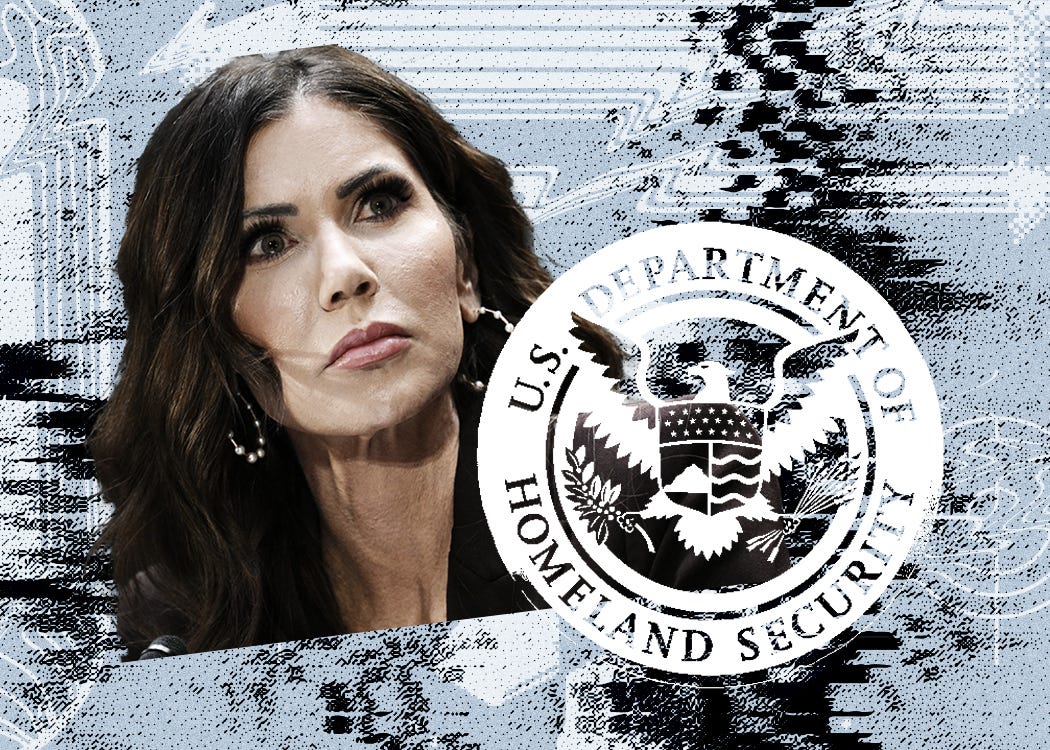
Kristi’s Unforgivable Sin
by Andrew Egger
Over the past year, Secretary of Homeland Security Kristi Noem has overseen many, many atrocities and told many, many lies on Donald Trump’s behalf. Ironically, however, the statement that made him mad enough to fire her seems like it might have been the truth.
Across two days of bruising testimony this week, Noem faced a gauntlet of pointed critiques from House and Senate Democrats—but it was a particular line of questioning from Sen. John Kennedy (R-La.) that sealed Noem’s fate. “The president approved ahead of time you spending $220 million running TV ads across the country in which you are featured prominently?” Kennedy asked.
“The president tasked me with getting the message out to the country and to other countries where we were seeing the invasion come from, with putting commercials out,” Noem said. “That has been extremely effective.”
If it was a lie, it’s one she’s been telling for a while. Thirteen months ago, speaking at CPAC and fresh on the job, Noem enthusiastically related a conversation she said she’d just had with the president: “Those beautiful ads you did about South Dakota. . . . I want you to do those for the border,” she said Trump had told her. “I want you to thank me. I want you to thank me for closing the border.” Seems plausible!
That’s not how Trump remembers it, though, at least not anymore: “I never knew anything about it,” he told Reuters yesterday.
In his second term, Trump has surrounded himself with a team of remarkably sycophantic and rubber-spined people; it’s amusing to note how even these people have learned how to play him. Noem had made many enemies for herself in the White House, both by her heavy-handed personnel management at DHS and by her catastrophic-in-hindsight attempts to blame Stephen Miller for her failures in Minneapolis (again: It’s true, but she shouldn’t have said it!). From beginning to end, the Kennedy play appears to have been an attempt by these enemies to lead the president like a toddler by the hand to the conclusion that Noem had to go. She’s trying to blame you for her mistakes, Mr. President!1 She could survive the deaths of Renee Good and Alex Pretti, since Trump didn’t care much about those. This, though, hit close to his heart.
Still: All’s well that ends well, and everyone can and should cheer Noem’s ouster. In a cabinet full of lunatics and lickspittles, Noem still managed consistently to distinguish herself by her cruelty, her stupidity, her paranoia, her pathological dishonesty, and her self-aggrandizement. She made a mockery of her department’s organizational structure by running her ship through the outside adviser she was allegedly boinking, the ur-psycho Trump ally Corey Lewandowski. Her consistent focus was on using her perch both to build her personal brand and to feed the online right’s bloodlust for scenes of violence against immigrants and protesters alike. (For a good rundown of the lowlights of her tenure, go read the great article our Adrian Carrasquillo wrote for the site yesterday.)
Trump’s pick to replace her, Oklahoma Sen. Markwayne Mullin, is a MAGA meathead of the highest order, but I’d hesitate to predict confidently that he’ll be any worse—at any rate, he’ll have his work cut out for him if he hopes to be. And this isn’t nothing: We hope we won’t have to think about Corey Lewandowski’s sex life ever again.
Presumably, Democrats will mostly oppose Mullin’s nomination; presumably, he will be confirmed on a largely party-line vote regardless. But Senate Democrats should keep their eye on the ball here: For the moment, who’s running DHS should matter to them a lot less than what institutional controls they can impose on it before turning the money spigot back on. We don’t yet fully know what a Mullin-led DHS might look like. But we know it’ll look a lot better if ICE and Border Patrol officers are wearing uniforms and badges than if they’re not.
How much of a change do you think Mullin will make at DHS? Are his incentives to make things better—or worse? Share your thoughts in the comments.
“Comfortable With the Use of Force”
by Mark Hertling
It’s not exactly breaking news that President Donald Trump has ordered the military into combat more often in his second term than in his first. “Though he was critical of other presidents’ foreign entanglements on the campaign trail,” says a report from the Council on Foreign Relations, “President Donald Trump has demonstrated a willingness to use U.S. military force in his second term.”
Greg Jaffe at the New York Times agrees: “One year into his second term, Mr. Trump seems to have shed his earlier skepticism and turned repeatedly to the U.S. military as a low-cost, high-payoff means of solving problems that have bedeviled American presidents for decades.”
But it was the phrasing of Times White House correspondent Peter Baker that struck me. “Trump,” he wrote, “is far more comfortable using the instruments of power than he was the last time around, at home as well as abroad.” Baker repeated this on Morning Joe yesterday morning: “He is more comfortable with the use of force.”
“Comfortable.” Should any leader ever really be comfortable going to war, sending American men and women into harm’s way?
During the first fourteen months of the second Trump administration, the president has ordered the use of military force in Iran, Iraq, Syria, Yemen, Nigeria, Somalia, and Venezuela. Most of those strikes signaled deterrence or retaliation and were precise, surgical, and quick. Was the immediate feedback from those actions overinterpreted, and was the lesson to someone who has not been in combat that war can be sanitized, controlled, and failure-proofed?
Military professionals spend their careers studying how force works—how it is organized, applied, sustained, and limited. They study weapons and logistics, but also psychology, escalation, and the unpredictable friction of combat. Over time military leaders come to understand something civilians sometimes overlook: Once force is unleashed, what unfolds never goes exactly as expected.
History reinforces that lesson.
From Korea to Vietnam, from the Balkans to Afghanistan to Iraq, American presidents have ordered the use of military force to advance political objectives. As the Prussian strategist Carl von Clausewitz famously wrote, war is “the continuation of policy by other means.” But Clausewitz also wrote about “chance” and “friction,” and how things don’t always go as desired in war. Every president has confronted that reality. And Harry Truman, John F. Kennedy, Lyndon Johnson, Bill Clinton, and George W. Bush aren’t the only presidents who have learned that even with the best planning, no one can anticipate every possible second- and third-order effect of military operations.
Force is never abstract. It is carried out by real people—America’s sons and daughters—who strap on body armor, climb into aircraft, sail into dangerous waters, or deploy to distant bases knowing they may not return. Behind every strike order sits the possibility of escalation, retaliation, or a wider conflict that pulls young Americans deeper into harm’s way.
Experienced commanders know this instinctively. Many of the most seasoned military leaders often sound cautious when discussing war not because they doubt American capability, but because they understand its limits. Military power can destroy targets with remarkable efficiency. Turning that destruction into durable political outcomes is far harder. Tactical victories often produce strategic complications. Successful strikes might trigger wider reactions.
This is why responsible national leadership requires two qualities at the same time: expertise and, in my view, a level of discomfort and anxiety.
Expertise ensures decisions are grounded in strategy—clear thinking about ends, ways, and means. What is the political objective? What military action advances it? How do those individual tactical actions contribute to an operational plan? What risks follow? What happens the day after the strikes end?
Discomfort serves as a moral and strategic guardrail. Leaders who feel the weight of ordering teenagers toward hardship, injury, and death are more likely to ask the necessary hard questions. They consult widely, think about escalation, and remember that war is not simply a tool of policy but a human undertaking with irreversible consequences.
The paradox is that those who understand force best are rarely eager to use it. They prepare for it. They plan for it. They master it. But they never become comfortable with it.
If a president is becoming more knowledgeable about military power, that is a good thing. If he is becoming “comfortable” ordering it, that should give all of us pause—because too much comfort with the desire to use force is rarely a sign of wisdom.
One Man’s War Becomes One Party’s War
by William Kristol
This week, first in the Senate and then in the House, the Republican party defeated legislation limiting President Donald Trump’s currently unchecked ability to conduct the war in Iran. And the GOP has chosen not to advance alternative legislation that might have imposed less stringent time constraints, or any limitations at all—even just reporting requirements—on President Trump’s conduct of the war.
Rather, the Republicans in Congress have given a blank check to Trump for war. It’s a war that his press secretary said yesterday is based on his “feeling, based on fact, that Iran does pose an imminent, indirect threat to the United States of America” Yet the administration has produced no facts that would support Trump’s feeling.
But not to worry. After his party blocked the War Powers Resolution in the House, Speaker Mike Johnson tried to reassure the American people that “We’re not at war, we have no intention of being at war. The president and the Department of Defense have made it very clear . . . this is a limited operation.” Except that the president himself reiterated yesterday that we are at war. Indeed, he reminded us that “When you go to war, some people will die.”
Many already have. More will. Especially because as Trump’s secretary of defense emphasized earlier this week, the war is “just getting started” and is “accelerating.” And Trump himself has refused to rule out introducing ground troops; he is encouraging and supporting cross-border actions into Iran that would further widen the war; and he seems to plan on exercising a veto on who next rules that nation.
Meanwhile, less than a week in, the major economic consequences of this not-so-limited operation are already becoming evident. The administration is signaling that substantial additional congressional appropriations will be required. And of course the human toll of the conflict will continue to mount.
I still think, as I suggested yesterday, that Donald Trump may well realize he is on a path to political disaster and may reverse course. Given that the rewards of the action (removing Khamenei and degrading his regime’s power) are mostly already reaped, and the risks and costs are increasing every day, he might conclude that ending the conflict would be, from his own point of view, preferable to letting it go on.
But Congress has left this entirely up to him. Who knows in which direction Trump’s narcissism and megalomania will push him? For now, what we do know is that one man has taken us to war. We know his party has voted to give him a blank check to continue it. One hopes for the sake of the country that things turn out reasonably well, better than this administration deserves. But wars tend to dash hopes.
AROUND THE BULWARK
How the Iran War Looks From Russia… And what it could mean for Ukraine, reports CATHY YOUNG.
No, There Was No ‘Imminent Threat’ From Iran… Team Trump shows that words made to mean everything will cease to mean anything, observes WILL SALETAN.
Ethan Suplee and the Challenge of Getting Nasty… On The Bulwark Goes to Hollywood, ETHAN SUPLEE and ROD BLACKHURST join SONNY BUNCH to discuss their new film, Dolly.
Plus, Sonny reviews The Bride!, Maggie Gyllenhaal’s new film.
The Secret is out now! Sarah and JVL recorded an early Secret Podcast exclusively for Bulwark+ members. They talk about the Noem defenestration and Stephen Miller’s hidden hand. Then Sarah reveals her secret.
Quick Hits
ANTHROPIC UNDER FIRE: The Pentagon officially dropped the hammer on AI company Anthropic yesterday, informing the firm it had been designated a supply-chain risk—but going much less far in that designation than Defense Secretary Pete Hegseth had initially threatened.
Last week, Hegseth announced that “no contractor, supplier, or partner that does business with the United States military may conduct any commercial business with Anthropic.” While any supply-chain risk designation for the company would have constituted an enormous overreach, this claim beggared belief: By commanding contractors not only to leave Anthropic out of their government work but to cease all business with them altogether, it essentially amounted to a declaration of intent to murder the company.
The actual designation, Anthropic announced yesterday, doesn’t go nearly so far. “With respect to our customers,” Anthropic CEO Dario Amodei said in a statement, “it plainly applies only to the use of Claude by customers as a direct part of contracts with the Department of War, not all use of Claude by customers who have such contracts.” (Emphasis original.)
Amodei also reiterated that Anthropic is still working toward a resolution with the Defense Department and apologized for a rash (read: honest) internal memo he sent last Friday, which was later leaked, in which he had said the “real reasons” the White House had gone after them was because “we haven’t donated to Trump” or given him “dictator-style praise.” Heat of the moment, you know?
PAXTON’S LAST STAND: Donald Trump is leaning toward making an endorsement in Texas’s GOP Senate primary—for one sensible reason and one insane one.
Republicans are, of course, heavily favored to win the Senate seat currently held by Sen. John Cornyn this year. But some have worried that Democratic nominee state Sen. James Talarico could have a real shot if Republicans abandon Cornyn for scandal-plagued state Attorney General Ken Paxton. This week, Talarico won his primary while Paxton and Cornyn advanced to a runoff, and party officials quietly started leaning on Trump to throw his support behind Cornyn. Then Trump raised the stakes by announcing, “I will be making my Endorsement soon, and will be asking the candidate that I don’t ENDORSE to immediately DROP OUT OF THE RACE!”
But Paxton didn’t take the hint. Instead, he said Wednesday that he intended to stay in the runoff no matter what. “I owe it to the people of Texas,” he said. “Everything that Trump stood for, John Cornyn’s fought.”
But Trump wasn’t impressed—who is this pipsqueak Paxton to tell him what he stands for? “Well, that’s bad for him to say,” Trump told reporters of Paxton’s comment. “That is bad for him. So maybe—maybe that leads me to go the other direction.”
Man, do these people deserve each other.
Cheap Shots

And a bonus . . .

Bringing General Hertling on was one of the best choices the Bulwark ever made. I always learn so much from his pieces.
Kristi Noem was a good soldier until the very end. She did everything she was asked and then some. She shoveled the red meat to the base faster than they could eat it until the hemoglobin load became too much. Her firing demonstrates the limits of a certain style of performative Trumpism and its limits and it all comes down to Minneapolis.
The citizens of Minneapolis demonstrated an America we weren’t sure existed anymore. Minneapolis started feeding the hungry, clothing the naked, ministering to those in prison and welcoming the stranger within our midst. Values we once thought were part of us, but had atrophied away a spirit of collective activism we didn’t know we still had. When people say empathy is toxic and compassion weak, I have one word: Minneapolis. The citizens of Minneapolis should take a bow as your empathy and compassion just took the first scalp of the Trump administration. Minneapolis and what happened there as tragic at it was ultimately sealed her fate.
Somewhere in a dark room Kristi Noem lies rocking in the fetal position, thumb in mouth while hugging her blankie whispering over and over, Minneapolis.