




Donald Trump doesn’t have enough fights going on at the moment, it seems, so last night he picked one with the pope. “Pope Leo is WEAK on Crime, and terrible for Foreign Policy,” the president wrote on Truth Social. He went on and on: how he likes the pope’s MAGA brother Louis better, how he doesn’t “want a Pope who criticizes the President of the United States because I’m doing exactly what I was elected, IN A LANDSLIDE, to do,” how unforgivable it is that the pope had an audience with “Obama Sympathizers like David Axelrod.”
“Leo should get his act together as Pope, use Common Sense, stop catering to the Radical Left, and focus on being a Great Pope, not a Politician,” Trump concluded. “It’s hurting him very badly and, more importantly, it’s hurting the Catholic Church!”
Given Leo XIV’s richly earned reputation as the Bulwark pope, we suppose this was only a matter of time.
Programming note: Tonight is the first Founders Town Hall of 2026. Thanks to all our Founders and Navigators for helping to fuel our growth! Want in on this exclusive livestream? Upgrade now and join us tonight. Sarah and JVL will kick things off at 8:30 p.m. EDT.
Happy Monday.
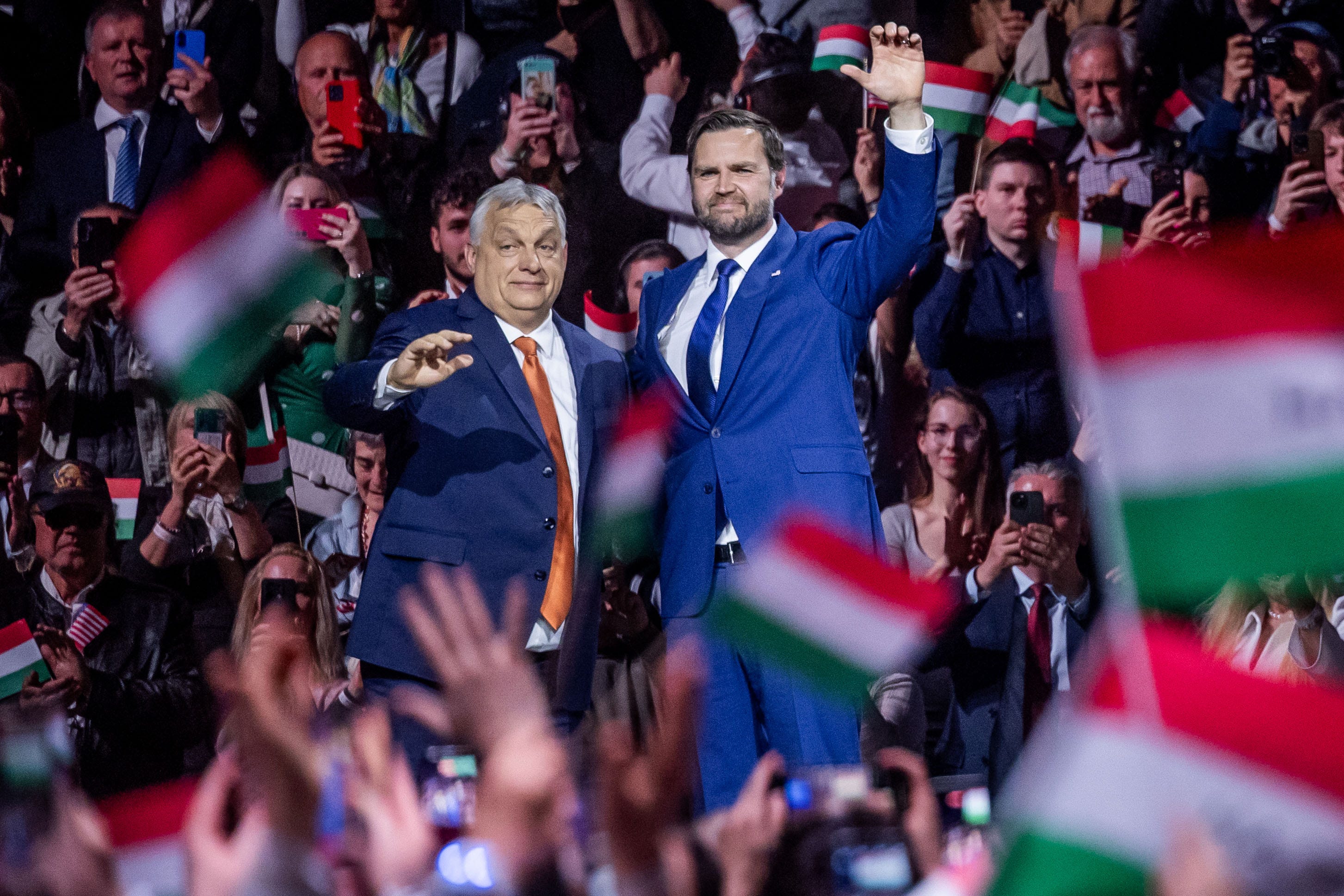
Victor Not Orbán
by H. David Baer
Budapest, Hungary
“Spring wind brings rising water . . . every bird must choose a partner”—so begins the popular Hungarian folk song that Péter Magyar’s opposition party adopted as the theme for its campaign. The image of rising water goes well with the party, which shares its name, Tisza, with a river in eastern Hungary. Yesterday, the Tisza flooded.
The flood began with record turnout, upwards of 77 percent, an early sign that looked favorable for the opposition. Soon after returns started coming in, Tisza took a commanding but not decisive lead. Then, unexpectedly, around 9:15 p.m. local time, Prime Minister Viktor Orbán phoned opposition leader Péter Magyar to congratulate him. Minutes later, Orbán delivered a concession speech that, if not exactly gracious, was nonetheless honorable and fully in line with democratic expectations. Fears that Orbán would not acknowledge defeat proved unfounded.
At 10:30 p.m., Magyar appeared, waving a Hungarian flag as he marched through the middle of the enormous crowd assembled for his victory party in Batthyány Square.
Like everything in Magyar’s history-making campaign, the choice of election-night venue was overlaid with symbolism. Batthyány Square takes its name from Lajos Batthyány, the first prime minister of Hungary and a hero of the 1848 Revolution, who was executed for his commitment to Hungarian freedom. The square sits on the banks of the Danube, directly across from the country’s neo-gothic Parliament, whose columns and spires glimmered as Magyar ascended the podium to deliver his victory speech—and to announce that Tisza had won a supermajority in Parliament. Now, with nearly all the votes counted, Tisza is expected to have 138 seats, five more than needed to reach the two-thirds threshold for enacting sweeping constitutional reforms.
Yesterday’s election was, in part, a referendum on Orbán’s leadership and his makeover of the Hungarian government. But it was also a battle for the soul of Hungary. To describe the election as a clash of two campaigns would be to miss a major part of the story: Yes, Orbán was running a campaign, but Magyar was leading a social movement. In every city he visited the last two weeks, crowds came out by the tens of thousands. The photos are astounding. Rallies this big aren’t really rallies; they feel more like marches or demonstrations, something more significant than a rally. Hungarians did not take to the streets in numbers like this even in 1989.
Orbán apologists are already trying to use this election as proof that his regime was always democratic—how else, after all, could Orbán have been defeated? But this shallow and self-serving argument ignores the improbability of Magyar’s rise, the scale of his achievement, and the change in Hungarian society set in motion by the movement he led. This country is different than it was when Orbán was returned to power sixteen years ago. Its people have drunk deeply from the bitter cup of divisive politics, of petty vindictiveness, of corruption and incompetence, of resentment and hatred. They have had more than a taste of kleptocratic authoritarianism, demagoguery, and unrestrained political power. They have gorged themselves on Christian nationalism—and they have spit it out. True to the Hungarian traditions of 1848 and 1956, they have chosen Europe; they have chosen democracy.
This must all be especially demoralizing for Orbán’s American apologists and the hangers-on at the Danube Institute and Mathias Corvinus Collegium1 in Budapest. But if they look closely enough at Hungary rather than its strongman leader, they might discover a few lessons in Orbán’s fall. Here’s one: In their narrowminded focus on the value of so-called national sovereignty and national traditions, they forget that nationalism in its early eighteenth-century stages was closely aligned with liberalism. Early liberals, seeking to establish a political foundation for their countries other than monarchy, appealed to sentiments of national unity built on language and culture. This early nationalism wasn’t perfect, but at least it was a political project built on aspirations for self-determination, a better life, and respect for other peoples.
Such liberal nationalism is connected to collective aspirations for better things and healthy pride in one’s national history, both of which are closely connected to the capacity to feel shame. A person feels shame when he recognizes that he has failed to live up to his high standards and ideals, when he has failed to demonstrate the quality of character of which he is capable. A nation feels shame when its people recognize they have failed to live up to their principles, to the image of themselves as a noble people pursuing a better future. In both cases, the feeling of shame motivates an individual or a nation to change, to improve. A true patriot has a capacity to feel both pride and shame in his country.
Although making people feel ashamed is not a normal campaign strategy, feelings of shame did float in the background of Magyar’s campaign when he talked about how Orbán had betrayed his country. This was one of Orbán’s most striking accomplishments: to make many Hungarians ashamed of their country. Although Orbán’s fearmongering about Ukraine worked for him four years ago, his willingness to betray Ukraine for the sake of personal gain revolts many Hungarians. Orbán’s alliance with Russia, which all Hungarians can see, evokes visceral disgust.
Observers around the world watching Orbán fall will likely comment on how the ‘illiberal international’ has lost its lodestar—but the significance of yesterday’s election runs much deeper. As early as 2011, the Hungarian philosopher Ágnes Heller wondered if the rise of Orbán might be related to the way Hungary experienced the events of 1989. Poland had Solidarity, East Germany the Monday Demonstrations, Czechoslovakia its Velvet Revolution, and Romania its violent revolution. But in Hungary the change of regime was negotiated over the heads of the people by reform Communists and a small group of dissidents.2 Now, thirty-seven years after the fall of communism, Hungary has at last had its color revolution.
Next: The work begins. In his victory speech, Magyar promised to move swiftly to root out Orbánism, and he called on Orbán’s allies to resign. With his parliamentary supermajority, he will be able to do much more to fulfill his campaign promise that Hungarians will rebuild their country “step by step, brick by brick.”
Jekyll Jekyll Hyde...
by Andrew Egger
Despite last week’s supposed ceasefire, the Strait of Hormuz never really reopened. Iran had been letting a trickle of vessels pay tolls to get through before the ceasefire, and they kept doing the same thing after. Now, however, it appears the strait is about to be—for the first time—totally shut. And this time, it’s Trump who’s shutting it.
This weekend, Pakistan-brokered talks between the U.S. and Iran broke down over the negotiation’s fundamental point: Iran remains unwilling to end nuclear enrichment, and the White House remains unwilling to sign a deal without this concession. Now, however, the United States has added its most aggressive economic pressure yet: It will forcibly close Iran’s Hormuz tollbooth.
“Effective immediately, the United States Navy, the Finest in the World, will begin the process of BLOCKADING any and all Ships trying to enter, or leave, the Strait of Hormuz,” Trump wrote on Truth Social Sunday morning. Iran’s continued economic control of the Strait, Trump wrote, was “WORLD EXTORTION.” “I have also instructed our Navy,” Trump added, “to seek and interdict every vessel in International Waters that has paid a toll to Iran. No one who pays an illegal toll will have safe passage on the high seas.”
Between the United States and Iran, in other words, the strait will now be completely blockaded: If Trump is to be believed, no ship that fails to pay Iran will make it through the strait, and no ship that pays will make it through either.
Four points are worth making here. The first is simple: The United States has no more right than does Iran to blockade the Strait of Hormuz, a waterway in which unmolested freedom of passage is guaranteed by international law.
The second is that this announcement represents just the latest insane policy yo-yo from Trump in this conflict. Until now, the president—sweating under the skyrocketing global price of gas—has pursued a Jekyll-and-Hyde policy of making it easier for Iran to ship and sell its oil even while bombing the country to smithereens. Last month, the administration lifted decades-old sanctions on some Iranian oil in an attempt to control global costs. Now, they have swung without warning as far the opposite way as it’s possible to go: not merely sanctioning but blockading Iranian oil, and the oil of any vessel from any nation that pays Iran’s exit bribe to boot.
The third is that this is the latest Iran plan announced without, it seems, the slightest consideration of its effects. Set aside the blatant pirate illegality of Trump’s move. America’s military, the president suddenly announces, now stands ready to take hostile action toward any ship of any nation that tries to transit the strait under Iran’s conditions. And not only that: A plain reading of Trump’s threat would seem to indicate that any ship anywhere that paid the bribe even before Trump’s announcement—“every vessel in international waters that has paid a toll to Iran”—could be subject to U.S. interdiction. You don’t need MENSA certification to see some of the obvious immediate risks for spiraling conflict. Chinese ships have transited the strait through the tollbooth; is the U.S. military now under orders to seize these ships? This astonishingly open-ended threat has, unsurprisingly, driven yet another massive wedge between us and our allies; the UK has already announced it will not help Trump enforce his blockade.
Finally, the announcement is the clearest demonstration yet of the strange dual forces shaping Trump’s strategic decision-making. If the president is truly determined both to stop Iran’s nuclear enrichment and confiscate its fissile material and to reopen the strait, there is really only one strategy at his disposal that would fit both aims: an invasion with ground troops. But Trump, perceiving—probably correctly—that this would lead to yet another despised Middle East forever war, seems unwilling to give such an order.
In fact, putting boots on the ground is about the only thing Trump is apparently unwilling to do—or even to threaten. This has forced him into a series of bizarre contortions as he tries to find elaborate and disruptive ways to coerce the Iranians into submission from afar. He’s tried a shock-and-awe bombing campaign. He’s tried threats of genocide. Now, he’s trying a naval blockade. What are the odds he threatens to use nuclear weapons next?
AROUND THE BULWARK
Trump’s Path of Destruction… On Shield of the Republic, MONA CHAREN joins ERIC EDELMAN to discuss the week’s developments—from NATO and Hungary to Vance’s Iran assignment—while unpacking MAGA’s internal splits, Netanyahu’s influence on Trump, and the broader political and cultural fallout at home.
Hey, Democrats: Take Yes for an Answer… Welcome America Firsters into the tent—and steal their message, argues TIM MILLER.
Zoning Laws Are Killing the Middle Class… On How to Fix It, JOHN AVLON talks with MECHELE DICKERSON about how housing rules, college costs, and the modern school system are stacked against working families—and how those same systems could be fixed.

Exclusive member-only presales for our Southern California live shows start on Tuesday, April 14. Watch your inbox for the access code and visit TheBulwark.com/Events for updates.
Tickets for everyone else go on sale Friday, April 17.
Quick Hits
SWALWELL FALLING: California Rep. Eric Swalwell was a liberal star who was widely considered the Democratic frontrunner to succeed Gavin Newsom as governor next year. Then, in a single weekend, the wheels fell off. On Friday, CNN and the San Francisco Chronicle independently released stories detailing separate allegations of sexual misconduct by Swalwell—including a rape accusation from a former staffer and accusations of unsolicited nude photos and explicit messages from several other women. Swalwell denied the allegations, despite their being corroborated by significant circumstantial evidence. But it was clear almost at once that his campaign stood little chance of surviving them. His endorsers, including Nancy Pelosi, started backing out en masse.
On Sunday night, the congressman threw in the towel: “I am suspending my campaign for Governor,” he wrote in a statement. “To my family, staff, friends, and supporters, I am deeply sorry for mistakes in judgment that I’ve made in the past. I will fight the serious, false allegations that have been made—but that’s my fight, not a campaign’s.”
The statement was odd—if he’s claiming the allegations are lies, what’s he apologizing for? Regardless, his departure leaves the California governor’s contest in a truly bizarre spot: No other candidate in the jungle primary had been polling above 15 percent. The latest Emerson College poll found Republicans Steve Hilton (13 percent) and Chad Bianco (11 percent) near level with Democrats Tom Steyer (11 percent) and Katie Porter (8 percent).
SAND RISING: In less sordid governor news: We’ve been paying quite a bit of attention lately to Rob Sand, the Iowa auditor who’s running a surprisingly competitive Democratic campaign for governor. On Friday, the nonpartisan Cook Political Report moved its rating of the contest from “Lean Republican” to “Toss Up,” pointing to Sand’s favorable brand as an anti-corruption crusader, his strong fundraising numbers, his early polling position, and his go-everywhere media strategy.
In a post this weekend on her Substack, Iowa political reporter Laura Belin pointed to another element of Sand’s pitch: his regular attacks on the lack of state oversight of a school voucher program Iowa Republicans passed in 2023. School choice has become a major culture-war issue in red-state politics over the past few cycles, with more Republican governments passing policies to allow parents to take their public-school tuition dollars to pay tuition for private schools. The issue tends to be broadly popular on paper but can generate a backlash in practice, since it risks creating major budgetary problems for the public schools where most parents send their kids. And Sand, with his transparency- and accountability-focused brand, seems uniquely positioned to make hay on the topic. Here he was this weekend at a forum of the Iowa State Education Association, per Belin:
The only thing private schools can’t do with the voucher funds [Sand said] is pay a rebate to parents. “If you want to buy booze with public dollars as a private school in the state of Iowa, you can do that. If you want to run a for-profit school,” you can do that as well.
“And bless my heart, I thought they had made a mistake,” he said, drawing laughs from the crowd. “Pat me on the head, right? So trusting, so naive.” He went to find one of the bill’s supporters, thinking they would want to fix the problem. . . . Sand said that after he walked through the problems with the bill, [the supporter] replied, “We know. We don’t want public oversight of private schools.”
“Then don’t give them public money! How about public oversight of public money? That’s not complicated!” Sand said, drawing applause and another standing ovation.
Cheap Shots


Correction (April 13, 2026, 5:15 p.m. EDT): As originally published, the name Mathias Corvinus Collegium in this sentence was mistakenly written as Matthias Corvinus College.
The deeper reasons for this have to do with the Revolution of 1956, which pushed Hungary’s Communist regime to develop in a moderate direction over the long run, so that by 1989 even reform Communists were ready to let the system go. But the Hungarians who benefited most from 1956 were a new and different generation. The freedom they received in 1989 was an unexpected gift, something they hadn’t even asked for.
 | A guest post by
|
It bothers me so much that after 70 years as a proud American, I am now celebrating when our president is defeated and humiliated publicly. He's the most vile person imaginable.
Regarding: "Is Trump Resurrecting Epstein?" Hah, Bill, I didn't know you could be so snarky! Thanks for that laugh.