




As we were putting this newsletter to bed this morning, Secretary of Defense Pete Hegseth took to a Pentagon podium to brief the media on the ongoing state of the conflict in Iran. TL;DR: Mission Accomplished.
Iran’s regime, he said, has waged a “savage, one-sided war against America” for decades. “We didn’t start this war, but under President Trump, we are finishing it.” Apparently, this war will go better than Iraq and Afghanistan because we have no long-term objectives: Trump “called the last twenty years of nation-building wars dumb, and he’s right. This is the opposite,” Hegseth said. “No stupid rules of engagement. No nation-building quagmire. No democracy-building exercise. No politically correct wars.”
Guess we’ll see. Happy Monday.
It’s Not Too Late for Congress to Act
by William Kristol
Over the past year, the Trump administration has done great damage both to our free government at home and to the cause of freedom abroad. Now it has sadly—even tragically—put the admirable cause of freedom for the people of Iran at odds with upholding the Constitution of the United States.
In June of last year, when the United States acted to help Israel damage Iran’s nuclear program, President Trump drew the line short of seeking regime change. But at some point since then, the Trump administration seems to have decided that in fact regime change was the only real solution to the dangers posed by the Iranian regime, and that now was the time to finally help the people of Iran liberate themselves from their dictatorship.
I don’t quarrel with this judgment. Indeed, there were many occasions over the last two decades that we could have done more to help the people of Iran move towards freedom. Now, two days into the war, one can’t help but be moved by the scenes of citizens of Iran taking to the streets to welcome the prospect of liberation from their cruel and despotic regime.
Could their belated liberation be at hand? One hopes so.
There were indications—most obviously the massive deployment of military forces to the region in recent months—that the administration was planning on a major war aimed at regime change in Iran. Given the lack of evidence of serious reconstruction of Iran’s nuclear program, and given that there was no reason to fear any kind of imminent danger from Iran’s missiles, the aims of that war were clearly going to go beyond simply further degrading those programs. And it’s now obvious that the administration has been working with Israel for quite a while on an attack whose scope and scale is consistent with the goal of regime change.
So, in announcing the attack early Saturday morning, President Trump said,
Finally, to the great, proud people of Iran, I say tonight that the hour of your freedom is at hand. . . . When we are finished, take over your government. . . . For many years, you have asked for America’s help, but you never got it. No president was willing to do what I am willing to do tonight.
But the president’s action was his alone. He had plenty of time over the last couple of months to make the argument to the American people for regime change in Iran. He didn’t. Even more important, he had plenty of time to go to Congress for authorization for such a war. He didn’t. He probably would have prevailed in such a vote. If he hadn’t, then he could and should have held off on going to war.
But Trump didn’t go to Congress. So now we are in both a major war and a constitutional crisis.
Congress may now have a limited ability to affect the course of the war. But it can respond to the constitutional crisis. Congress will have a chance this week to assert its role, even if belatedly, with some form of War Powers resolution. It can show it is unwilling to leave crucial questions of war and peace to the full and unlimited discretion of the executive. It can refuse to acquiesce in the shredding of our Constitution.
Meanwhile, Trump is unfortunately spreading confusion about rather than clarifying our war aims. Over the last two days, President Trump made such contradictory remarks that one can have no confidence that he really knows what he’s doing. The Economist’s Gregg Carlstrom summarized the situation well early this morning:
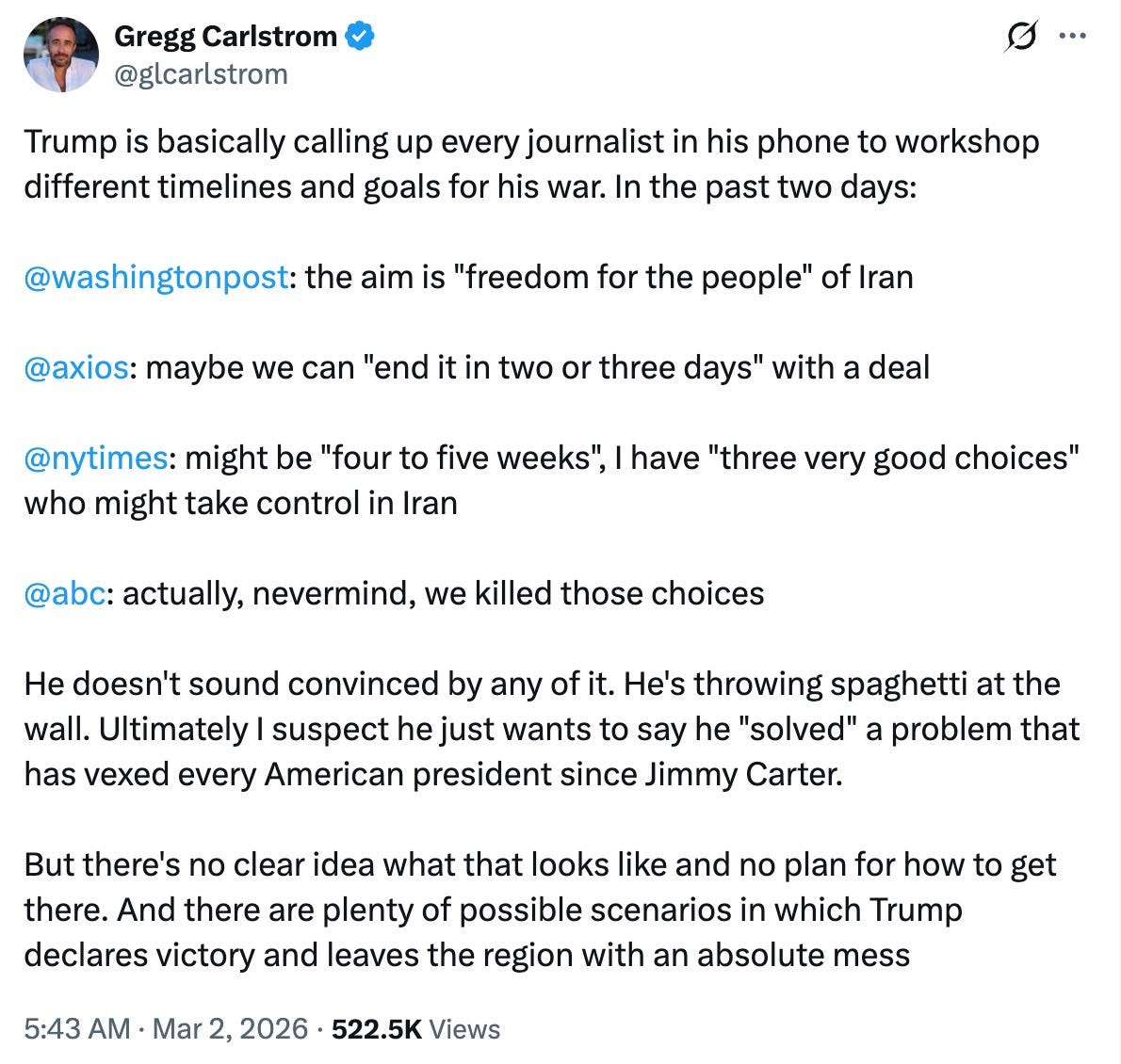
I very much hope that this war doesn’t end with the region in “an absolute mess.” I very much hope it results in a better Middle East, and in freedom for the people of Iran. Congress may not be able to do much to get the president to focus seriously and consistently on this objective. But Congress can at least uphold and strengthen our constitutional order. Congress can act to prevent Donald Trump from leaving our own Constitution “an absolute mess.”
For generations, Congress has been happy to give up its power and amp-up its grandstanding. How do we make it take back power—and responsibility? Share your ideas in the comments.
Join us for MAGA Monday this morning at 10 a.m. EST!

In Case You Missed It. . .
If you decided to enjoy your weekend and wait to catch up on the news until this morning, we have everything you need. Here’s what we published on Iran over the past two days:
Tim Miller, Sarah Longwell, JVL, and Lt. Gen. Mark Hertling went live on Saturday morning as news was still breaking. You can watch the livestream playback on Substack or on YouTube.
Ben Parker asks three major questions about Trump’s attack on Iran: Why now, what role did Israeli Prime Minister Benjamin Netanyahu play, and doesn’t this all seem a little bit like the leadup to Iraq, but faster and dumber? Believe it or not, we have some preliminary answers to those questions!
Mark Hertling cautions that launching air strikes is easy; translating violence into political change is much, much harder. The administration has lofty goals, but it’s not clear they have a plan to achieve them. Simply put: You can’t bomb someone into democracy.
Giselle Donnelly thinks through what happens in Iran after Khamenei. Trump has made it clear that his goal is regime change. The Israelis killed the supreme leader. But what actually happens next in Iran could be no improvement. In fact, things could get worse.
Tim and Mark joined Bill on Bulwark on Sunday to discuss the future of Iran, the United States, and what this attack could mean in a larger context. They also talk through the design of the initial American attacks and the three U.S. service members who died in the operation. Watch on Substack or on YouTube.
Sarah and Tim ask: Where is the Trump administration anyway? Shouldn’t they be out there explaining to the country why we’re suddenly at war? Why does the administration think that a Truth Social post is the same thing as an Oval Office address combined with a congressional declaration of war? Watch on Substack or on YouTube.
Mark Stein and Will Saletan break down the defenses of the Iran attack. With the administration conspicuously quiet, it fell to the likes of Sen. Ted Cruz to explain the rationale for attacking Iran. And it did not go well. Watch on Substack or on YouTube.
We’re able to cover breaking news like the Iran attack with this much breadth and depth thanks to our Bulwark+ members. Because of our dedicated community, we’re able to cover the news that’s important—not just what gets clicks. And we’re able to do it in a way that doesn’t rely on the personal preferences or business interests of a corporate overlord. If you’re not yet a Bulwark+ member, consider signing up.
AROUND THE BULWARK
Kleptocrat-in-Chief… Professors ALEXANDER COOLEY and DANIEL NEXON join MONA CHAREN to discuss their Foreign Affairs essay on the staggering corruption Trump is normalizing and how it is affecting foreign policy.
Growing Fears That Hungary’s Orbán May Cancel Next Month’s Election… As polling shows the opposition widening its lead, observers worry the prime minister is preparing a drastic step to retain power, reports H. DAVID BAER.
China Is Ready For War. We Aren’t… On Shield of the Republic, ERIC EDELMAN and ELIOT COHEN recap the State of the Union, debate rising global tensions and U.S. military strategy, and talk with CSIS’s SETH JONES about China’s defense production, U.S. procurement woes, and lessons from Ukraine.
Democrats Are at 26 Percent. Why? On How to Fix It, Michigan sheriff and Democratic gubernatorial candidate CHRIS SWANSON joins JOHN AVLON to talk about why Democrats’ numbers are stuck in the mid-20s, how the party lost working-class trust, and what it would take to win it back.
Quick Hits
GRUBBING FOR ANTHROPIC’S BUSINESS: In its standoff with the AI company Anthropic, the Defense Department has been as bad as its word. On Friday, after it became clear that Anthropic would not drop its redlines forbidding use of its AI for mass domestic surveillance or autonomous weapons systems, Defense Secretary Pete Hegseth went nuclear—not just canceling the Pentagon’s $200 million Anthropic contract, but also banning all defense contractors from working with Anthropic in any way. It was a ridiculous, utterly disproportionate retaliation: The Pentagon now officially trusts Anthropic, the American AI lab that until now has been the most enthusiastic about supporting U.S. national-security aims, less than it does Chinese AI firms like DeepSeek.
Watching this situation unfold, America’s other leading AI labs could have decided to stand in solidarity with Anthropic’s modest redlines. Instead, they mostly just leapt at the opportunity to pick up Anthropic’s vacated market share. It wasn’t particularly shocking, for instance, to see Elon Musk using the fight to further ingratiate himself with the right-wing government, denouncing Anthropic as an enemy of Western Civilization and inking a deal for his Grok AI to be used in classified military settings.
What was perhaps surprising was how OpenAI responded. The company behind ChatGPT didn’t stand in solidarity with Anthropic—but they didn’t twist the knife like Musk either. Instead, plainly realizing that much of their customer base was sympathetic with Anthropic’s stand, they did perhaps the least defensible thing of all: They signed a new deal agreeing to Hegseth’s no-guardrails terms while publicly lying that their contract enforced the same red lines Anthropic wanted. In reality, as was soon reported, OpenAI’s contract contained language that made it sound like the company shared Anthropic’s concerns about domestic surveillance and killer robots—while actually leaving all the relevant decisionmaking in the hands of the Pentagon. The effect was to knife Anthropic while also giving political cover to Hegseth by suggesting Anthropic’s stance wasn’t really about its redlines at all, but some other thing. Not great!
LET SLIP THE DOVES OF WAR: Look, it’s far from the most important thing right now. But amid all the fear and anxiety sparked by America plunging headfirst back into military adventurism in the Middle East, we admit to feeling a little schadenfreude about the isolationists Donald Trump has brought along for the ride.
Vice President JD Vance and Director of National Intelligence Tulsi Gabbard both built their political brands through years of accusing other members of their own parties of being bloodthirsty warmongers lusting after “regime change” around the world. Now they’re experiencing a harsh reminder that today’s Republican party doesn’t really hate war—it only hates people Trump decides to call warmongers when it suits him. When it’s Trump himself out here mongering1 the wars, it’s a whole other story.
Last summer, after Trump’s first attack on Iran, Vance struggled to square the circle. “I certainly empathize with Americans who are exhausted after 25 years of foreign entanglements in the Middle East,” a pained-looking Vance told Meet the Press. “But the difference is that back then we had dumb presidents, and now we have a president who actually knows how to accomplish America’s national security objectives.”2 Easy as that, huh?
Cheap Shots

monging?
Correction, March 2, 2026, 9:58 a.m. EST: As originally published, this newsletter mistakenly stated that Vice President Vance made his comments about U.S. involvement in the Middle East over the weekend. He instead made those comments in June 2025, immediately after Operation Midnight Hammer, the U.S. attack on Iranian nuclear facilities.
Does anyone else get the impression that Hegseth's comments, no matter the subject, always have to include terms like "politically correct" and "stupid"? I wonder if, in his more sober moments, he realizes that he is nominally and fully responsible for what transpires in Iran from this time forward.
Not only is Hegseth a horrendous human being, he is also a deeply unserious, stupid person.
In 2003, when we invaded Iraq, we were seen as liberators by the majority of the populace. Saddam was deeply unpopular and there was a chance that something better would emerge. Even with that popular support, due to some missteps over the subsequent 7 years, we had an enormous amount of sectarian violence. Hundreds of thousands of Iraqis died. ISIS came to power. Thousands more died during its reign of terror. Now in Iran, the clerics have more support than Saddam did at his ouster. We don’t have a coherent opposition like in Venezuela. And unlike Iraq, and to a much lesser extent, Venezuela, we have no clear objectives here. So with a MUCH LESS competent team at the helm, we are engaging in a regime change war with a much more fanatical enemy. How could this ever go wrong?!?!